
Beginning Meta-Detective
Pascal Gambardella’s practical guide to exploring meta-programs through Meta-Detective, the Matrix Model and Axes of Change.
 Share
Share



Reading preferences
Optional. Your reading and listening position stays in this browser, not in your public profile. Avoid enabling this on a shared device.
Meta-detective is a great game for detecting meta-programs in ourselves and others. This guide[1]provides ideas and material for playing Meta-Detective. Use this guide:
· When first playing the game.
· With an NS-NLP Study group, especially if they have a wide spectrum of experience with meta-programs (from none to extensive).
· As a supplement to learning how meta-programs relate to the Neuro-Semantic Matrix and Axes of Change models.
(To download this file in .PDF format, click here.)
First Two Rounds of Meta-Detective
Have you ever tried to learn an elaborate dance (or a martial arts form) with a million moves? One way is to learn the moves is to practice the first few moves, and then starting from the beginning add the next few, etc. With the number of meta-programs at 50-plus and growing, a similar strategy applies. The analogy is not so far off from dancing. Meta-detective not only allows you to learn meta-programs cognitively but to incorporate them into your body as you step into and act out each metaprogram.
Table 1 illustrates the meta-programs that you could include in the first round of the game. The numbers in the diagram correspond to the numbering scheme in the book Figuring Out People. Some of the meta-programs are also in the Lab Profile, which is documented in the book Words that Change Minds (1997). For people who have that book the last column in Table 1 provides a mapping between the meta-programs in Meta-Detective and those in Words that Change Minds.
TABLE 1. Round 1 of Meta-Detective and the Lab Profile
Meta-Detective
Lab Profile (closest match)
#1 – Information Size (Global, Specific)
Scope
#2 – Relationship (Mismatching for difference, Matching for Sameness)
Decision Factors
#14a – Attention Direction (Self, Other)
Attention Direction
#14b – Authority (Internal, External)
Source
#20 – Motivation Sort (Towards, Away From)
Direction
#21 – Conation Adaptation (Options, Procedures)
Reason
#24 – Preference Sort (People, Things, Place, Information)
Organization
#33 – Social Response (Inactive, Reflexive, Active, Balanced)
Level
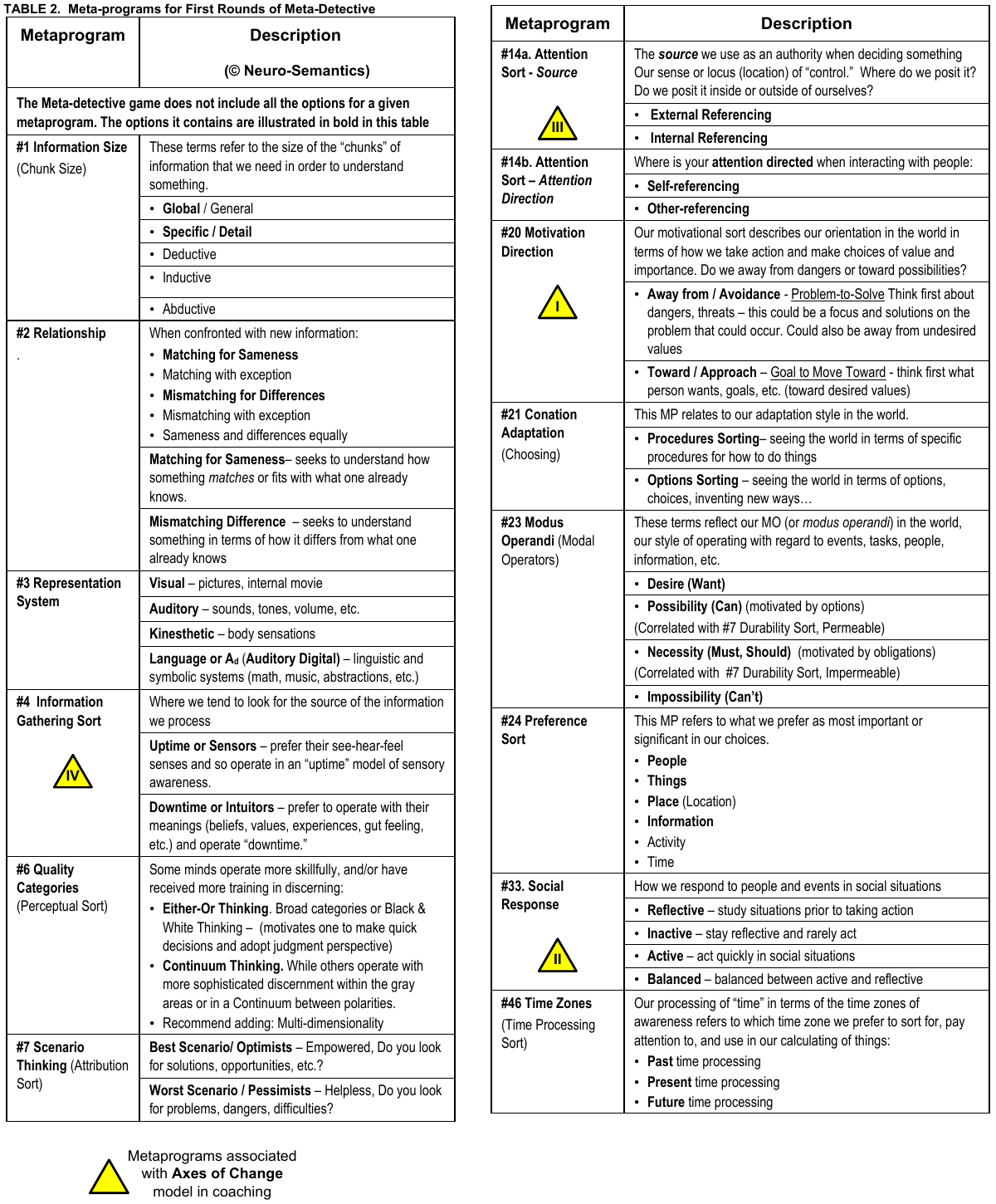
The meta-programs in Figure 3 (mind map) and Table 2 (further below) are choices you can use for the first two rounds of Meta-Detective. Make a copy for each participant to use as he or she plays the game.
Matrix Model and Meta-Detective
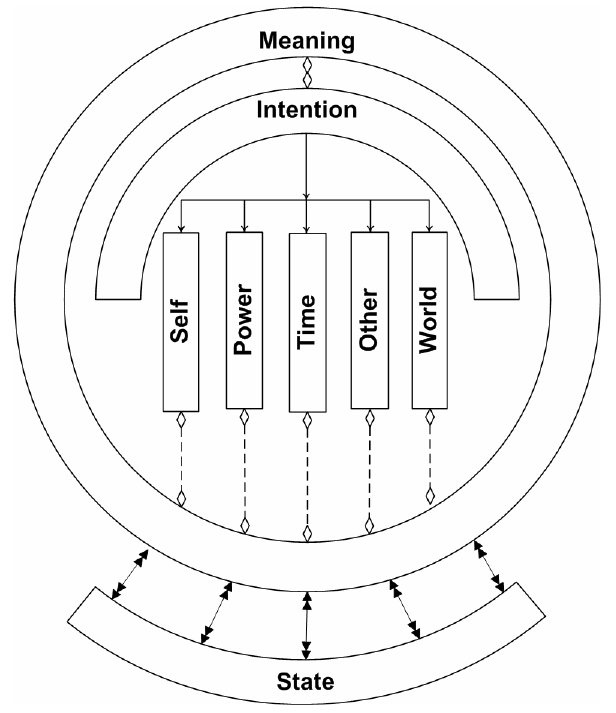
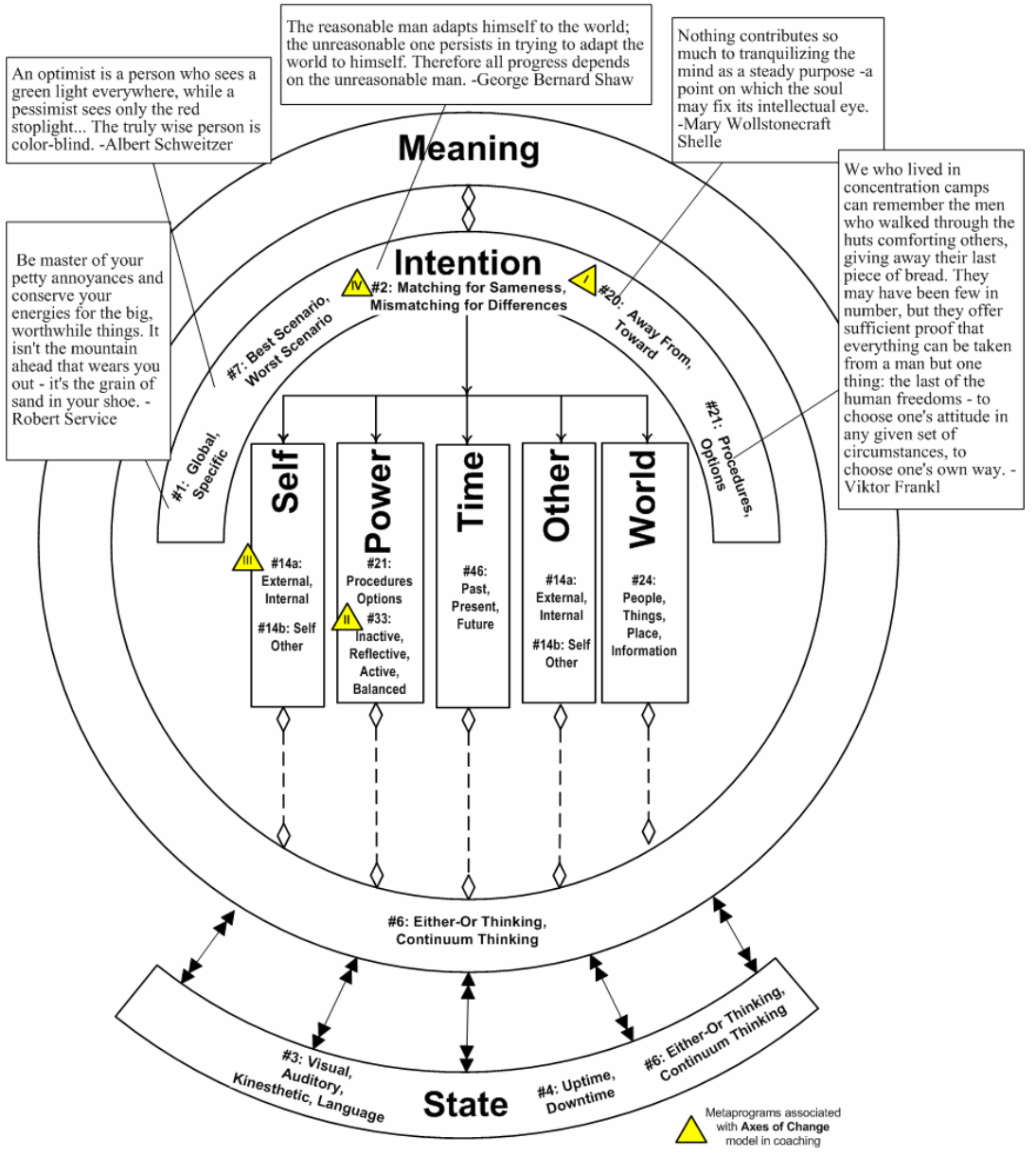
The Matrix Model provides a way for us to understand and elicit how we construct our model of the world. There are key meta-programs associated with each matrix. Figure 1
“…shows the embracing frame of meaning, which surrounds everything and calls the Matrix into being. It also positions the Intention matrix over the central content matrices and shows how everything is grounded in the State matrix” – Matrix Model 2nd Ed, page 113.
Use Figures 1 and 4 to introduce the Matrix Model when playing Meta-Detective. The meta-programs recommended for the first two rounds of the game are overlaid on the matrices (Meaning, Intention, Self, Power, Time, Other, and World) in Figure 4. This figure also has quotations that illustrate each metaprogram within the Intention matrix. George Bernard Shaw’s quotation also applies to the Adaptation metaprogram (#22 Judging-controlling/Perceiving-floating, which is not included in Figure 3 and Table 2).
Axes of Change Model and Meta-Detective
Figure 2 illustrates the Axes of Change Model which is used in Meta-Coaching to describe the change process (see Coaching Conversations, 2003). The axes are related to meta-programs. These meta-programs are also recommended for the first two rounds of Meta-Detective and are indicated by small triangles in the figures and tables in this guide.
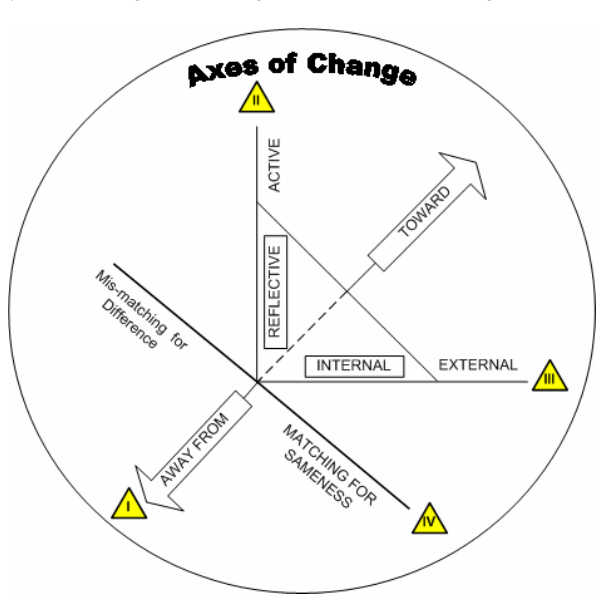
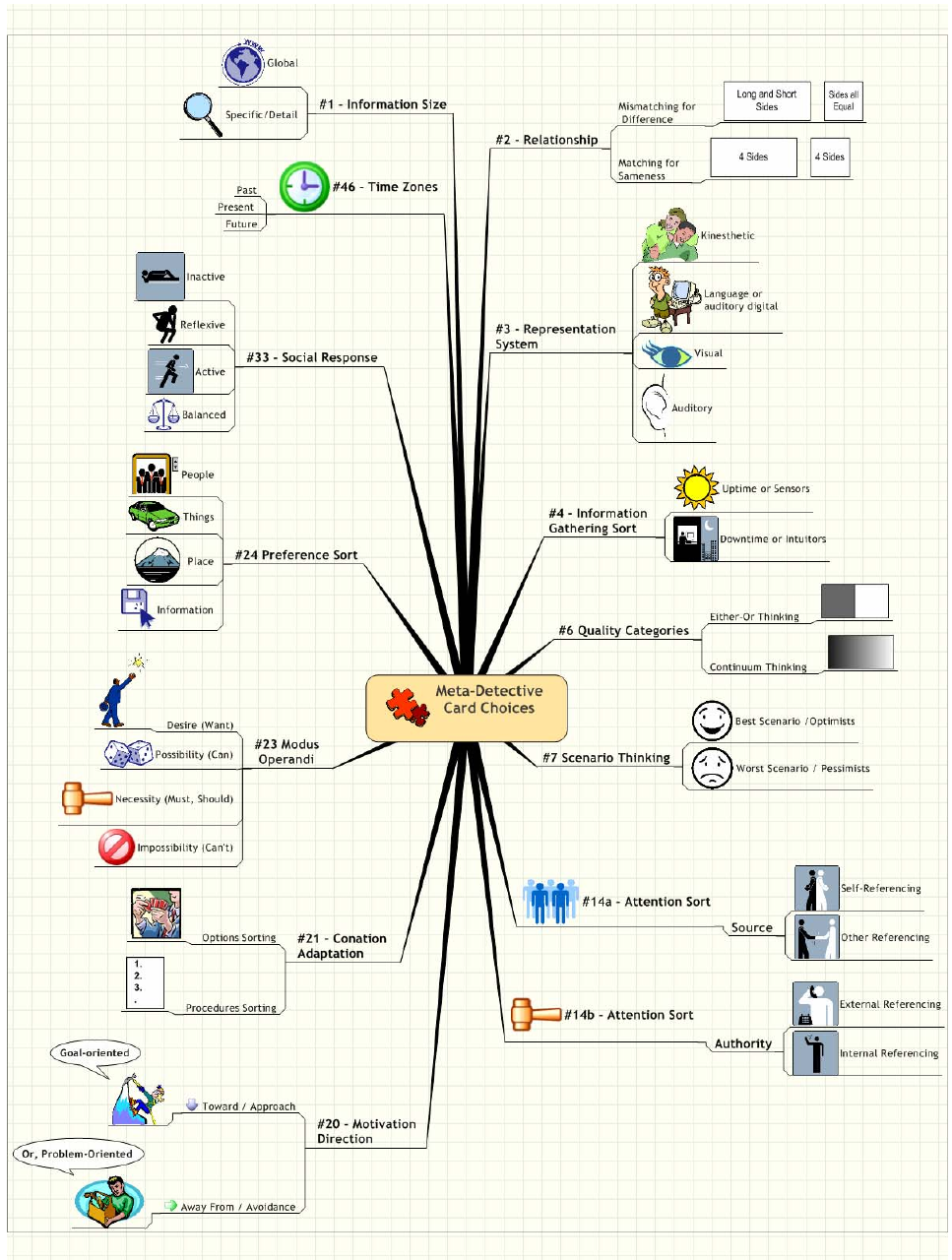
TABLE 2. Meta-programs for First Rounds of Meta-Detective
Metaprogram
Description (© Neuro-Semantics)
The Meta-detective game does not include all the options for a given metaprogram. The options it contains are illustrated in bold in this table
#1 Information Size
(Chunk Size)
These terms refer to the size of the “chunks” of information that we need in order to understand something.
Global / General
Specific / Detail
Deductive
Inductive
Abductive
#2 Relationship
When confronted with new information:
Matching for Sameness
Matching with exception
Mismatching for Differences
Mismatching with exception
Sameness and differences equally
Matching for Sameness– seeks to understand how something matches or fits with what one already knows.
Mismatching Difference – seeks to understand something in terms of how it differs from what one already knows
#3 Representation System
Visual – pictures, internal movie
Auditory – sounds, tones, volume, etc.
Kinesthetic – body sensations
Language or Ad (Auditory Digital) – linguistic and symbolic systems (math, music, abstractions, etc.)
#4 Information Gathering Sort
Where we tend to look for the source of the information we process
Uptime or Sensors – prefer their see-hear-feel senses and so operate in an “uptime” model of sensory awareness.
Downtime or Intuitors – prefer to operate with their meanings (beliefs, values, experiences, gut feeling, etc.) and operate “downtime.”
#6 Quality Categories (Perceptual Sort)
Some minds operate more skillfully, and/or have received more training in discerning:
Either-Or Thinking. Broad categories or Black & White Thinking – (motivates one to make quick decisions and adopt judgment perspective)
Continuum Thinking. While others operate with more sophisticated discernment within the gray areas or in a Continuum between polarities.
Recommend adding: Multi-dimensionality
#7 Scenario Thinking (Attribution Sort)
Best Scenario/ Optimists – Empowered, Do you look for solutions, opportunities, etc.?
Worst Scenario / Pessimists – Helpless, Do you look for problems, dangers, difficulties?
Metaprogram
Description
#14a. Attention Sort – Source
The source we use as an authority when deciding something Our sense or locus (location) of “control.” Where do we posit it? Do we posit it inside or outside of ourselves?
External Referencing
Internal Referencing
#14b. Attention Sort – Attention Direction
Where is your attention directed when interacting with people:
Self-referencing
Other-referencing
#20 Motivation Direction
Our motivational sort describes our orientation in the world in terms of how we take action and make choices of value and importance. Do we away from dangers or toward possibilities?
Away from / Avoidance – Problem-to-Solve Think first about dangers, threats – this could be a focus and solutions on the problem that could occur. Could also be away from undesired values
Toward / Approach – Goal to Move Toward – think first what person wants, goals, etc. (toward desired values)
#21 Conation Adaptation
(Choosing)
This MP relates to our adaptation style in the world.
Procedures Sorting– seeing the world in terms of specific procedures for how to do things
Options Sorting – seeing the world in terms of options, choices, inventing new ways…
#23 Modus Operandi (Modal Operators)
These terms reflect our MO (or modus operandi) in the world, our style of operating with regard to events, tasks, people, information, etc.
Desire (Want)
Possibility (Can) (motivated by options)
(Correlated with #7 Durability Sort, Permeable)
Necessity (Must, Should) (motivated by obligations)
(Correlated with #7 Durability Sort, Impermeable)
Impossibility (Can’t)
#24 Preference Sort
This MP refers to what we prefer as most important or significant in our choices.
People
Things
Place (Location)
Information
Activity
Time
#33. Social Response
How we respond to people and events in social situations
Reflective – study situations prior to taking action
Inactive – stay reflective and rarely act
Active – act quickly in social situations
Balanced – balanced between active and reflective
#46 Time Zones
(Time Processing Sort)
Our processing of “time” in terms of the time zones of awareness refers to which time zone we prefer to sort for, pay attention to, and use in our calculating of things:
Past time processing
Present time processing
Future time processing
References
Hall, Michael L., Bob Bodenhamer (1997). Figuring Out People: Design Engineering with Meta-Programs, Crown House Publishing, Wales, UK.
Charvet, Shelle (1997). Words that Change Minds: Mastering the Language of Influence, 2nd Ed, Kendall/Hunt Publishing, Co., Dubuque, Iowa.
Hall, Michael L., Michelle Duval (2003). Coaching Conversations: The Power of Conversational Change, NS Publications, Clifton, CO.
Hall, Michael L., Michelle Duval, Anchor Point, Axes of Change (Part 1, July 2004; Part 2, August 2004; Part 3, September 2004)
Hall, Michael L. (2003). Matrix Model 2nd Ed,, NS Publications, Clifton, CO.
[1] This version of Meta-Detective and guide are based on the meta-programs in Figuring Out People (1997) by Hall & Bodenhamer
© Pascal J. Gambardella.