
DISTINGUISHING SELF-ESTEEM AND SELF-CONFIDENCE
To think with clarity and precision is to make critical distinctions—distinctions that provide essential maps if we’re to experience well-being and sanity.

 Share
Share



Reading preferences
Optional. Your reading and listening position stays in this browser, not in your public profile. Avoid enabling this on a shared device.
To think with clarity and precision is to make critical distinctions—distinctions that provide essential maps if we’re to experience well-being and sanity. To that end, there is no distinction more critical than the one between self-esteem and self-confidence. Fail to make this distinction, and you will construct an internal “sense of self” which will put your sense of worth and value “on the line” undermining your mental sanity and physical well-being. It’s that crucial. Fail to make this distinction and it makes you extremely vulnerable to the outside world.
What is this distinction? It is actually a very simple one to understand, much harder to integrate and live. It is the distinction between yourself as a person and what you can do—your behaviors. Conceptually this is also an obvious one that doesn’t take much to point it out.
- What you do is an expression of you. It is your behavior that we can see as you act or hear as you speak or even as you use your body to gesture or move.
- Who you are is your person, your identity, your inner self, your soul. It is that inner essence of your sentient being who acts.
When you were an infant, this distinction was crystal clear. You, as a person, was considered valuable and worthwhile unconditionally. Why? Mostly because you could not do a thing! You could not talk, walk, pay the rent, carry on a decent conversation, pick up after yourself, etc. You could not even focus your eyes, roll over, or effectively communicate what you needed. In spite of being completely ignorant and incompetent— you were precious, lovable, and of immense value. We did not rate you, measure you, gauge you by your behaviors.
Then began the great confusion. As you learned to do things, and you grew in your confidence about what you could do, we began linking the two. “If you can do X, you can feel good about doing X, and good about yourself. This proves you are worthwhile.” Today this shows up in every article and book that recommends that you “raise your self-esteem by improving your skills.” “For greater self- esteem, buy A, wear B, drive C, etc.” The message is “You are what you have.” “You are what you do.”
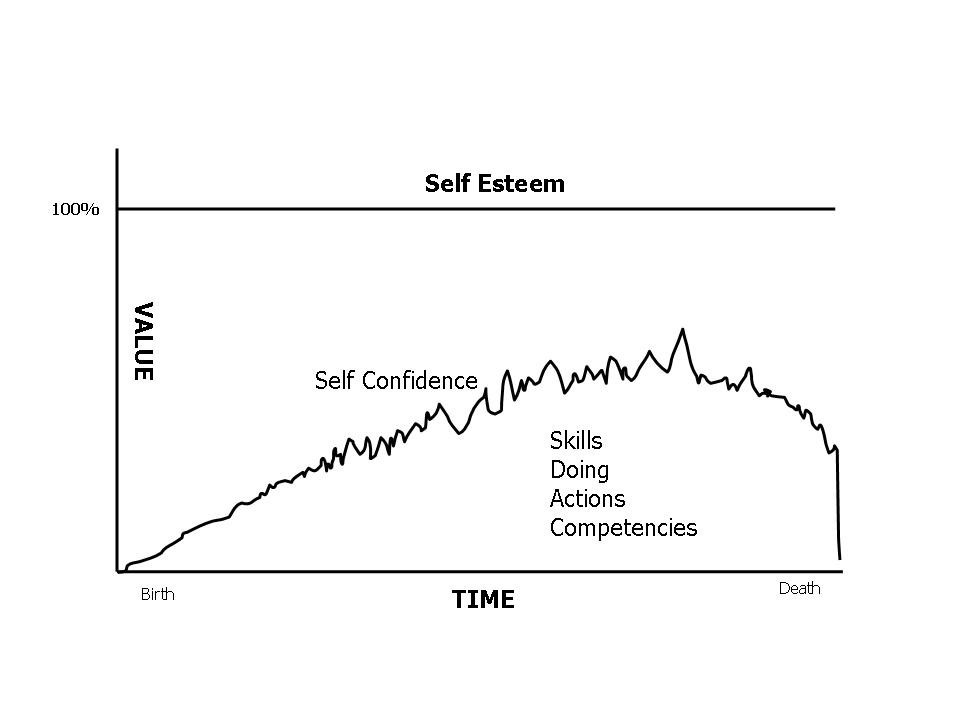
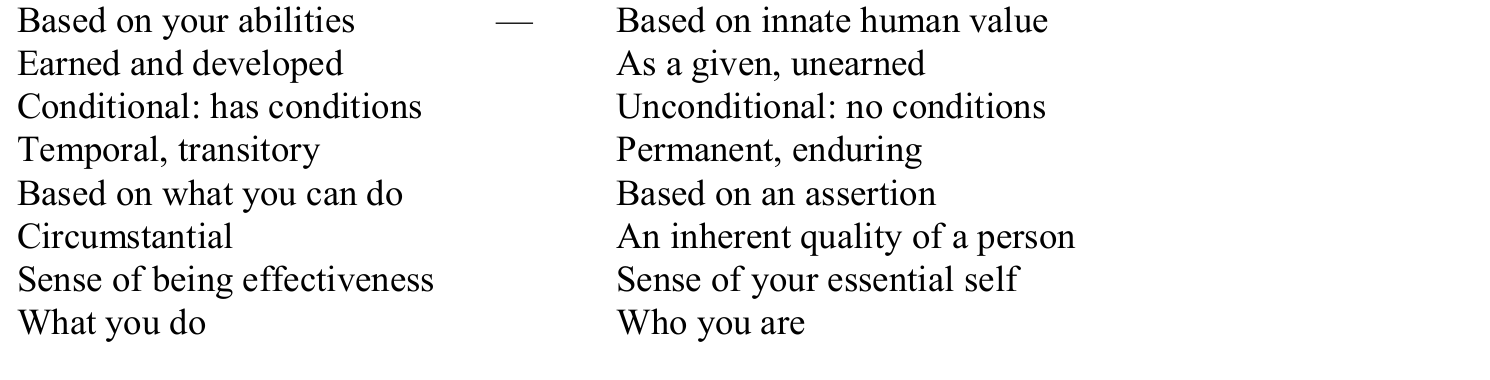
Now in Neuro-Semantics, we address this confusion and misunderstand in the morning of Day One when we teach the Meta-States Model. The second pattern leads a person to create three meta-states: self-acceptance and self-appreciation for what you have in terms of talents and dispositions which lead to what you can do. Then we introduce self-esteem for what you are in your inner person. We emphasize that self-confidence is conditional upon competence. If you can do something, you can feel confidence in yourself that you can pull it off. Self-esteem, however, is unconditional and not based on anything. That’s why it is irrational to use the modifiers “low” or “high” for self-esteem. It cannot be low or high since it is an unconditional given. It just is. That’s why the verb “esteem” (to appraise) is a judgment that you make about yourself, not a feeling.
None of this is rocket science and numerous people in the Human Potential Movement from Rogers to Maslow to Nathaniel Brandon (The Psychology of Self-Esteem) and others have written extensively about this for years. I first put it in writing in 1985 in my book on Emotions. Here is a chart I put in that book:
So I found it really disturbing to find this very confusion in the 2020 book by Scott Kaufman, Transcend: The New Science of Self-Actualization. While most of that book is excellent, he really makes a terrible mess regarding this distinction.
“The latest research suggests that a healthy self-esteem is an outcome of genuine accomplishment and intimate connection with others... As psychologists Richard Ryan and Kirk Brown note, becoming too focused on improving one’s self-esteem is an indication that something has gone awfully wrong in self-regulation and well-being. . . . What is a healthy self-esteem? Modern research has identified two distinct faces of healthy self-esteem: self-worth and mastery.” (p. 59)
Kaufman then gives six statements for each, self-worth and mastery. His “mastery” statements are all about self-confidence: “I am highly effective at the things I do.” “I perform very well..” “I deal well with challenges.” The statements for self-worth are a mixture of emotional statements, “I like myself,” “I am comfortable with myself” and partial self-esteem assertions.
“Self-worth involves the evaluation of your overall sense of self: Are you a fundamentally good person with social value in this world?” (p. 60)
Talk about academic confusion, this is it! An “overall sense of self” is your self-image, not self- esteem. And a “good person with social value”—that’s your social self, not your self-esteem. It’s hard to believe that an otherwise intelligent writer could create this level of nonsensical confusion, but he did.
Don’t you love his over-generalized statements about research (“the latest research” “modern research”)? This highlights the problem with any and every so-called “research” that starts off with sloppy and vague definitions. Calling something “self-esteem” but essentially confusing it with self- confidence about what you can do would result in the “research” being complete invalid. Whatever “facts” the so-called “research” found are irrelevant because are based on inadequate definitions in the first place. And worse of all, this misleads more people as it creates a fallacious understanding about what self-esteem is. Now you know why making this distinction is so important for your sanity and well-being.
Distinguishing Self-Esteem and Self-Confidence
Self-Confidence Self-Esteem
For more: See The Crucible and the Fires of Change, chapter 7 “Unconditional Positive Regard.”