EMOTIONAL CONTINUA
Having provided an operational definition and description of what an “emotion” is (#1-#3) and that no every emotion is a real emotion (#4), I now want to present another perspective for thinking about emotions— one that will assist in experiencing more emotional mastery.

 Share
Share



Reading preferences
Optional. Your reading and listening position stays in this browser, not in your public profile. Avoid enabling this on a shared device.
Having provided an operational definition and description of what an “emotion” is (#1-#3) and that no every emotion is a real emotion (#4), I now want to present another perspective for thinking about emotions— one that will assist in experiencing more emotional mastery.
The perspective is to view any given emotion on a continuum. If you think about your emotions in terms of a continuum, you can get a fuller and richer view of your emotions. If you position any given emotion (the basic emotions) on a continuum, you thereby make it possible to begin to identify the other emotions that cluster around that one. This will enable you to see the relationship between similar emotions and that will lead you to see how one emotion can shade or evolve into another emotion.
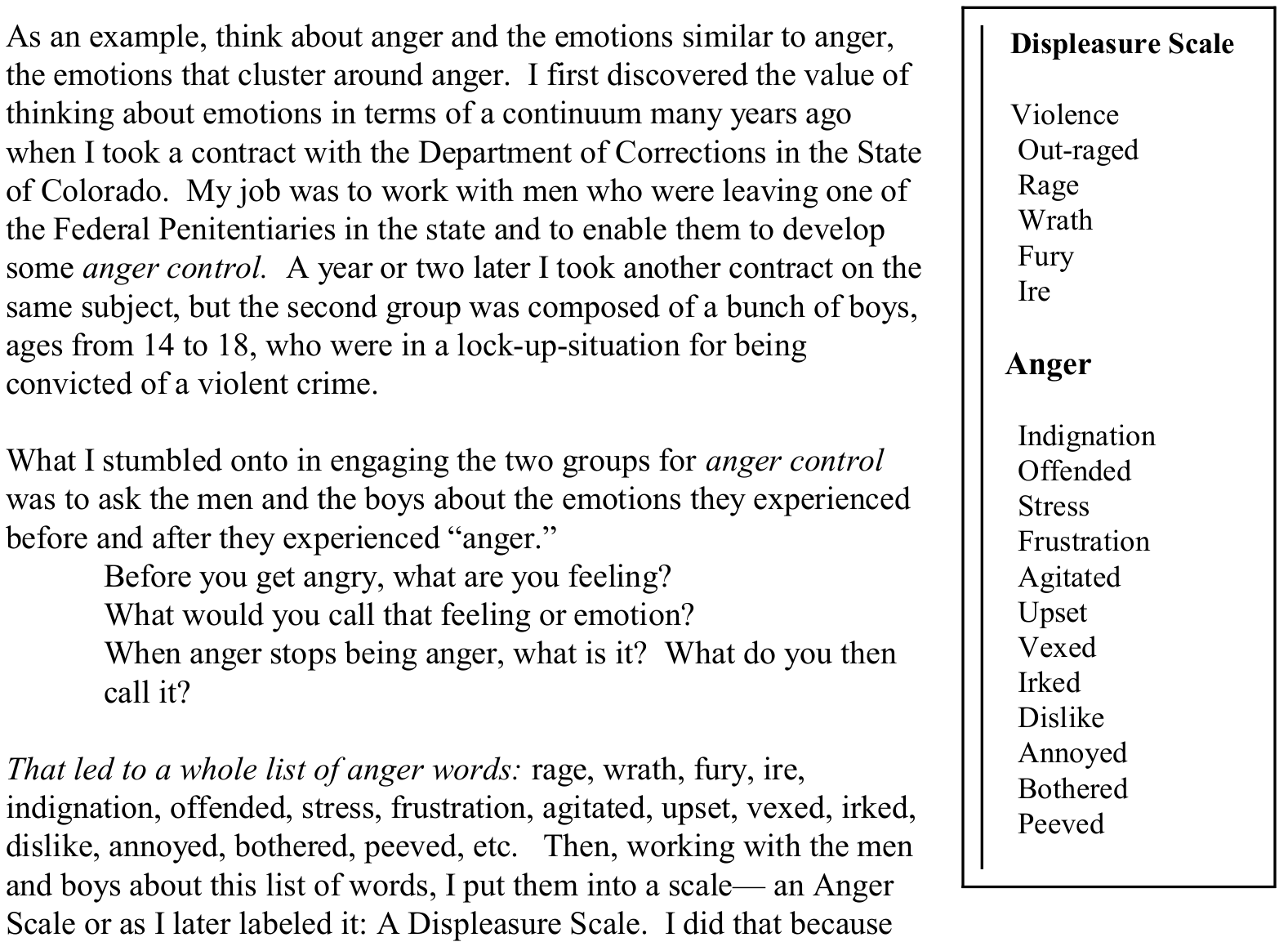
displeasure is the message of anger— displeasure with something that’s not going the way we want it to go.
There are many words for describing kinds and intensities of displeasure:
Anger: “Anger” is the general term for the emotional reaction of displeasure, typically strong displeasure. Anger refers to a sense of threat to your person and values. You can experience rational and irrational anger, in-controlled anger or out-of-controlled anger, useful verses unuseful anger; current and appropriate anger and old dated angers. Anger does not refer to any outward expressions, only to the feeling of threat and desire to aggress.
Prior to the emotion of anger, we experience the levels and intensities of displeasure as:
Upset: a state a disorder, confusion, disturbed, decomposed, a disorder that may range from minor to major.
Annoy: feeling disturbed or irritated, something wearing on the nerves.
Vex: more provocation than just annoyed, feeling perplexity and anxiety.
Irk: having difficultly in enduring & resulting weariness or impatience of spirit.
Bothered: feeling bewildered, upset, interference with peace of mind.
Peeved: irritation, mild mood shift to resentful, holding a grudge.
Peevish: querulous in temperament, fretful, contrary, marked by ill temper
When anger grows in intensity, then we have:
Ire: great intensity and exhibition in words and deeds.
Fury: even more violence and connotes a degree of temporary madness.
Indignation: righteous anger at a commonly agreed upon unfairness, injustice, or meanness.
Wrath: either rage or indignation and suggests a strong desire to avenge or punish.
Rage (anger, sometimes including violent actions.
The Displeasure Scale — of Anger
When it comes to the emotions of displeasure, there is a wide range of descriptive terms we can use to sort and separate levels, intensities, and kinds of displeasure. By developing the ability to distinguish these kinds of negative anger emotions saves the emotional energy of true anger for those events and situations that truly violate our values and call for a strong emotional response.
There’s a verse in the Bible that says, "Be angry and sin not . . ." (Eph. 4:26). Here is some ancient wisdom about properly owning, using, and registering anger in a way that does not use it to violate another person or even yourself. The verse also says, "Neither let the sun go down on your anger . . ." That describes the need for releasing anger so that it is not stored up and turned into "cold" anger (e.g., malice, ill-will, resentment, bitterness).
Construct an Emotional Constellation for Emotional Awareness
This works with lots of other emotions. Because emotions occur along a range and have varying degrees of intensity, we can gauge an emotion’s intensity on a scale and distinguish emotions at different levels of significance.
- What is the range of the emotion and on what scale?
- When is the emotion more intense, less intense?
- What is it? What do you call it?
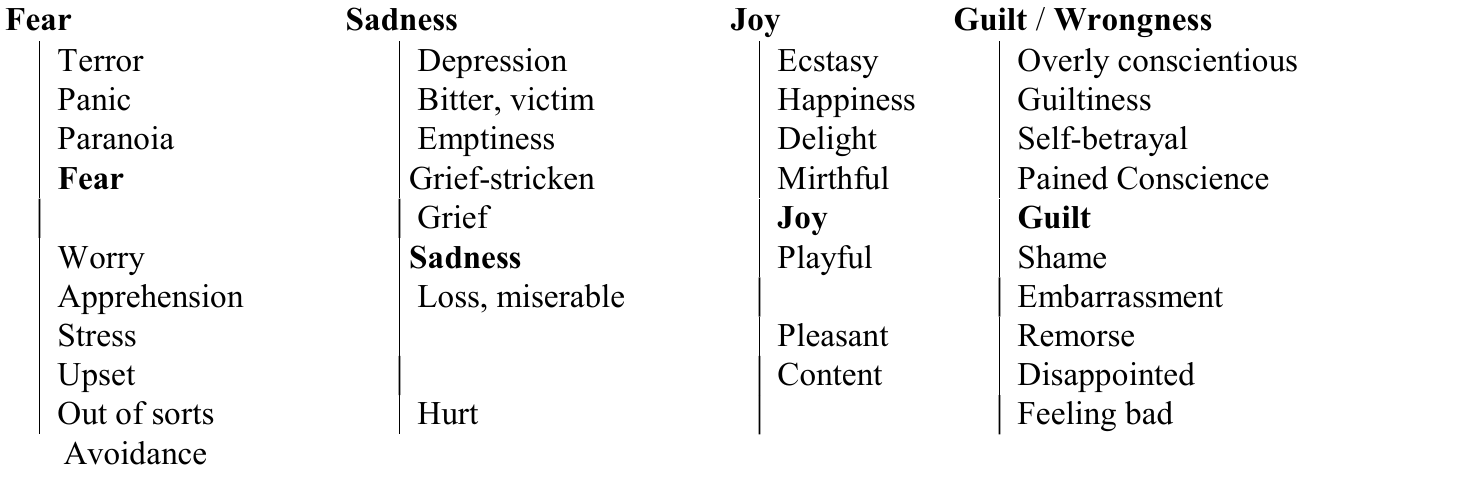
These questions and distinctions allow us to create emotional scales and distinguish emotions at different degrees. This means that there are typically a constellation of emotions around an area of emotionality. And as we did this with the Dislike Scale, we can do it with other emotions. How?
1) Choose an emotion.
2) Make a list of similar emotions, words that indicate a closely related emotion.
3) Invent a continuum to put the emotions on.
4) Put the various emotions along the range of emotions from least to most intense.
Here are some more examples: