EMOTIONS AND STRESS
In one sense all emotions create or involve what we call stress.

 Share
Share


Reading preferences
Optional. Your reading and listening position stays in this browser, not in your public profile. Avoid enabling this on a shared device.
In one sense all emotions create or involve what we call stress. That’s because every e-motion involves moving, movement, and energy. To be without any movement, emotion, muscular tension, and/or stress is to be dead. If we then begin with the idea of a continuum, we can begin to quantify the amount of movement, energy, or “stress.”

Let’s now ask the question, “What does it kinesthetically feel like at each of these stages, and what emotions would be typically present at each stage?” The kinesthetic feel means that at each increasing stage, there is more energy in the body, more movement, and more physical tension. Your heart beat would be very relaxed and slow at the far left ... and increasingly active to the point of reaching a really fast pace at the far right. So with the lungs, muscle tension in various parts of the body, and as a person moves to the right, there will be more nervous energy, excitement, and inability to stay still.
Emotionally, we would move from depressed, fatigued, relaxed, calm, serene, active, eustress, excited, anticipating, anxious, irritated, annoyed, overwhelmed, panic. Now imagine we turn the continuum up on its end to create a vertical line. The arrow (↑) indicates the increasing of “stress” as we move up the scale.
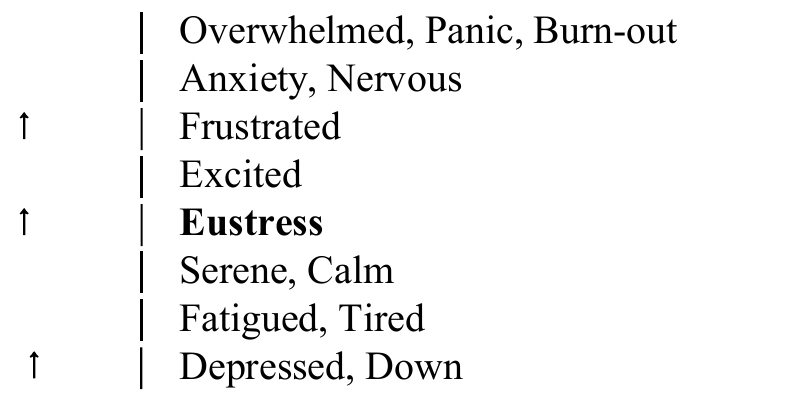
Eustress, in the middle, is the word that Hans Selye, the Stress Expert, invented to indicate good or healthy stress. The problem is not the external or internal trigger that evokes us to respond. Actually, we need and have to have a certain level of “stress” in order to live and thrive and be healthy, hence eustress. At this level we feel alive and energetic. Emotionally we feel enough energy to do the things that we want to do in everyday life. Below that level we may be exhausted and needing rest, fatigued and below that we may be depressing our energy, our hopes, our dreams, etc. Stress problems generally occur above the level of eustress. When there’s too much to do, when we have expended all of our energy within a time limit, when there are too many demands, or not enough resources, then we feel anxious and nervous and eventually overwhelmed.
Acute stress occurs when this happens all of a sudden. A crisis arises. An accident occurs. Out of the blue, we are called upon to take care of an emergency. There’s an immediate threat or danger and generally, we experience the General Arousal Syndrome of fight/ flight in order to deal with that acute stress situation.
What’s most dangerous is chronic stress. This is the stress that slowly builds up over time as we take on yet “one more thing.” Generally, we then begin adapting and after awhile, we don’t even notice. But we’re getting less sleep, we’re feeling drained and exhausted more often, we’re cutting out long-term resources (exercise, quality time with friends, coaching, etc.). And then, eventually, something gives. We reach threshold and can take no more. This is the strss that causes heart attacks, strokes, headaches, backaches, ulcers, and all sorts of psycho-somatic illness wherein the body is paying the price for the ongoing stress.
Stress is not a thing, it is a process—namely, the process of the strain you put upon your mind, emotions, and body by how you think about the demands of your environment and your mind. That’s why what stresses one person may be excitement to another. Stress is psychological in that it comes from your interpretations and meanings. It also is influenced by your skills in stressing yourself and your skills in de-stressing yourself.
For more: See the book, Speak Up, Speak Clear, Speak Kind (1987) on the Shop, it’s free. It’s about stress and communication.
Questions about Emotions? I have almost completed this series on emotions, emotional mastery and emotional intelligence, if you have a qustion, send it to me — [email protected]