HOW META-STATES HAS BEEN “EATING” NLP
In 1996 Dr. Graham Dawes wrote a book review after reading Meta-States and Dragon Slaying.

 Share
Share



Preparing your audio…
You can keep reading while we get it ready.
- Waiting to start
- Creating audio
- Checking recording
Waiting to start
Audio ready
Tap Play to start listening.
AI-generated narrationListen at your own pace
Listen to this article
 Listen to this article
AI-generated narration
Narration covers the article text on this page. Linked documents and illustrations are not read aloud.
0:00--:--
Enable JavaScript to listen, or read the complete article below.
Reading preferences
Optional. Your reading and listening position stays in this browser, not in your public profile. Avoid enabling this on a shared device.
In 1996 Dr. Graham Dawes wrote a book review after reading Meta-States and Dragon Slaying. Graham was the first person to create a NLP Training Center in London. Later Graham collaborated with David Gordon to write a book on modeling with NLP using the Experiential Array. At the time that Graham wrote his review and some of his comments, he surprised me about one of this comments. Namely,
“Meta-States will be the model that eats NLP”
Dr. Graham Dawes, 1996, Book Review of Dragon Slaying
Anchor Point (USA) and Rapport (UK), and NLP World (Europe).
I still remember the shock that I felt when I first read that statement in the book review. Truth be told, I was actually utterly shocked by the statement. That was a statement that I had never even entertained, I had not thought of Meta-States in that way. Yet given that it was presented so bluntly, I even felt a bit confused about it at first. Having not been my radar, I didn’t know how the Meta-States model could have consumed NLP.
That was 1996. Then one day a decade later I suddenly realized that Graham was more right than I ever suspected. Since that 1996 review of Meta-States, the Meta-States Model has indeed almost “eat up” and consumed the NLP Model in numerous ways. During the years in which this took place, I was mostly unconscious of it. Yet in review, I am able to take a broader perspective and to see the revolutionary effect of Meta-States on the original NLP model and domains.
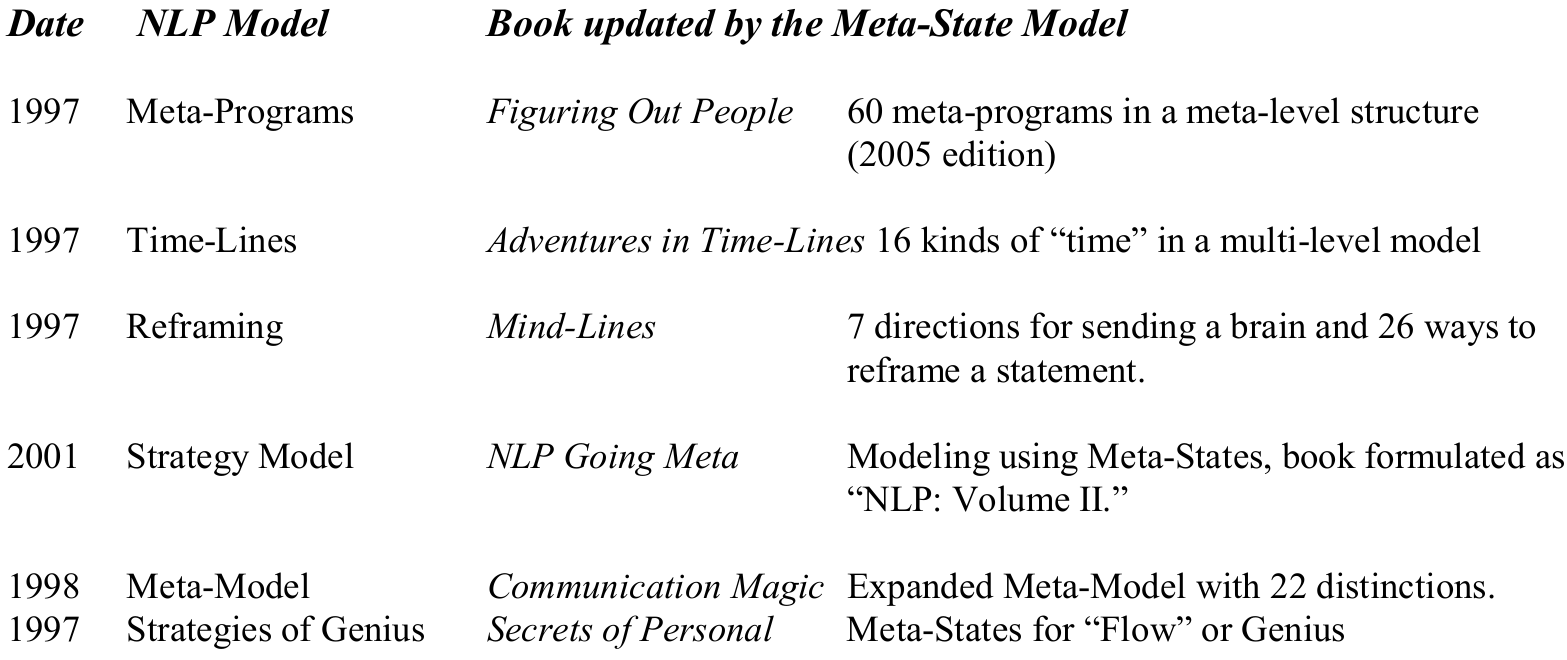
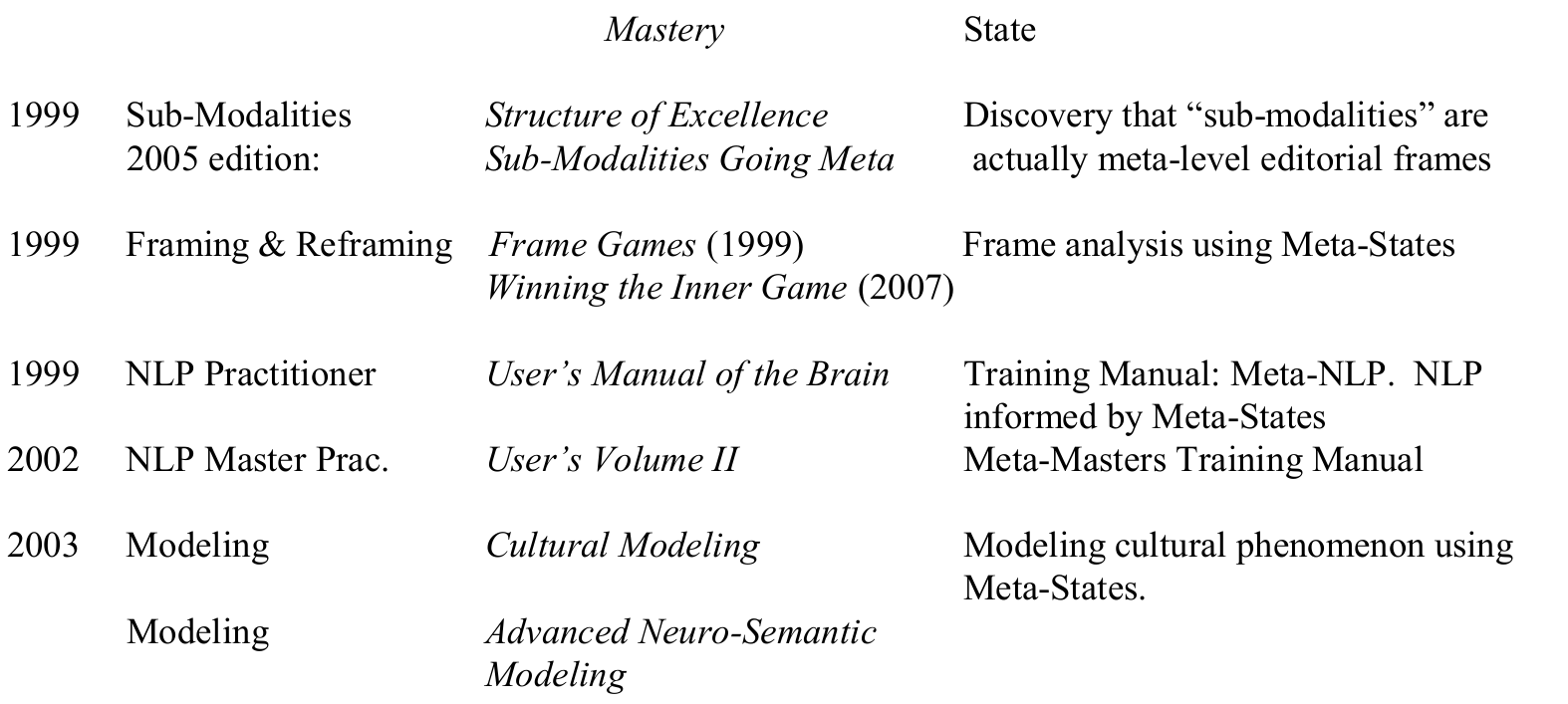
I never set out with a futuristic Mission Statement to create these books and training manuals for the purpose that Neuro-Semantics would “eat up the NLP model.” Yet that is what essentially happened over the years. Further, at the time, I did not know that it was happening. That only became evident in looking back.
In the mid and late 1990s I wrote a series of articles as critiques of NLP. Some of the articles I wrote by myself and some of them I wrote with others. One of the first was written with Dr. Bob Bodenhamer, “The Downside of NLP.” Later I wrote an especially biting critique of DHE, “Ten Years and Still No Beef.” In all of them I attempted to address problems in both the field of NLP and the NLP model itself. The design was to take NLP to a new level professionally and ethically.
Yet through it all we discovered many things and began to distinguish what we were doing from NLP. What we have discovered? One of the things that we mainly discovered is that a large portion of the magic of NLP occurs above the representational level. Now, true enough, the representational level is indeed the genius of NLP. It is a genius and contribution that we readily recognize as the unique creation of John Grinder and Richard Bandler. What NLP does best and what NLP is mostly about is representation. That is, it is about what and how we represent information on the theater of our minds and how that some simple shifts can generate very powerful results.
In this, NLP is truly magical. As a cognitive psychologist, when I found NLP I immediately knew that it filled in the gaps of Cognitive Psychology, Rational-Emotive Therapy, and of Reality Therapy. That’s why I found it so compelling.
Yet while NLP is all about representation, we learned something unbeknowest to Bandler and Grinder. We learned that there was another part of NLP that created magic that actually operated at meta-levels, at meta-state levels, and that the founders and developers somehow never truly realized this. We learned that what we had found in the Meta-States model actually explained most of the so-called magic.
This is nowhere better illustrated than the whole mis-adventure into the so-called sub-modalities. NLP decided that the finer features of the various sensory representational systems were “sub” to the modalities and so thought and used metaphors about “going down” and probing to a sub-level to find the elemental particles of experience.
Yet these cinematic features of our mental movies, the qualities of our visual, auditory, and kinesthetic systems are not “sub” at all. As the features by which we edit our movies, they occur at a meta-level as one of our frames. Somehow the entire process of even detecting these features is discovered by stepping back and going meta. And when we discover them, we discover meta-programs and meta-model distinctions. All these are strong indicators that the term “sub-modalities” was the problem and had mis-led us.
In all of this, the reductionistic approach of Bandler and Grinder that created NLP in the first place by identifying the “languages of the mind” in terms of the sensory and meta representational systems ultimately proved to be its own confusion. The result? There has been essentially nothing new produced within the basic NLP model in the past 20 years.
By way of contrast, Meta-States that originated as a NLP model and so recognized by the International Association of NLP Trainers has continued, year after year, to generate new models, hundreds of new patterns, new modeling of experts to create new training modules and programs, etc.
The reason for this? Meta-States is all about referencing rather than representation. Mere representation is a first level mapping whereas the frames that we set about a representation is much more governing. So the direction for finding more of the “magic” of NLP was not down but up. And that’s the direction that Meta-States took us. That’s why the idea of Meta-States becoming a model that “eats up NLP” was obvious to several people before it dawn on me.
The meta-level states and frames of Meta-States explains why and how the mind-body-emotion system operates as it does and brought forth a whole series of new presuppositions for the field of NLP and which later established the presuppositions of Neuro-Semantics. “The person who sets the frame governs the game.” “Someone always sets the frame.” “Where there’s a game, there’s a frame.” And that will be the subject of our next Reflection.