
KNOWING THE META LANDSCAPE
When it comes to your mind, and mine, there’s always a lot going on in the mind, sometimes so much you can hardly keep track of it all.
Reading preferences
Optional. Your reading and listening position stays in this browser, not in your public profile. Avoid enabling this on a shared device.
When it comes to your mind, and mine, there’s always a lot going on in the mind, sometimes so much you can hardly keep track of it all. So we ask about the processes going on upstairs: “What am I thinking?” “What kind of thinking is this?” “What is this that I’m experiencing and where did it come from?” These are but a few of the questions we ask ourselves, trying to understand ourselves.
Yet understanding your own mind is not the easiest thing to understand. With the large number of factors involved, it’s often hard to know precisely what you are feeling or thinking or how to interpret what you are experiencing. To figure that out, you need some landmarks of the mind—landmarks that can help define the inner landscape of your mind. These are not brain anatomy landmarks. Generally knowing about brain anatomy tells you very, very little about what you are thinking, or why, or what effect it will have. Knowing the mind requires a whole different set of landmarks.
As I’ve been working to identify the meta place, I’ve been thinking of the mind as a space with certain processes. To know this enables us to sort out and separate the different processes of the mind-body system. And while I’m using a solid and stable metaphor (landmark) it is actually a dynamic landscape, not of solid ‘things,’ but of dynamic processes which are always moving and changing. Learning to see this landscape in action enables you to see your mind in action—how it does what it does as it creates your inner experiences. And, of course, what happens there then transfers to the outside. That’s why winning the inner game makes winning the outer game a walk in the park. After all, your outer world experiences are functions of your inner world experiences.
Seeing this dynamic landscape in action equips you in systemic thinking. Now you can see the system in action. And when you can do that, you will be able to know where in the system to intervene to create systemic change and transformation. Then what will seem magical or impossible to others, will be regular and normal to you. You will be able to get to the heart of things in a few minutes, not hours, days, or months.
Begin with learning and knowing the landscape features—the ten basic processes (state, stimulus –response, thinking patterns, representations, beliefs, reflexivity funnel, background knowledge, imagination, ecology, and feedback loops). Then learn to recognize them in action, as mind processes something. Once you do that, you’ll begin to see the dynamic functions in real time and be able to intervene in real time.
While I can now do that, I’m not the only one, others in Neuro-Semantics can do it as well, and before long, there will be a great many more who can do that. Now if you know how to see and how to work in the meta place, then whenever you hear even a small slice of a conversation, you will be able to identify where a person is in his or her meta place and how to open it up for them so that they can gain a perspective of the whole. And to do that is actually quite a gift. The following is the beginning of a conversation as an example of opening up a meta place.
“Yes, I’m stressed about this project, but it just comes with the territory, because I need to do my very best.”
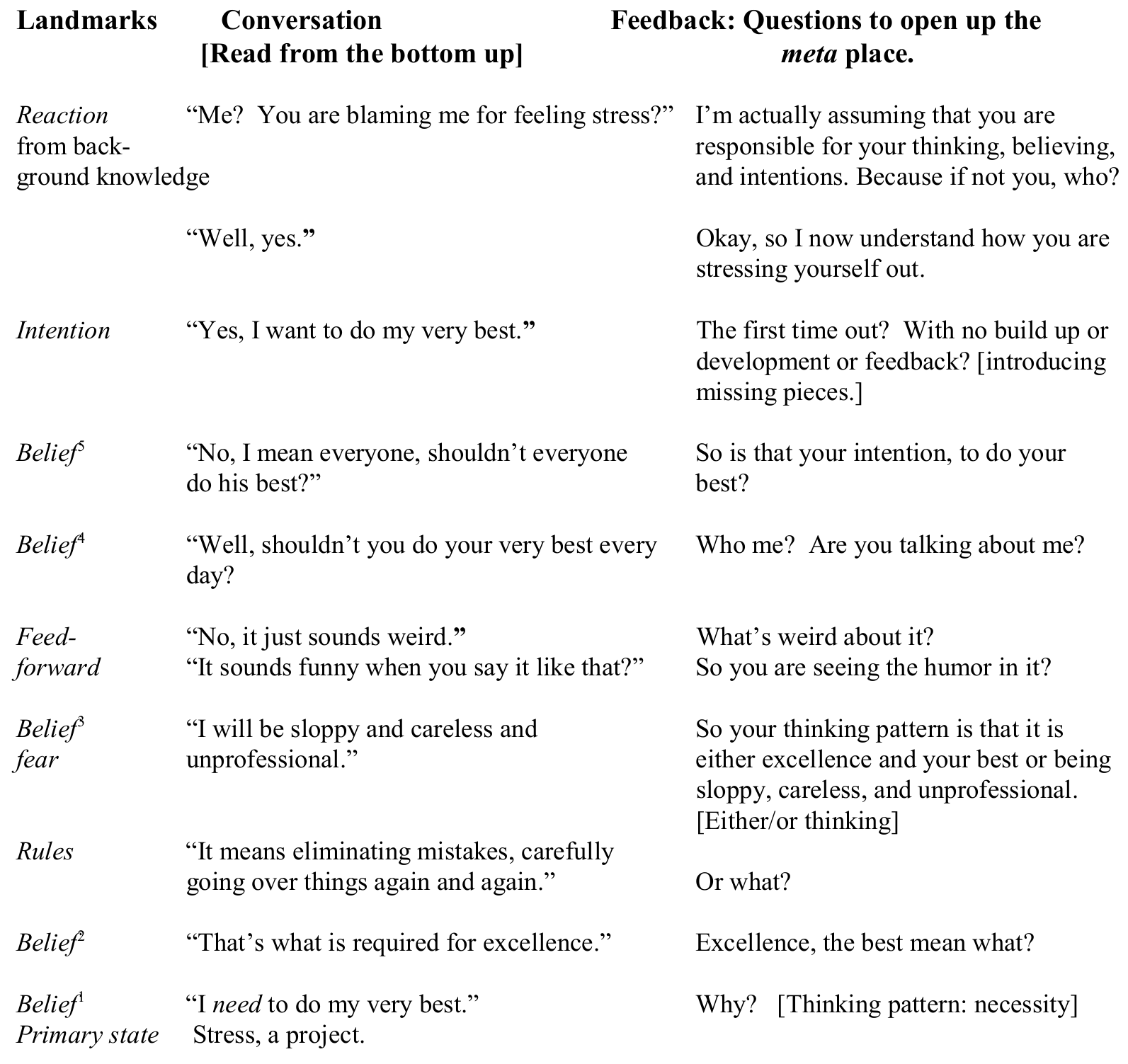
To open up the meta place —
1) Identify the landmark in the meta place that the person is indicating.
2) Explore that landmark with questions.
3) Look for what’s above it, beside it, and below it. Find all of its connections and associations.
4) Identify the feedback loops. The person is responding to what? He is responding how? When his responses come back, they come back how?