
META-STATING AND EMOTIONS Part III
In the previous two Meta Reflections I’ve described a theory and understanding of “emotions” from the Neuro-Semantic and NLP perspective.
Reading preferences
Optional. Your reading and listening position stays in this browser, not in your public profile. Avoid enabling this on a shared device.
In the previous two Meta Reflections I’ve described a theory and understanding of “emotions” from the Neuro-Semantic and NLP perspective. And if you’ve read any of the Frame Game Books or Sourcebook of Magic, or Unleashed, or The Crucible, you will have seen that before. What you have not seen before is the following. It is only in the Training Manual, Emotional Mastery although I have talked about it at numerous times.
There’s another unique and fascinating feature about emotions— emotions occur along a range and have varying degrees of intensity. And because of the natural range of an emotion, we have numerous terms for emotions as they increase or degree in intensity. We also can now gauge an emotion’s intensity on a scale and distinguish emotions at different levels of significance.
• What is the range of the emotion and on what scale?
• When is the emotion more intense or less intense, what is it? What do you call it?
• What is the significance of being able to scale and gauge an emotion?
The significance is that because an “emotion” as a process of thinking and feeling (somatizing your meanings), we can now create an emotional scale for any given emotion and begin distinguish the emotion at different degrees of intensity. What this means is that there are typically a constellation of emotions around an area of emotionality. An example is the Dislike Scale. Here you will see a list of the range of emotions that’s involved in “dislike” which makes up the Anger or Displeasure Scale:
Displeasure Continuum
Violence
Out-raged
Rage
Wrath
Fury
Indignation
Anger
Ire
Offended
Stress
Frustration
Agitated
Upset
Vexed / Irked
Dislike
Annoyed / Bothered
Peeved
So, what do you feel? Oh, you feel “angry?” Okay. Is your anger an ire? Or is it a sense of being offended? Or is it stress? Frustration? Agitated? Upset? Vexed / Irked? What would take your anger down to a frustration so that it is a strong “frustration,” just before it comes “anger?” What would turn your anger up to an indignation? Or fury? Or rage?
The fact that every emotion sits on a range of emotions— and can be located in a continuum of emotions speaks about how what we call and experience as one emotion can become another emotion, more or less of the same emotionality that creates the emotion. This highlights how emotions change. As neurological processes of mind-body, they are forever changing and altering and shifting and changing. And with a little bit of meta-stating, you can easily and effectively and powerfully become a change-agent to yourself so that you manage these processes rather than be a victim of them.
Here is another set of emotions— fear, sadness, joy, and guilt. And you view them form the perspective of a range, a continuum, think about how the cognitive– meaning mechanism that creates them (in the italics underneath) generates the emotion and your experience of it. And when you know this, you know the leverage point for transformation, do you not?
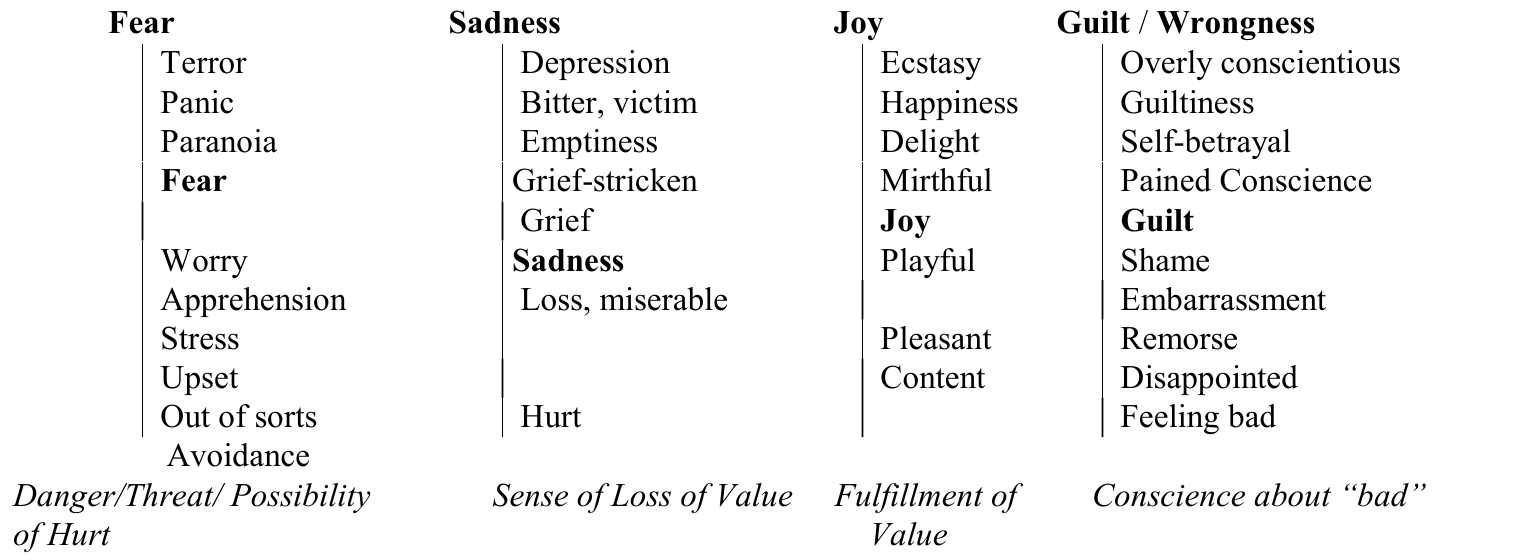
For example, with “guilt” many people are quick to feel guilty whnever anything goes wrong. “Wrongness” is translated into “guilt” rather than “feeling bad or sad,” disappointed, having some remorseful feelings, embarrassment, or shame. All of a sudden, the person jumps all the way up to “guilt” which is much more intense and series than just embarrassment or shame. Now the person has made a moral issue out of something that might be a communication issue or a social etiquette issue. Having toilet paper dragging on your shoe is not a “sin” for which you need to feel “guilty.” Just feel embarrassed!
So I always ask, “What law have you violated?” Embarrassment would be your rules and social rules, shame would be societal rules, and that leaves guilt for true moral rules, God’s rules. Ah emotions, we all have them and we have them everyday and we have them just about everything! Well, we’re fallible human beings who register our meanings in our bodies— we somatize what things mean to us, and when we do our feelings (kinesthetic sensations) turn into emotions.