NLP DISCOVERIES IN THE 1990s
1970s: Neuro-Linguistic Programming (NLP) was launched with the Communication Model that we today call The Meta-Model.
Reading preferences
Optional. Your reading and listening position stays in this browser, not in your public profile. Avoid enabling this on a shared device.
1970s: Neuro-Linguistic Programming (NLP) was launched with the Communication Model that we today call The Meta-Model. That set everything in motion because using the linguistic distinctions that Grinder had already identified in the Cognitive Model of Transformational Grammar (TG), they were able to identify the “structure of the linguistic magic” in Fritz Perls and Virginia Satir. Then with those same tools, they modeled the hypnotic language patterns of Milton Erickson and created The Milton Model. NLP then had two communication models. One set of tools enables a person to become more professional as a communicator through precision communicating and the other through the skill of being artfully vague. One grounds a person in reality, the other seeks to build new and better abstractions to live by (non-sensory-based mappings using hypnotic language patterns).
1980s: The 1980s brought into full development more models: The Strategy Model for how to track an experience step by step as the NLP developers enriched the TOTE model of George Miller, detailed the Representational Model with its cinematic features (called “sub-modalities” even though they are not sub, but meta), Perceptual Positions (Grinder), Time-Lines (Bandler), Meta-Programs (Leslies Cameron-Banlder), Neuro-Logical Levels and SCORE Models (Robert Dilters), and lots and lots of patterns. I don’t include “New Code” even though it was developed in 1983/85 by Grinder and Judith DeLozier; it was not really a new model, just a different focus on things (a dis-avowing the conscious mind and a treating of the unconscious as nearly infallible).
1990s: What new models appeared in the 1990s? In addition to more patterns which are particular processes (strategies, guided experiences, or steps) for a particular experience, and various tools (which provides a method for using a Model or a Pattern), several new models appeared within the field of NLP in the 1990s. Central to them were the following: DHE (Design Human Engineering), Meta-States, Clean Language, Social Panorama. Now Models are different from Patterns. Models have and operate by a theory, they have basic guidelines, variables, and they lead to patterns. They also differ from Tools. The Lab Profile that was developed in the 1980s is a Tool of Meta-Programs (a Model). And as another tool, a tool for NLP Modeling, David Gordon and Graham Dawes created the Experiential Array (putting together the basic NLP strategies, beliefs, states, behaviors, etc.). [There may be other Models created during the 1990s that I have not listed here, if so, do let me know.]
DHE (Design Human Engineering): Richard Bandler.
Richard developed DHE in the early 1990s and he had hoped it would be the next big revolution after NLP. That didn’t happen. But the idea was great! The ideas was that instead of modeling an expert, instead of finding an expert — a human being who could already do something at the level of excellence—why not take a more direct route? Why not simply design or engineer the skill, state, or experience that you desire and then install it? The metaphor was a cyborg: If you had a cyborg and could program anything into it, what would you design? This is the heart of DHE.
So what is DHE? It is essentially sub-modalities and representations within a hypnosis format. Trance yourself into a state, or have Richard Bandler do it. And then invent whatever you want to design for human excellence, and make it so. Of course, the problem is that merely designing things without taking the constraints of reality into account doesn’t produce much. So after ten- years of DHE, I wrote an article, “Ten Years and Still No Beef” as a review of DHE challenging the fact that after ten years— DHE had produced nothing, and people with DHE training could do nothing more than those with NLP training could do. It was a great experiment: fun, play, silly, etc. but not productive in terms of actually creating results. You can read the article on www.neurosemantics.com (Writings, NLP Critiques, Strengths & Weaknesses of DHE).
Clean Language — Modeling Symbolic Landscape and Space
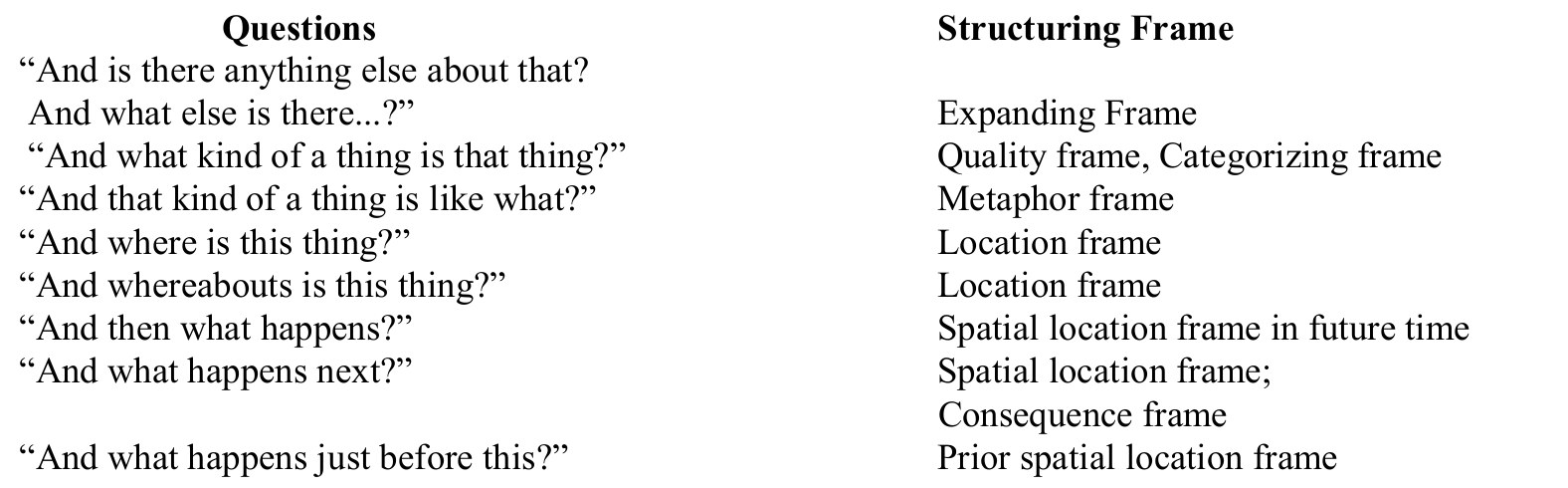
In the 1990s James Lawley and Penny Tompkins (England) modeled David Grove and came up with a model that they called Clean Language for Symbolic Modeling. Their book came out in the year 2000, Metaphors in Mind: Transformation through Symbolic Modelling (2000). Researching the field, they used several sources: Lakoff and Johnson’s Metaphors we Live By, Pinker’s work, How the Mind Works. This lead to using the sub-modality of location (space) to construct metaphoric landscapes—which is truly a new creative addition to the field of NLP.
My only critique is about the name itself. Calling this powerful tool for symbolic modeling “clean language” seems to suggest metaphorically that it is uncontaminated by the user’s own thoughts, emotions, states, assumptions. And that’s just not the case. It can’t be. Now the intention is great— not wanting to impose upon a client “any value, construct, or presupposition” (p. 52). But, of course, that’s not possible. To their credit, they do begin with a focus on using the client’s words and then go into questioning about the shape of the metaphor: it’s location, direction, size, etc.

Social Panorama — Modeling the Semantic Space of Relationships
Another tremendous contribution to the field of NLP comes from taking a tool that the field of Sociology gave us, the Sociogram and updating it with some NLP. Lucas Durks from The Netherlands did this as he applied the idea of sub-modalities to relationships (the Others Matrix). By doing this he created the Social Panorama (which has since been published as a book by that title, published by Crown House Publications). So as we code and represent “time” externally to ourselves so that we can point in space to such concepts as “the past,” “the future” (and so create “time-lines”), so using various cinematic features we can locate people in space around us.
In the Social Panorama model, you can take the cinematic features (sub-modalities) of distance (close and far), height (up and down), two and three dimensional, color or black-and-white, etc. and can create a world of people all around us. Then in this model, you symbolically use physical space to stand for and represent the meanings that we give to the people in our mental- emotional world.
Meta-States - Modeling of Self-Reflexivity
It was while modeling resilience (1992-3) that I discovered the Meta-States Model. I was studying highly resilient people (Frankl, survivers, etc.) as well as continuing my study of the sources of NLP, especially Bateson and Korzbyski on the subject of “logical levels.” This resulted in discovering the meta-layers of states-about-states and so the modeling the kind of consciousness most unique to human beings— self-reflexive consciousness. This gave birth to the Meta-States Model in 1994 which was almost immediately recognized by the International Association of NLP Trainers in 1995 as “the most significant contribution to NLP.” Soon thereafter I began putting the Meta-States Model into various books: Secrets of Personal Mastery, Meta-States, Dragon Slaying, Winning the Inner Game. Then over the years literally hundreds of patterns arose — there are 143 Meta-State Patterns in the book, Sourcebook of Magic, Volume II. And, of course, after that arose the field, model, and community of Neuro- Semantic itself.
The unique thing about the Meta-States Model, is that it re-models the models of NLP because reflexivity is built into the model and that’s, in part, why the model has been so rich and robust over the years.