
SCALING YOUR EMOTION’S INTENSITY
Because an e-motion involves motion that is going out of you (ex-motion), it’s not surprising that your emotions involve a degree of energy.
Reading preferences
Optional. Your reading and listening position stays in this browser, not in your public profile. Avoid enabling this on a shared device.
Because an e-motion involves motion that is going out of you (ex-motion), it’s not surprising that your emotions involve a degree of energy. From what you think and evaluate as you interpret your experiences in the world, your brain sends signals to your body regarding what to do and how to respond. Your interpretative centers in your pre-frontal cortex activates your associative cortexes and your motor cortex which then activates you to sense (feel) things in a way that allows you to respond appropriately.
This enables us to not only ask, “What do you feel?” (#5), but also “How much do you feel X?” And with this question you can begin to scale an emotion’s intensity? “How much do you feel afraid? Or angry? Or joyful? Or in love?” This gives us yet another way of operationally defining an emotion— an emotion is an energy field. Imagine the emotion as an energy bubble that surrounds you, give it a color: In anger, you’re in a red bubble and it can range from 0 to 10 in intensity. In relaxation, a blue bubble and you could rate it in percentages, 20%, 50%, etc. In joy, a golden bubble and you could measure it as low, medium, or high. In grief and sadness, a dark bubble and you can scale it very dark to gray.
There’s many ways that you could talk about the intensity of the emotion. Years ago when working with men coming out of the Federal Prison here in Colorado, I was commissioned to do “anger control” with them. So I created an anger scale. I took all of the words for anger that I could find and put them on a scale ranging on the bottom for “very little” to anger in the middle to out-rage and violence at the top.
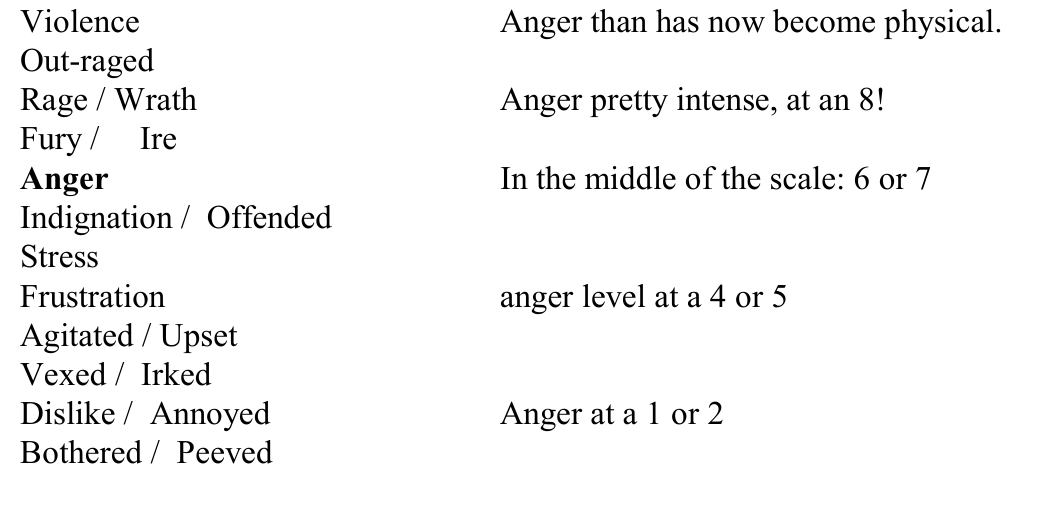
Once you scale an emotion, you can now make distinctions in how much you feel a particular emotion. The men that I worked with were under the delusion that their experience of anger was an all-or-nothing affair. Either they had it or they did not. “You wouldn’t like me angry!” a couple of them told me. “Why are you a son-of-a-bitch when you’re angry?” I would ask them—keeping my distance (!). Sheepishly, they would admit, “Yes” they were. As they would talk about a provoking event, I would ask, “How much anger did you experience?” It was always “10!” “So you can’t make it any stronger?” They always said they could—so they were not truly at a 10! “Okay, turn it down to 9.” “Are you man enough to do that?” If they said “8" or something, I would say, “Turn it up to 9, now 10. Okay, good, now down to 7.”
The amazing thing is that once you think about the energy level of an emotion, everybody seems to have the innate ability to turn it up and down. Make it more; make it less. Sometimes I had to help them do that. “Think about the threatening bully in diapers and holding a rattle. Good. Now feel the anger at 10.” They couldn’t!
In our training manual on Emotional Mastery, we have a page of a dozen emotional scales— a scale for joy, love, relaxation, etc. and a scale for fear, sadness, guilty, etc. In each of the scales I have searched for words that are synonymous, or nearly so, with the key word. For example, on the scale of Joy, at the lowest levels there is content, feeling pleasant. A little higher is playful, laughter, mirthful. Then delight, happiness, ecstasy at the top. And where language fails us, the scaling itself offers a sense of degree. And when you can scale or gauge the degree of intensity of an emotion— it gives you a way to describe it, at least a little bit more accurately.
I found scaling as an excellent first step in training people to begin to manage their emotions. It breaks the all-or-nothing frame and enables a person to get in touch with their inner powers for amplifying or dampening their emotional intensity.
If you have been in a learning state as you have read these two pages, how much interest, curiosity, and fascination did you experience? Was it a lot or a little? Did that degree of curiosity intensity on the scale enable you to have been in your best the learning state? Now suppose you amplify or reduce your curiosity intensity to a level where it is just optimum for you; now reread this article. How does that impact your learning? Your enjoyment of learning?