
SECOND STAGE VICTIMIZATION
Three weeks ago Jeffrey Epstein committed suicide in prison.

 Share
Share



Reading preferences
Optional. Your reading and listening position stays in this browser, not in your public profile. Avoid enabling this on a shared device.
Three weeks ago Jeffrey Epstein committed suicide in prison. He was there as a convicted sex predator who apparently trafficked in sex with scores, if not hundreds, of women. But then he died. And while the report said it was suicide, many question that. Anyway, more recently (August 28) a dozen or more women went to court and testified about their experience were then interviewed.
“He took away my innocence” one said. “He cheated me out of my childhood,” another asserted. “He has now taken away my day in court to tell my story.” “I wanted to see justice done, but now that he’s gone, that will never happen.”
Now what strikes me is not the pain and distress of the women suffered due to the criminal behavior of Epstein, but how they are perpetuating their own misery by the way they are thinking about it. It’s one thing to be mistreated, abused, deceived, etc. It is another thing to take a bad experience and unnecessarily perpetuate it. The first is an example of interpersonal violation and abuse, of “man’s inhumanity to man,” the second is an example of self-abuse.
A basic principle in most psychology and especially in NLP is that how you frame something determines how you experience that thing. So if you frame things so that you are the recipient of another person’s actions— you have thereby victimized yourself. The amazing thing in this is how you can do it so quickly and so easily with language. The above examples demonstrate this. Here they have taken a nominalization (“innocence,” “childhood,” “justice”) and posited that a person has taken that away. That frames them as a victim of a theft, a theft of something that is lost forever. After all, how do you get one of those things back? Language is not innocent. What you say, and what is implied in what you say, can be as devastating as an actual assault.
It began with being a victim of another person’s lust, anger, violence, stupidity, unethical beahvior, craziness, etc. That describes the brute facts of what happened in a given case. The victimization could have stopped there. But for some, that’s just the beginning. To make matters worse, they then victimize themselves by the way that frame things. They jump-to- conclusions which are unfounded, they over-generalize, they personalize, they awfulize, etc. and in the end they so interpret things so that they are in a stuck state of loss, injustice, disempowerment forever. They frame things so that there’s only one solution and it depends on something or someone external to them. And if external, then they can do nothing about it.
The disempowerment then worsens with the actions that the “victims” take, namely, complaining, whinning, and narrating a self-identity as a victim. As a way of thinking, all of this makes things worse, puts one into a prison of one’s own making and throws away the key. And as if that’s not bad enough, all of this creates a particular mental blindness—they can’t see what they are doing and what they could be doing.
All of this describes second stage victimization. And while we cannot always control the first stage of victimization— when we are the object of someone’s rage or cruelty or stupidity, we can always control how we respond to that first stage. Doing so, in fact, is the place where true human empowerment occurs.
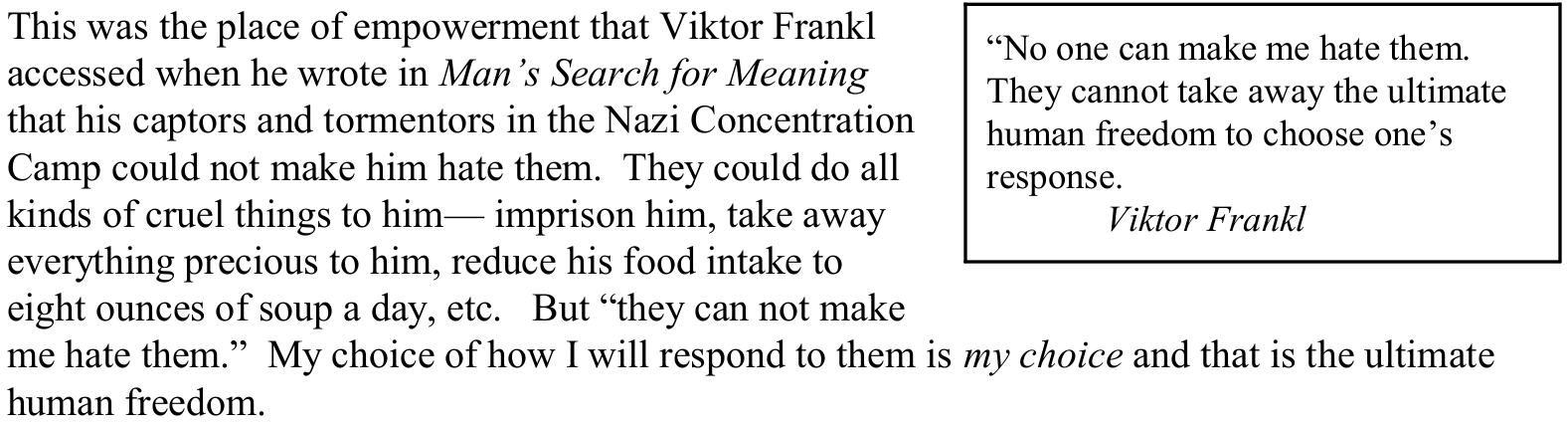
He was a victim once, but not twice. He received treatment regarding which he was powerless to do anything, but he did not continue the victimization treatment to himself. He asserted his unconditional value as a human being. He claimed his ultimate powers of response. And in doing that he did not become traumatized by what otherwise traumatized millions and could have traumatized him. He took it and experienced it on the primary level, but never on the meta-level. That is, he did not give it a negative meaning that would imprison him in a mental prison.
President Reagan did something similar. After he was shot by John Hickley and nearly died, he forgave him. His son, however, did not and refused to. Thirty years later his son said that he was still angry at Hickley and unwilling to forgive him. At the same time he noted that his dad, the President, forgave him two days after the shooting. Two ways of thinking about an experience— two ways of experiencing an experience.