Self Actualising Peak Safety Performance
Jason Kong’s original 2012 paper on applying self-actualization and Neuro-Semantics to workplace safety.
 Share
Share



Preparing your audio…
You can keep reading while we get it ready.
- Waiting to start
- Creating audio
- Checking recording
Waiting to start
Audio ready
Tap Play to start listening.
AI-generated narrationListen at your own pace
Listen to this article
 Listen to this article
AI-generated narration
0:00--:--
Enable JavaScript to listen, or read the complete article below.
Reading preferences
Optional. Your reading and listening position stays in this browser, not in your public profile. Avoid enabling this on a shared device.
Abstract
Safety is of paramount importance to organizations in various industries like power, petrochemical and construction. Many companies adopt safety as one of their core business values and high emphasis is put into safety management.
There are a lot of articles and publications on safety management. Most of them elaborate the management commitment, safety model, safety policy, incentive scheme, training/education, control & monitoring, KPI, … etc. These safety measures address mostly the hardware side, which has successfully achieved certain degree of safety when implemented properly.
Recent survey of Dupont has indicated that very few organisations are able to achieve the ‘interdependent’ stage, which is the highest level in safety with ‘no one gets hurt’ as the ultimate goal.
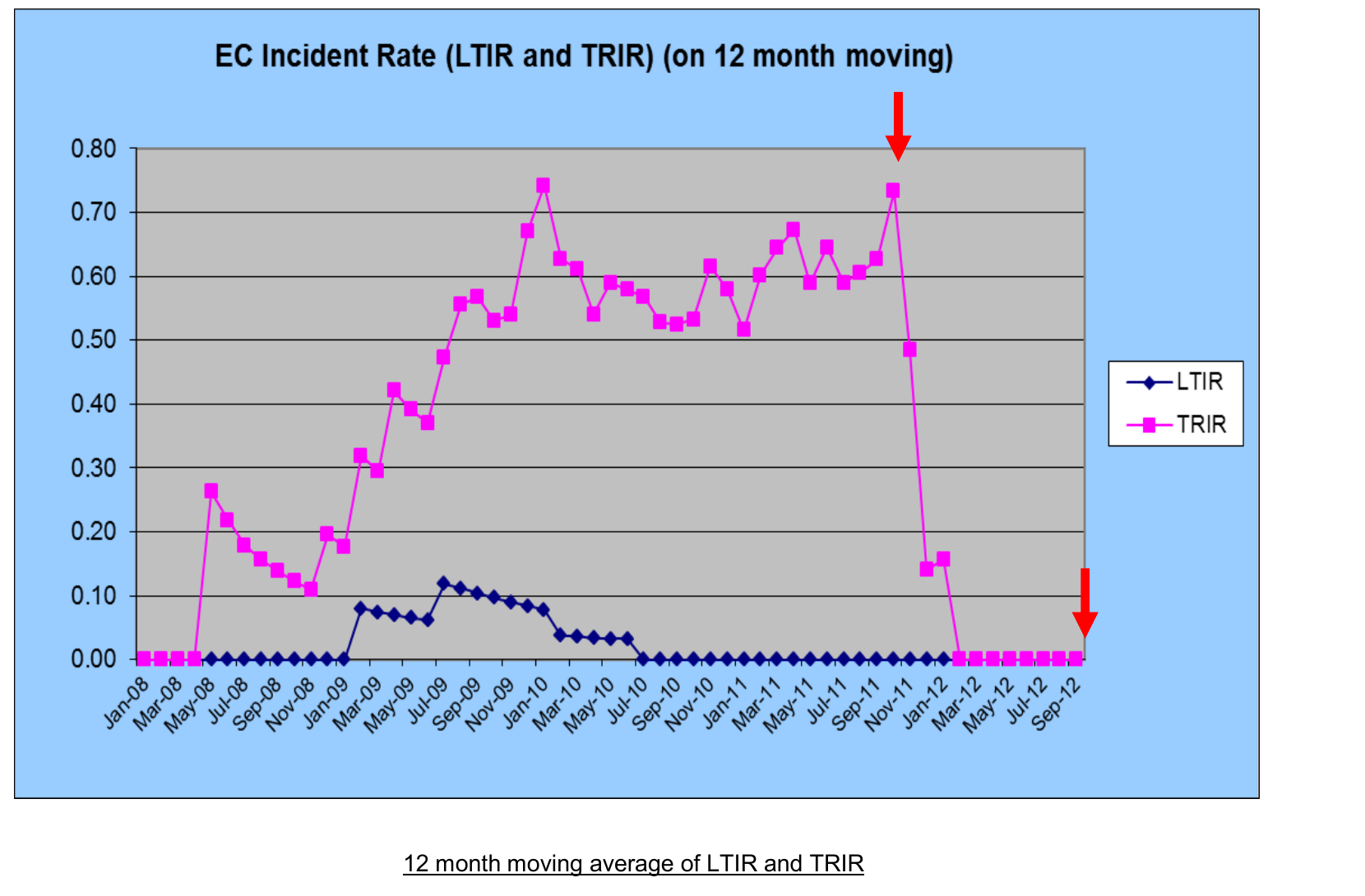
This paper addresses the safety management from the neuro-semantics perspective, which identify the meaning behind human behaviour and unleash the potential of each individual and the team through self- actualisation. Self-actualisation approach has been applied in the close-out phase of CLP Emissions Control (EC) Project. During the peak period, 40 contractors and 2800 staff from 20 countries were involved in the EC Project, which is one of the largest engineering projects in terms of scale and complexity in Hong Kong over recent years. The approach supplements the hardware safety measures, such as the management site observation program, that has been successfully implemented on site. As a result of joint effort of the staff, management, consultants and contractors, EC Project has successfully achieved 10.3 million safe man-hour in total and zero LTI (Lost Time Incidence) during the close-out phase.
Introduction
In recent years, control-oriented (dependent) safety programs, that emphasise on rules, control and discipline, have lost ground to the more successful self-directed (independent) programs with emphasis on knowledge and employee involvement. Today with the growth of the team concept in industry, a mutual-caring (interdependent) approach to workplace safety is gaining wide acceptance with the goal to achieve zero accident. However based on the recent survey of Dupont on 3,450 locations in 41 countries, most of the companies are still in the dependent stage with some reaching independent stage, but only a few in the interdependent stage.
This paper describes a different approach to reach ‘interdependent’ stage in safety through neuro-semantics, which addresses the human nature in new psychology; and drives the peak performance in safety and sustain it through self-actualization, that have been used successfully during the close-out phase of the EC project.
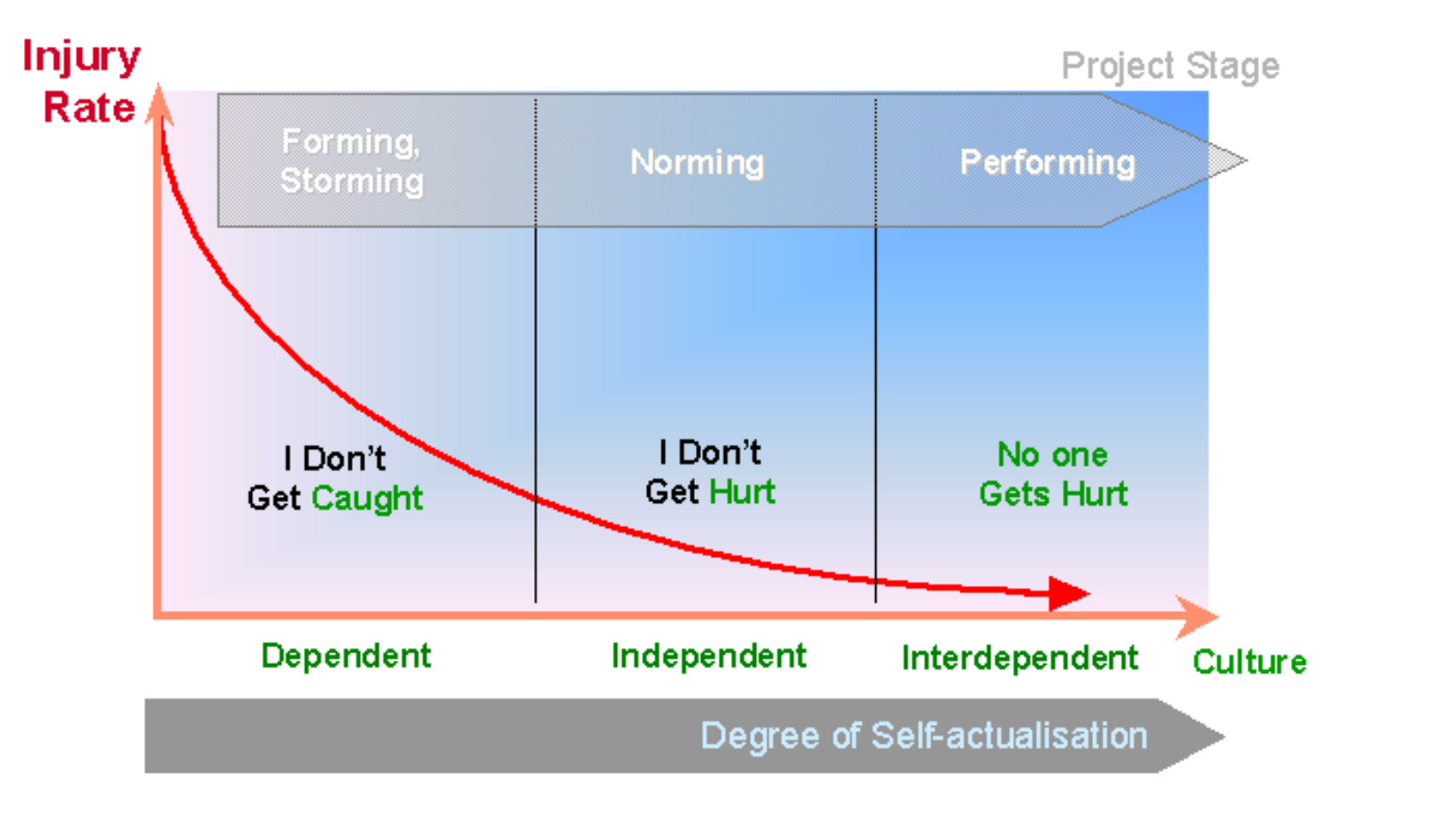
During the close-out phase of the EC Project, safety risk maintained to be in high level since all emission control equipment was in operation after commissioning; and there were high risk jobs to be handled. Some people started leaving the team; and workload increased for the remaining team members. Moreover a few new comers needed to be trained up on safety. How to further reduce the injury rate was a challenge to the management during the close-out phase.
Maslow’s Pyramid – Hierarchy of Needs
Abraham Harold Maslow was best known for creating Hierarchy of Needs, which is a pyramid describing the levels of human needs, psychological and physical. The lower the level in the pyramid, the stronger the drive. Those lower needs are driven by deficiency. For hunger, we need food. For thirst, we need water or drink. When the basic needs are fully and adequately gratified, the needs alone cease motivating anymore and people seek a higher level needs. While the higher needs emerge from time to time even while we are first learning to gratify our basic lower needs, they don’t truly emerge until we adequately gratify the lower needs. When a human being ascends the steps of the pyramid he reaches self-actualisation, in which he eager to experience more, learn more, create more, basically to actualise their full potentialities.
Safety is the second lowest level in Maslow’s pyramid of needs. To feel secure and safe in one’s work is a basic need. However over time the drive for safety diminishes and the safety awareness drops when we get familiar with the working environment. Therefore, we cannot rely on basic instinct to get high safety performance at work.
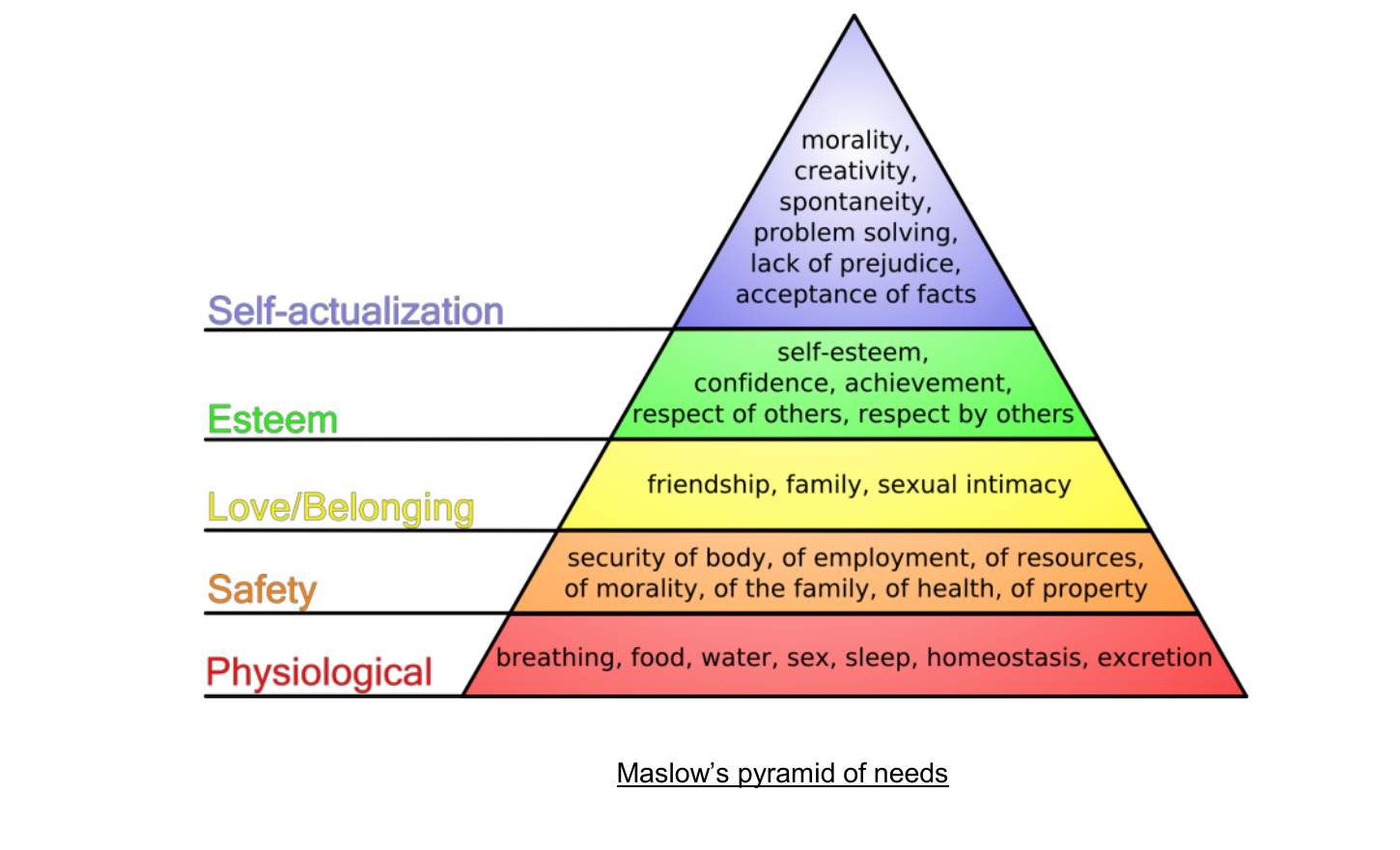
Self-actualization is the highest level of needs that never ends in satisfaction. The drive sustain if people get there – want to know more, achieve more, give more and create things of value. “Getting” from others and even demanding love, attention, touch…etc comes from the deficiency of our lower needs. “Giving” is the higher self-actualization need that drives us to connect with other people, to offer our knowledge and experience, to contribute and give to others, to leave a legacy.
Self-actualization occurs within groups / organization as it does individuals. Maslow believed that great companies would need to transcend the tangibles at the bottom of the pyramid and see differentiation through addressing the higher, intangible needs at the peak of the pyramid. When a group self-actualizes, the people there are able to unleash their best energies. If the energies are devoted to safety, best safety performance can be achieved and the result is sustainable.
Meaning versus Performance
The self-actualisation suggests that the key to business success involves treating people in their highest nature. It is this human nature that gives us good people, well, actually great people who are passionate, caring, responsible, engaged, and who are always unleashing more and more of their potentials.
The state of being engaged simply refers to being fully involved with something. In engagement the concentration can become so strong that people lose track of time and environment. What engages us to that degree and that level? Whatever it is – isn’t it highly meaningful and significant to you? It is precisely because you care about it, value it and consider it meaningful to your life that engages you. We need to make sense of things and to have a sense of mission and purpose. Meaning also enables and empowers our performance. Peak performance can be achieved when there is a meaning / belief strong enough and aligned with our nature.
In Neuro-Semantics, meaning is king. The quality of our life is the quality of the meanings that we create. We are the Creator of our Reality. And why is that? The meaning we give is the instinct we live. Give any human drive or human experience or human emotion a certain meaning, and that meaning will thereafter govern our mind-and-emotions, it will determine our sense of reality. We are the meaning-maker. Meaning is an inside-out job. As we create meaning, so we feel that meaning in our emotions and we perform it in our behaviours, actions and habits.
To fully engage the employees with safety, leaders in an organisation need to create a significant meaning to safety, that all levels of employee from workers, supervisors, engineers and managers can easily understand and get triggered by its value and meaning.
Manager focuses on performance, but leader creates meaning for the future.
Do you think that the staffs are motivated by given a target of zero accident? Are they motivated by the safety rules? We have to ask the question why employees care about safety. What is in it for me? To understand the meta-needs (the needs underneath), we have to ask ourselves some questions:
- Why do we go to work – may it be money, job satisfaction or something else?
- Why do we want to make more money – is it for entertainment, family, status, …?
- What do we care most – is it our health, family, friends, company….?
- Why is it important to work safety – is it for the company, for me, for my colleagues / friends?
Employees are motivated if the reason for working safety is to their own interests. For example ‘Nobody gets hurt. Go home safely every day’ was chosen as the safety meaning that has been communicated to all employees frequently and repeatedly during the close-out phase of the EC project. The ‘meaning’ has been used in different safety events – training, workshop and meeting; and posted in dominant positions at work to anchor them with their highest interest.
What is your personal reason to work safely? To relax and enjoy ourselves after work; to see the beloved ones at home; to have fun with the family and friends. Meaning to safety is strong and powerful if it is related to our own interest. It is about caring for our beloved ones – I work safely since I care about my family. It is about caring for others – I want my colleagues, who are my friends and buddies, to go home safely and don’t get hurt. Is that what ‘interdependent’ approach in safety all about?
Dr Michael Hall, the visionary leader in Neuro-semantics, uses the self-actualisation quadrants (shown in the diagram above) to describe the relationship between Meaning (Semantics) and Performance (Neuro-Physiology). The four quadrants are expressed in the meaning of safety as follows:
- Undeveloped who practises safety reluctantly
- Dreamers with safety desire but still poor in safety performance
- Performers who practise safety under guidance and monitoring
- Self-actualizer who excels in safety performance and understand the meaning behind
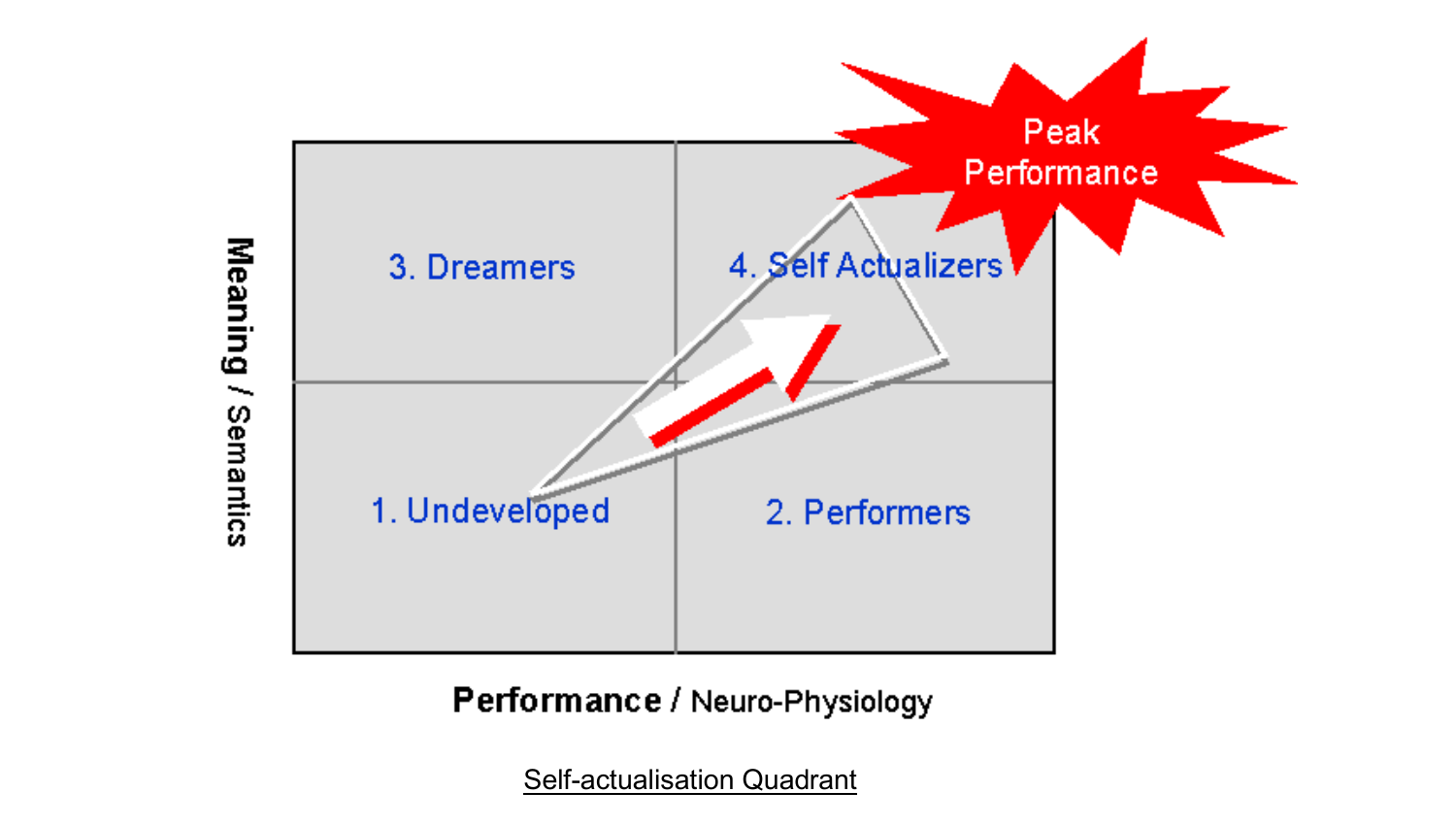
By installing a strong meaning to safety, the Undeveloped who practises safety reluctantly can be transformed into Dreamers with safety desire but still under in performance. The Performers who is practising safety under the rules and control can be transformed into Self- actualizer who excels in safety performance, which is motivated by a strong meaning behind.
From Principle to Action
How to translate Dreamers with a desire for safety into Self-actualizers who practise safety with whole heart? To facilitate the translation from the conceptual level into the practical level, the mind-to-muscle pattern (Neuro-Semantic pattern) can be used to close the knowing-doing gap. What you know intellectually can become an integral part of your performance. We do it when we learn typing. The learning takes time and trouble in order to get the muscle patterns and coordination deeply imprinted into your muscles. Yet by training and practising, the learning becomes incorporated into the every fabric of our muscles. We will then lose conscious awareness of the learning as the muscles run the program. At that point, we have translated principle into muscle and it is embodied into our neurology.
Mind-to-muscle pattern:
There are 6 steps in mind-to-muscle pattern. For each step, an example in safety is given below.
1. Identify a principle or concept you want incorporated into your muscle
- I understand that …..Nobody gets hurt. Go home safely every day
2. Describe the principle as a belief
- I believe that …….it is possible and achievable that I don’t get hurt at work
3. Reformat the belief as a decision
- I decide to ….. work safely from today
4. Re-phrase the belief and decision as an emotional state or experience
- I feel very happy that…. I won’t get hurt and go home safely every day. Same for my colleagues
5. Turn the emotion into actions to express the belief / decision
- I will act safely, make pre-assessment of safety before work and keep alert on safety every day
6. Step into the action and let the higher level of your mind spiral
- Start carrying out the work. Let the subconscious mind spiral
Safety Workshop
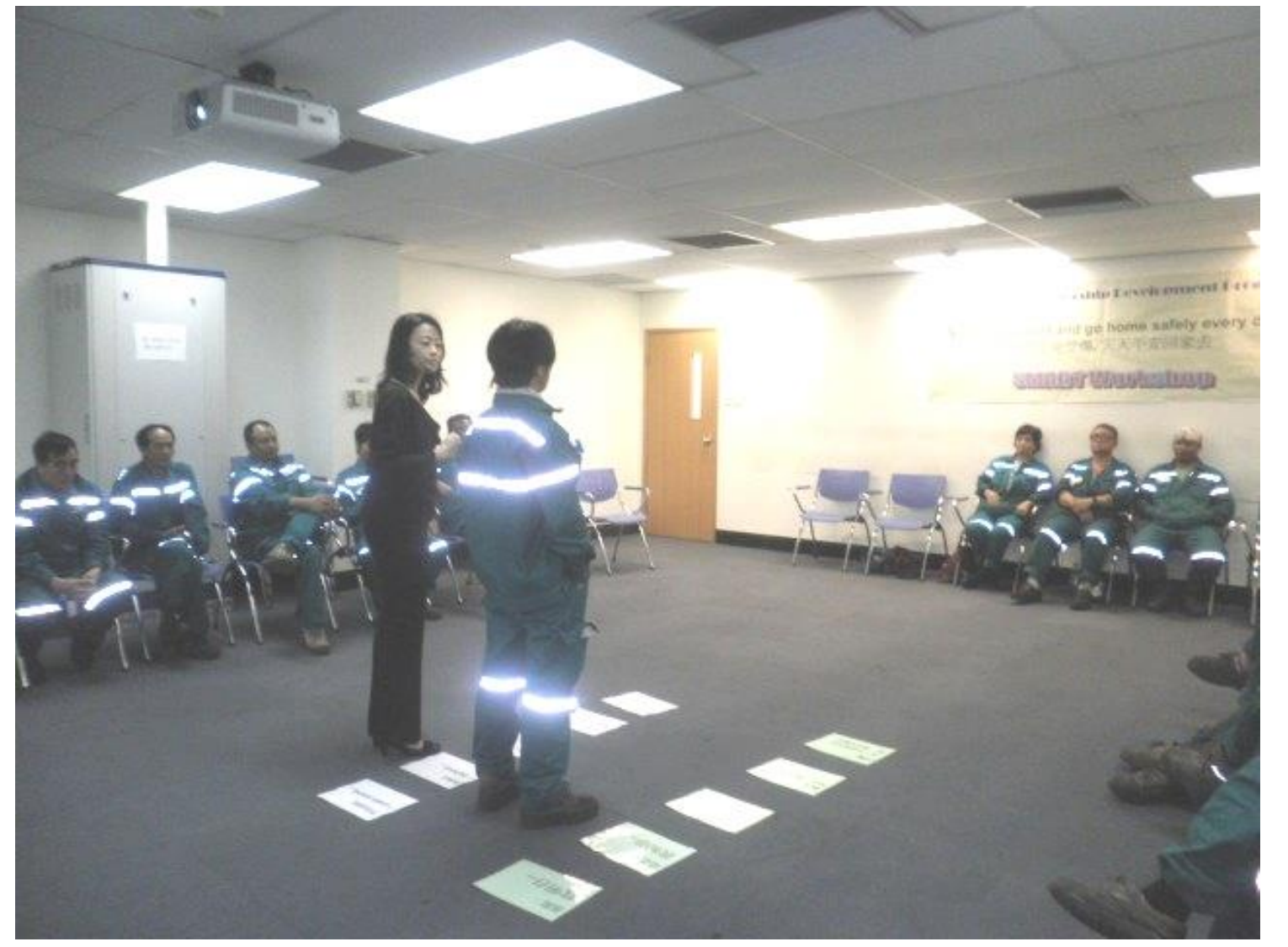
In close-out phase of EC project, all project staff (about 350) participated in the SMART Safety Leadership Development Workshop, in which they went through the mind-to-muscle steps as an exercise during the workshop.
Tek, Registered Safety Officer of EC Project , has been interviewed at the end of the EC Project for his opinion about the program.
‘Staff become more friendly and cooperative after the SMART training when we approach them in enforcing the safety rules’ Tek said.
‘Before attending the workshop we sometimes needed to contact their supervisor / managers in order to allow them complying with the safety policy. Staff now realises that safety is for his / her interest and benefit – going home safely every day.’ Tek recalled.
Sustainability in safety
To be sustainable in safety, it relies on the front line supervisor and managers to motivate and coach the staff in the daily work. Employees need to see every day and through multiple ways that safety is valued, rewarded, supported, and encouraged.
Self-actualisation through meaning is important to the peak performance in safety. On the other hand, proper monitoring mechanism is needed so that management can take immediate action if there is any improvement or deterioration in safety. Regular and irregular site observation visits allow management and safety team acquainted with the safety altitude and situation of front line staff. In case of deviations from the safety policy, proper coaching is needed to ensure staffs understand that safety is to their own interest and willing to make correction.
Besides the management site observation visit, the EC project also instituted a system for open recording of any incident and encouraged a no blame culture for reporting. Incidents were investigated in a low-key manner so as not to drive a culture of non-reporting.
Peak performance in safety asks for consistency through out the whole organisation – a self- actualising leader / manager coaches and vitalises the team leaders, who in turn coach and unleash the full potential of their subordinates. It calls for the self-actualisation culture in the company in which:
- Leader creates an inspiring vision for a sense of purpose, create meaning and meaningfulness in safety
- Managers listens to employees and includes their opinions in decisions in safety
- Managers taps into and release the capital of employee (intellectual and creative) in safety
- Managers communicate openly informing people of decisions and sharing information in safety
- Employees are empowered to be responsible for the service and product quality in safety
- Employees seek and desire feedback on how they are doing and what they can do better in safety
- Employees want to learn and understand their business, how it works, and how they contribute in safety
- Employees enjoy tapping their potential that release purpose, meaning and power in the workplace
Concluding Remarks
Rome is not built in one day. When a team is newly formed, it usually struggles in the beginning before the team members know each other and adapt to the new working environment and requirements. It takes time to build the self-actualising culture in a team. To ensure that safety rules are enforced in a newly formed team, it is probably necessary go through the ‘dependent’ stage, which emphasise on control and disciplines. However, the faster the self-actualising culture is built up in a team, the earlier ‘interdependent’ stage can be reached and lower the injury rate can be achieved.
During the close-out phase of the EC Project, zero Lost Time Incidence has been achieved and the 12 month moving average of Total Recorded Incidence Rate (TRIR) has been reduced from 0.73 to 0 in four months. The result is encouraging. Management caring and uplifted safety alert by frontline staff are indispensable to its success. Even though we are not completely sure that how well we are in the ‘interdependent’ stage, but definitely we are getting better than before through self-actualisation.
Self-actualisation is a sustainable approach in which:
Leaders create great meaning to organisations in which employees are completely engaged in their work and demonstrate that engagement as a joyful passion and high productivity.
References
1. ‘Unleashing Leadership’ – Self-Actualizing Leaders and Companies, by L. Michael Hall Ph.D, 2009.
2. ‘Using the safety perception survey to assess your organisation’s safety culture’ by Robert S. Krzywicki and Michael B. Keesey (Dupont) on April 21, 2011
3. ‘Overview of DuPont’s Safety Model and Sustainability Initiatives’ for Meeting with DOE on December 14, 2009
Related source documents
These original public PDFs open on the legacy Neuro-Semantics website.