
SETTING A GOAL TO SELF-ACTUALIZE SOMETHING
“The biggest puzzle is not solving and fixing problems, per se, it is fixing the thinking that causes problems.”

 Share
Share



Preparing your audio…
You can keep reading while we get it ready.
- Waiting to start
- Creating audio
- Checking recording
Waiting to start
Audio ready
Tap Play to start listening.
AI-generated narrationListen at your own pace
Listen to this article
 Listen to this article
AI-generated narration
Narration covers the article text on this page. Linked documents and illustrations are not read aloud.
0:00--:--
Enable JavaScript to listen, or read the complete article below.
Reading preferences
Optional. Your reading and listening position stays in this browser, not in your public profile. Avoid enabling this on a shared device.
“The biggest puzzle is not solving and fixing problems, per se, it is fixing the thinking that causes problems.” (LeGault, Think! 2006, p. 309)
In spite of the current world-wide inundation of information and the mythology that information is power, information by itself actually amounts to very little. The reason is because in order for information to be useful, you have to transform it into knowledge so that you can “know” something specific in a specific area.
Yet even that is not enough. After that you have to transform your knowledge or understanding into comprehension. Only when information has become comprehensible understanding of something (e.g., how it works, what you can do with it, its value, etc.) can a person then actualizes it in action and use it for developing personal excellence and mastery.
This means that today our problem is not the lack of information. Actually, we are inundated by so much data, facts, and information and to such an extent that we are overwhelmed by it. Sometimes we are even defeated by it because we don’t know where to start. With it we have too many choices, too many possibilities. Sometimes it is so much so that we are disoriented and don’t know where we are or what to do— paralyzed.
For a template for thinking about setting a goal to actualize something in Neuro-Semantics, we use the Meaning—Performance Axes.
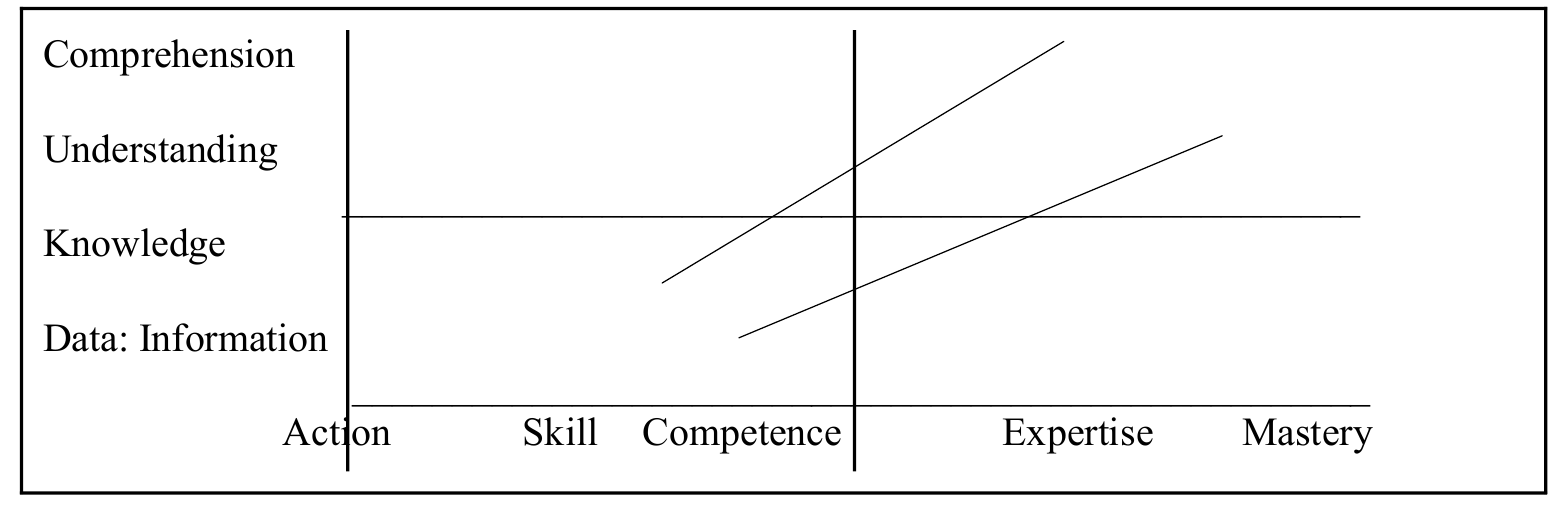
The key to actualizing anything is unifying meaning and performance so that they come together. When you do that, you have the possibility of a synergy— a unifying of what is highly significant and meaningful into an action, or set of actions, that translates the meaning that you comprehend. When the action is at a high level of competence— when it has a high level of expertise, then the resulting action is at its highest meaning and best performance.
On the meaning scale (the vertical line to the left) identify some information that you have. As you do, be sure that you clean it up with the Meta-Model questions. Where did you get it? Who said? How do they know? Can you corroborate the information? What evidence are you relying on?
Next turn it into knowledge. What do you think you “know” given that information? This knowledge falls into what area or category? How does it fit or not fit with what is already “known” in that domain?
“Good information is still a rarity, and rarer still is the intellect that can polish it and turn it into knowledge.” (LeGault, Think! 2006, p. 180)
Next, turn the knowledge into comprehension. Now that you know what you have learned, how does that enrich and expand your comprehension of X-category? What does it allow you to do? How does it affect the way you relate to X? What questions does this comprehension answer?
Finally, turn the comprehension into action. What will you now do that you know and understand that? How will you do that? What practice will you give yourself to in order to become skilled in doing that?
Along the horizontal line at the bottom are the actions and activities that actualize what you know and understand. As you practice an activity and become increasingly skilled with it, typically within 30 to 60 days you can become competent. Ten years more and you can move to the place of expertise (the 10,000 hour rule of deliberate practice, Anders Ericsson) and thirty years of expertise practice will take you to the place of mastery. All of this gives you a way to actualize information so it becomes transformational in you as you set and achieve your goals.