
7+2 Keys for Becoming a World-Class Coach
Nine keys, reflective questions and original models for developing a world-class Meta-Coaching practice.

 Share
Share



Preparing your audio…
You can keep reading while we get it ready.
- Waiting to start
- Creating audio
- Checking recording
Waiting to start
Audio ready
Tap Play to start listening.
AI-generated narrationListen at your own pace
Listen to this article
 Listen to this article
AI-generated narration
0:00--:--
Enable JavaScript to listen, or read the complete article below.
Reading preferences
Optional. Your reading and listening position stays in this browser, not in your public profile. Avoid enabling this on a shared device.
- What makes a person world-class as a coach?
- Are there any secrets for becoming a world-class coach?
- What are the prerequisites of knowledge and skill that secures a coach’s success?
- What are 7 keys to becoming a world-class coach yourself or for finding one?
- What does the Meta-Coach training system offer that facilitates becoming world-class?
- What’s involved in becoming a highly effective coach with a successful practice and building a first-class reputation?
In 1999 Coaching became the second fastest growing industry in the world behind IT. People at all levels of business, industry, government, media, and entrepreneurship have discovered the power of having a professional coach to facilitate their success. Coaching has become a revolution in business as a managerial tool and as a way to truly empower people to use their brains and talents. No longer is coaching reserved just for top athletes, Fortune 500 CEOs, or Presidents. Today ordinary men and woman are now achieving tremendous personal growth, taking their performances to new levels of achievement, and experiencing greater personal and career success via Personal and Executive Coaching.
The downside is that there many unqualified and poorly skilled people are hanging up coaching signs and flooding the market which threatens to sabotage the field and undermine the value and uniqueness of coaching. Yet as a market-driven industry, the good news is that those who are truly skilled, have the first-class qualities that make for an effective coach, and who operate from a solid coaching methodology will rise to the top of the field. They will be the ones to make a difference.
- What’s the difference between a mediocre coach and one who is truly productive, effective, and professional— one who is a world-class coach?
- How can we learn from expert coaches around the world and take our coaching skills and practice to a new level?
KEY #1: A FIRST-CLASS COACH KNOWS THE HEART OF COACHING AND CLEARLY DISTINGUISHES THE COACHING BOUNDARIES
In order for coaching, as a field and movement, to become a profession in its own right, it has to have clear distinctions between itself and the other fields of therapy, training, consulting, mentoring, and hypnotherapy. Without such distinctions, coaching becomes just a step-child of these fields. But with the clear distinctions, a coach will know his or her boundaries and be able to know when to refer.
Personal Questions if you want to be a World-Class Coach:
- Do you know how coaching differs from the other modalities?
- Are you able to draw a clear line between them and know when and how to refer as well as why?
- How does coaching differ from consulting, mentoring, training, and therapy?
- What training and level of expertise do you have in facilitating a coaching conversation?
- How will you handle clients who need something other than self-actualization facilitation?
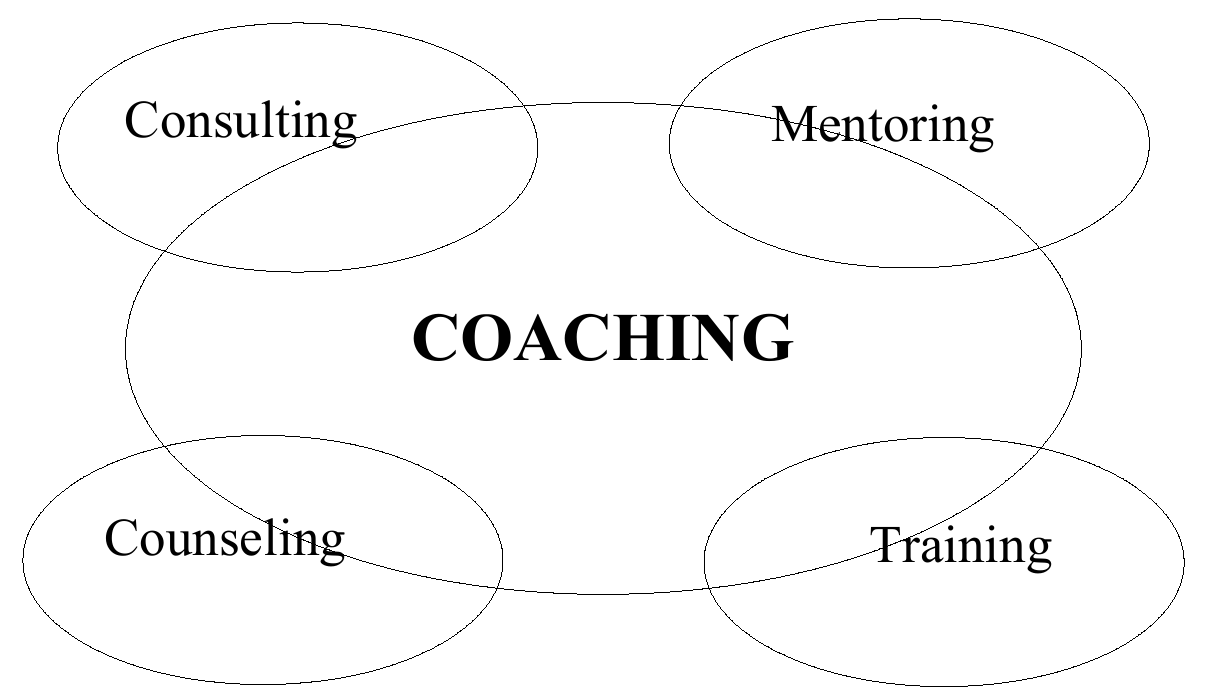
The Key Helping Modalities:
- Consulting is about giving advice and expertise.
- Mentoring is about guiding from experience.
- Training is about teaching and drilling in new skills.
- Counseling and therapy is about solving problem, healing hurts, resolving traumas and building up ego-strength so the person gets up to average and becomes “okay.”
KEY #2: WORLD-CLASS COACHING IS CENTERED IN A COGNITIVE METHODOLOGY
Coaching, as a collaborative and creative partnership, needs to be more than just a “flying by the seat of the pants” process. It needs to be more than just a “grab bag of tricks” from self-help books and seminars. Coaching needs to have a systemic framework based on the best knowledge in the cognitive-behavioral sciences. The world-class coach will know what to do, when, with whom, and why. To do that we need a psychological model that enables us to understand human development, consciousness, communication, learning, change, and self-actualization.
After all, that’s what coaching is all about—communicating and co-creating with a client a compelling future and facilitating the change for learning to mobilize resources that will unleash the client’s potentials for actualizing his or herself best talents.
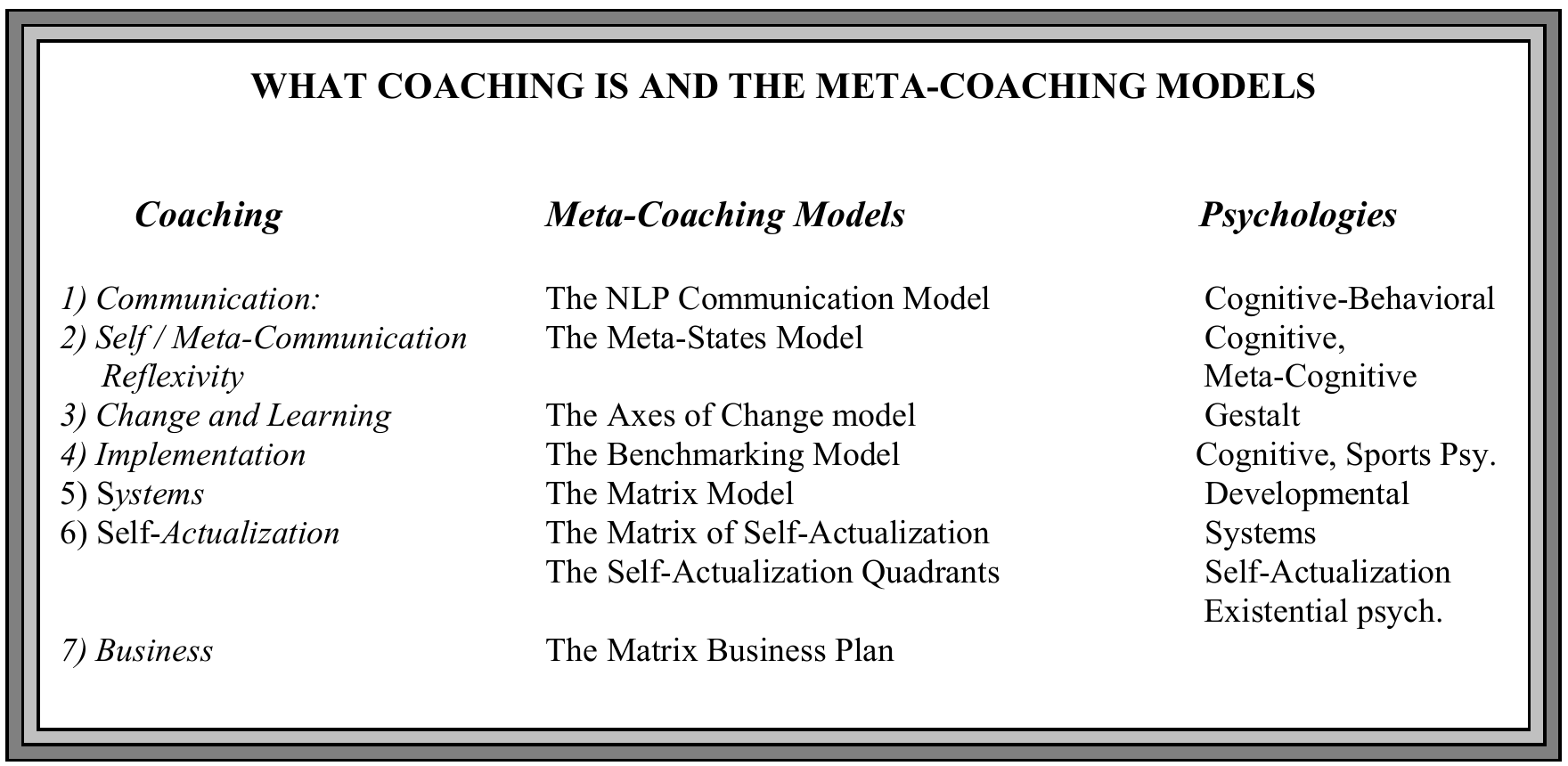
What then is coaching?
Personal Questions if you want to be a First-Class Coach:
- Do you have a systematic coaching methodology? What is it?
- Is your methodology based in the cognitive-behavioral sciences?
- Do you know how to use it so that you know what to do when with whom and why?
- Is your coaching methodology for healthy and self-actualizing people or does it come from the field of therapy?
KEY #3: WORLD-CLASS COACHING COMMUNICATES TO EVOKE STATES.
At the heart of coaching is a conversation, a dialogue that gets to the heart of things. As a special kind of communication, the coach must be highly skilled and professional as a communicator. This involves competency equally with both the verbal and non-verbal dimensions, with knowing how to ask questions, explore words, comment on gestures, calibrate to states and physiological responses, and much more.
Appreciating the complexity of communication, a first-class coach continually works on the foundational skills and competencies of communication. In Neuro-Linguistic Programming the Meta-Model provides 21 distinctions in language for creating precision while the Milton model allows one to use language to induce resourceful states that solidify new learnings and decisions. A distinctive feature of NLP is that it is about neuro-linguistics and not merely linguistics—it deals with how language affects us and evokes our mind-body states.
Personal questions if you want to be a world-class coach:
- What model of communication do you use?
- Is it grounded in the cognitive behavioral sciences?
- How do you respond when the response you get isn’t the response you wanted?
KEY #4: WORLD-CLASS COACHING STEPS BACK TO THE HIGHEST LEVELS OF AWARENESS
Coaching doesn’t just involve communication, it involves the unique human kind of consciousness and communicating—self-reflexive consciousness and meta-communication skills. This is where the Meta-States model offers so much for coaching as a profession.
To be first-class as a coach, we have to apply the principles of coaching to ourselves. This creates the power of personal congruency. In a profession like coaching, credibility is critical to be successful. It’s critical for marketing and positioning, it is critical for being winsome and influential as a business person. And given that most coaching clients come through word-of-mouth marketing and referrals, the coach’s personal congruence, professionalism, reputation, and ethics is central to a successful practice.
Because coaching is a very personal and experiential discipline, a world-class coach will have experienced coaching and will have a coach for his or her on-going development. This demonstrates the importance of congruence or “walking the talk” for the professional coach.
Personal questions if you want to be a world-class coach:
- Do you engage in self-coaching practices? When and how?
- Are you part of some larger community of coaches, the ICF, the MCF, etc.?
- Who coaches you? Do you have a coach? Who holds you accountable?
- Do you run an ethical and professional coaching practice?
- What are you working on in terms of unleashing more of your potentials?
- How well do you apply the coaching values and principles in your own life?
- What personal successes do you have in achieving your own outcomes?
KEY #5 WORLD-CLASS COACHING FACILITATES GENERATIVE CHANGE NOT THERAPEUTIC
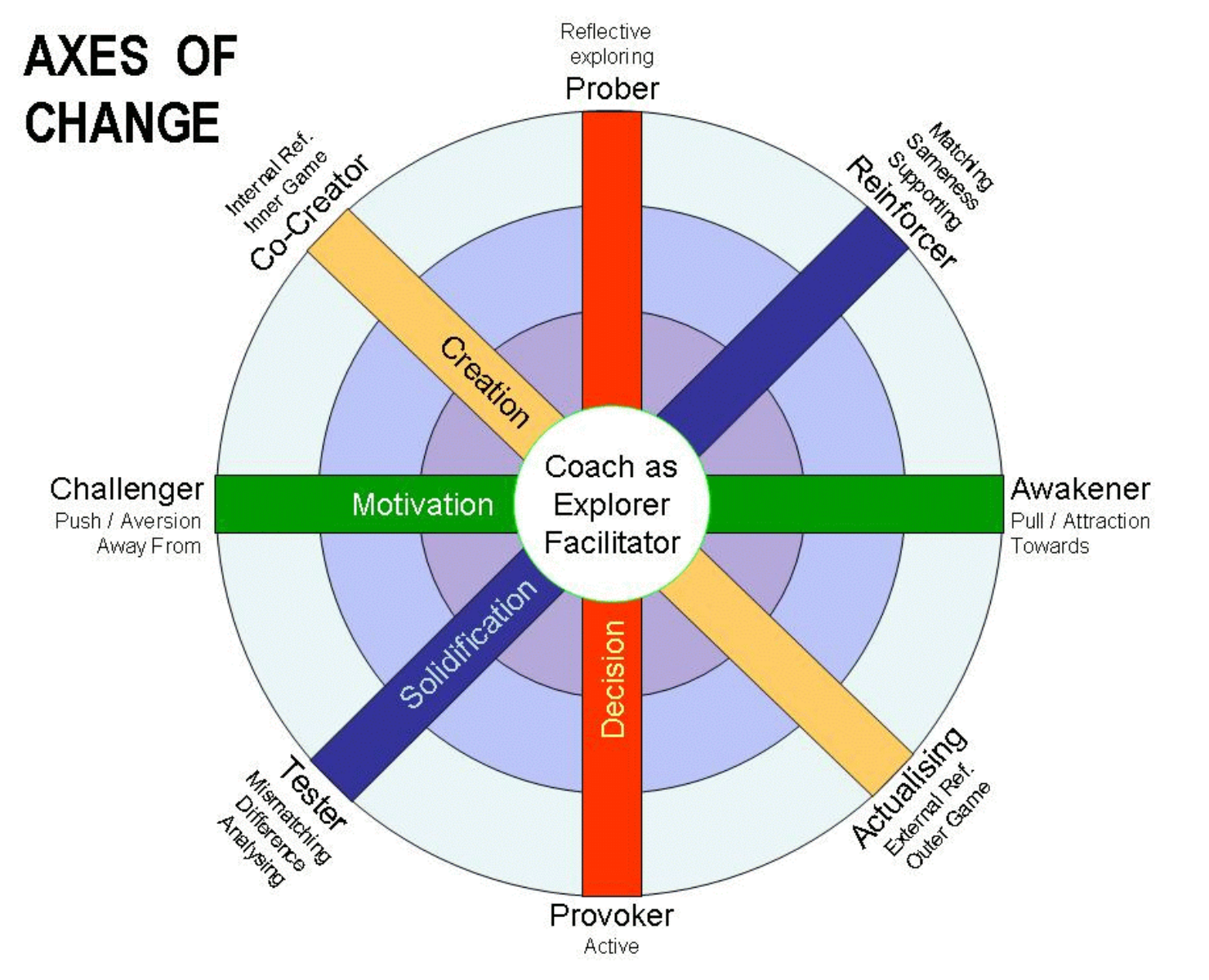
Coaching is about change, it’s about facilitating generative change at numerous levels and stages. As an effective change agent a coach needs to know the levels of change, the dance of change, the process of facilitating generative change, and have a change model that’s not based on therapy. There are numerous kinds of coaching and coaching skills based upon the kind of coaching that one takes on:
- 1) Performance Coaching: Enhancing skills and behaviors.
- 2) Developmental Coaching: Evolutionary change to beliefs, values and identity.
- 3) Transformational Coaching: Revolutionary change in purpose, direction and meaning.
Personal questions if you want to be a World-Class Coach:
- What are the levels, dimensions, and stages of change?
- What change model do you use in coaching?
- How skilled are you as a change agent?
- What skills have you developed for facilitating change?
- What’s the difference between a therapy change model of change and a non-therapy change model? Why is that important?
- Do you have the skills for detecting where a person is in the change process and for coaching someone through that level?
- Are you aware of the eight change roles that the Axes of Change provides for a coach?
Bateson’s “levels of learning / change” offers a model for the levels of change. Do you know those levels? The Axes of Change Model offers a non-therapeutic change model, actually the only one in the field of coaching. For coaches, this distinguishes the field of coaching from therapy and uses the premises of coaching to govern the operation of generative change.
In the field of coaching today, every coaching school that we have examined uses old therapy assumptions and change models. How can we tell? For one thing, every model assumes clients will resist change, think of change are “hard” and “painful,” and will almost inevitably relapse. Those statements are more true for people who need therapy and untrue for people who have moved beyond the deficiency needs into the growth or self-actualizing needs. Unlike the change-resisters, they are change-embracers. They don’t fear change, they long for it, plan for it, and desire it.
KEY #6: WORLD-CLASS COACHING FACILITATES THE SELF-ACTUALIZATION OF CLIENTS.
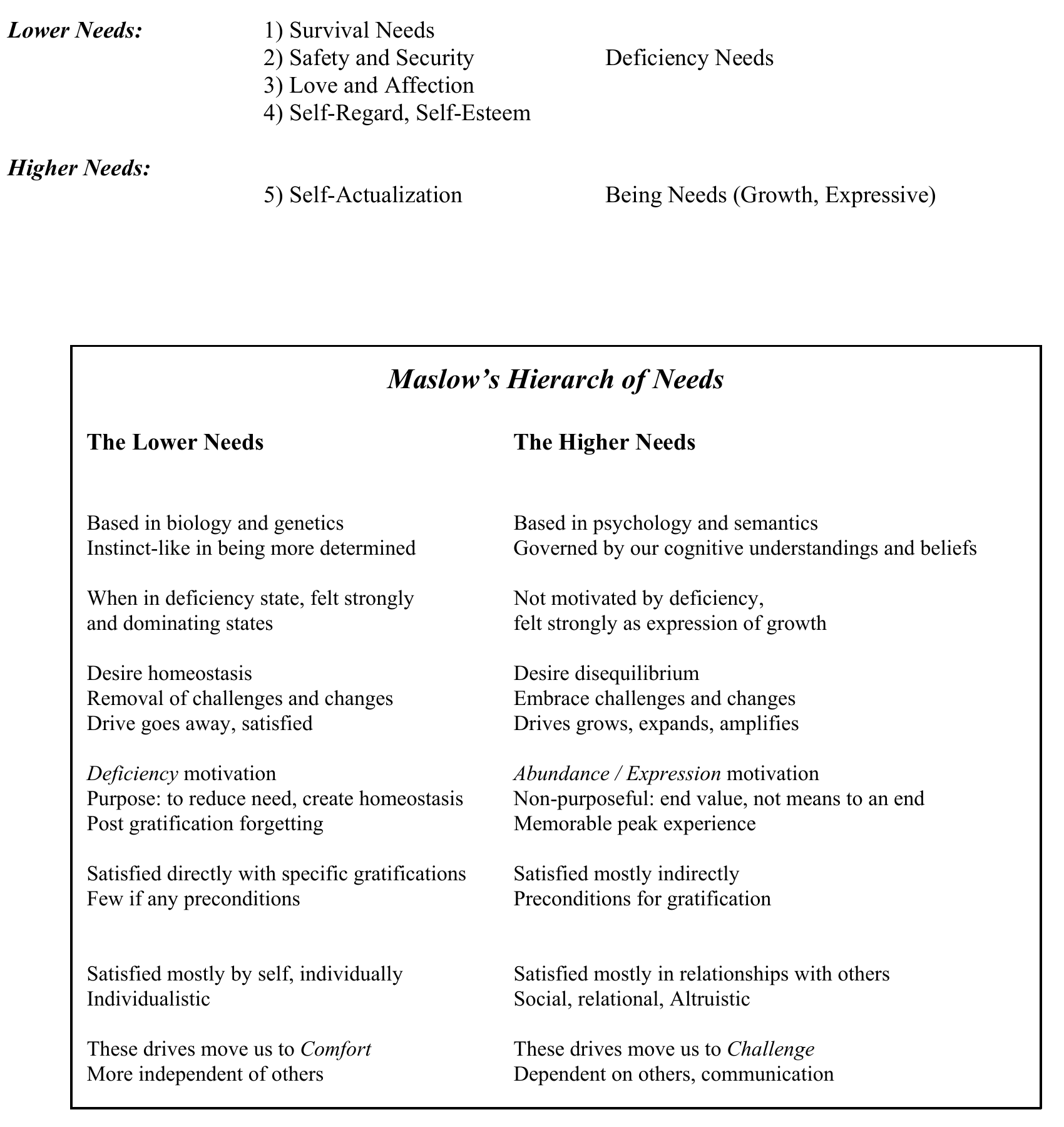
Because coaching is about generative change rather than remedial change, it is based upon and expresses self-actualizing psychology. This psychology addresses those who have move beyond the deficiency needs on Maslow’s hierarchy. Because coaching is for healthy people who want to realize or actualize their full potential, an effective coach knows and operates from a self- actualization model that provides insight about how to facilitate that kind of change and development.
Personal questions if you want to be a world-class coach:
- What kind of psychology is your coaching based on?
- Is it grounded in self-actualizing psychology for unleashing the potentials of healthy people?
- If so, how do you think of that and communicate it to clients?
- Do you ever do therapy and calling it “coaching?”
- What’s the difference in self-actualization and traditional psychology?
- What are the premises of self-actualization psychology?
Maslow shifted the psychology paradigm from a psychology of pathology to one of studying healthy self-actualizing people. People who operate from a higher or meta-needs—the needs of those who are seeking to express and actualize their potentials, rather than satisfy deficiencies, are those who are best suited for coaching.
KEY #7 WORLD-CLASS COACHES WORK SYSTEMICALLY WITH THE MIND-BODY-EMOTIONAL STATES OF CLIENTS.
Coaching, of all fields and professions, is about systems and about working systemically and holistically with the mind-body-emotion system. It’s for this reason that coaching so often focuses on the wheel of life and work/life balance, and taking an integrative approach to mind-and-emotions, the hard and soft skills, etc.
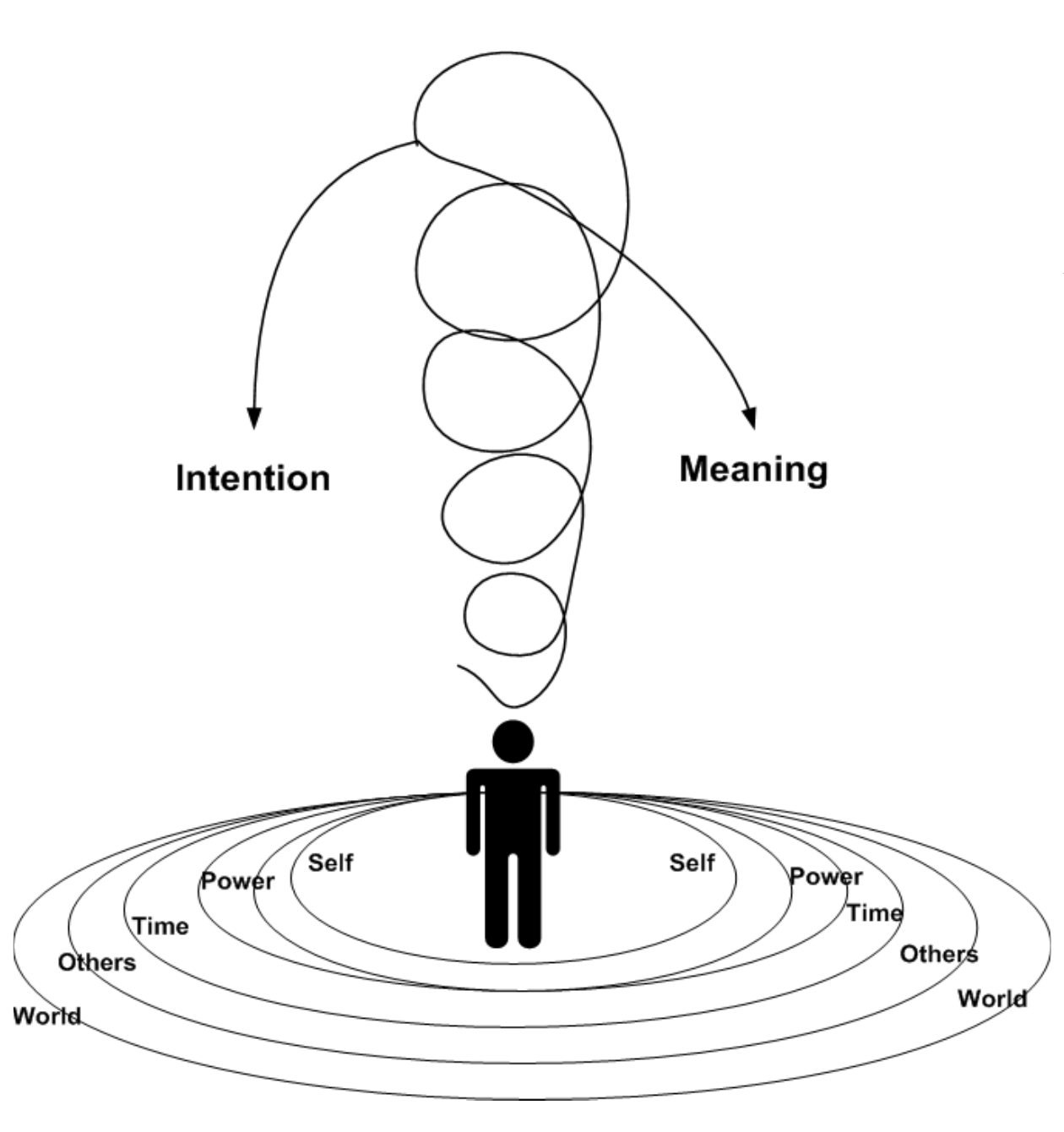
If coaching by definition works with the human mind-body system, then an effective and first-class coach will think and interact systemically. For this the Matrix Model gives the meta- coach a real advantage. The Matrix Model combines cognitive-behavioral psychology with developmental psychology to identify both the process and the content matrices that govern and determine our sense of reality. It also enables a coach to know how to “follow the client’s energy” as his or her mind-body- emotion system operates with its feedback and feed forward loops.
From the Meta-States Model, the Matrix Model was developed to provide even more structure about how we create layers upon layers of meaning which elicit our emotional states. From there we create specific content that we carry with us everywhere we go, content about our mappings of ourselves, our capacities, our relationships and sense of others, time, and the many universes of meaning that are out there.
Personal questions if you want to be a world-class coach:
- What does it mean to think and work systemically as a coach?
- What systems model embraces the entire mind-body-emotion system that you work with?
- How do you think about working with the feedback loop of information coming into the mind-body system and up the levels?
- How do you recognize or work with the feed forward loop of information transforming into the energy of emotions, language, and behavior?
KEY #8: A WORLD-CLASS COACH CONTINUES TO DEVELOP, IMPROVE, AND BENCHMARK HIS OR HER SKILL COMPETENCIES IN COACHING.
While on the outside, coaching may look like an easy and simple thing, just talking and asking questions, it is not as easy as it looks. High quality skills of listening, questioning, supporting, inducing states, giving and receiving feedback, along with many other coaching skills can be quite demanding. A professional coach will have taken coach specific training and been accredited in his or her development of the coaching competencies. In the Meta-Coach training system we have used a benchmarking process to specify precise behavioral measures and scale some 26 coaching skills which we then use to measure a person’s actual competency.
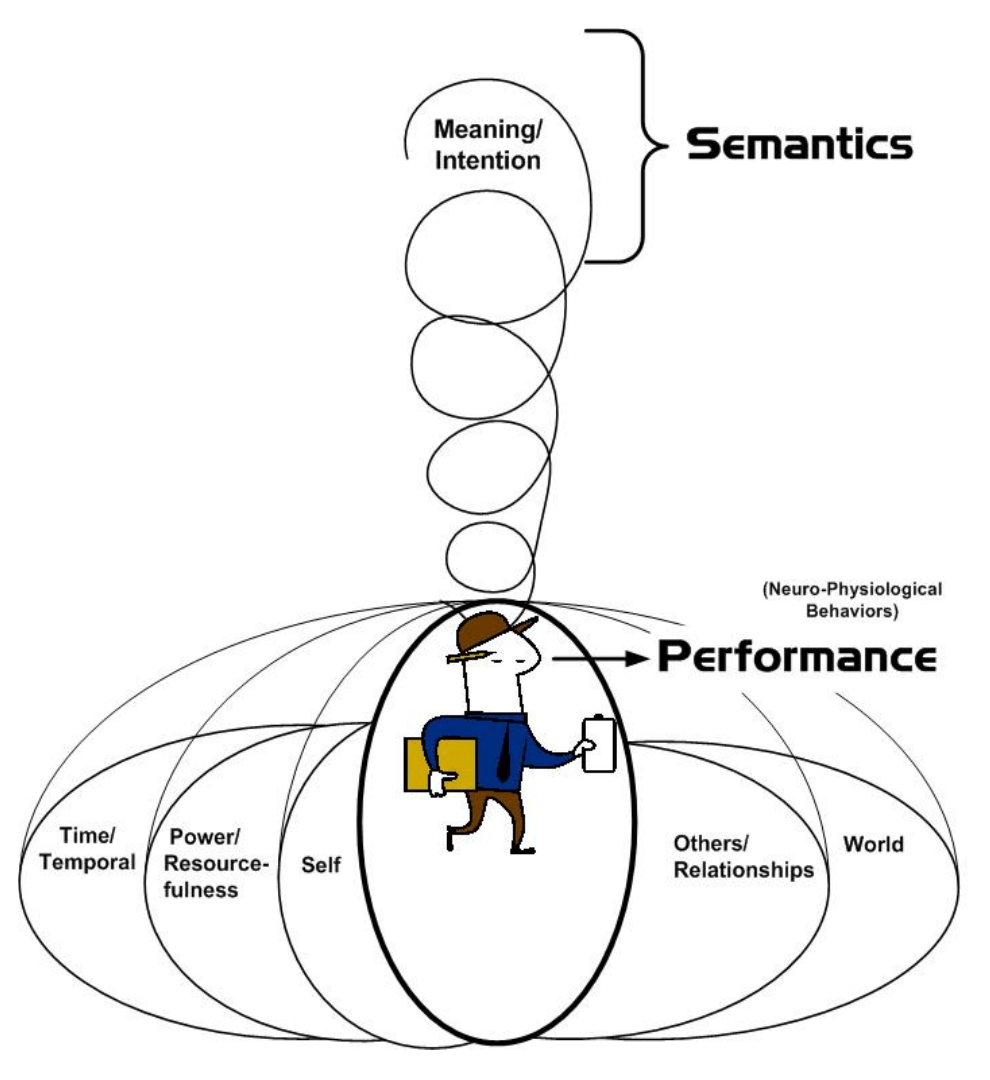
To facilitate the highest quality of skills, in Neuro-Semantics we use the Mind-to-Muscle pattern to close the knowing-doing gap as well as the Benchmarking model for both a tool in working with businesses and to apply to our coaching skills.
Personal Questions if you want to be a World-Class Coach:
- Do you have the competency of the core coaching skills to be effective?
- Have you achieved competency in specific core coaching skills?
- How do you know you are competent in facilitating change?
- Where are you as a coach on the competency scale with any given skill? How do you know?
- Do you know how to benchmark intangible skills so you can give concrete and specific behaviors to the skill?
- How many skills can you demonstrate a benchmarked competency to?
KEY #9: WORLD-CLASS COACHING RUNS A FINANCIALLY PROFITABLE BUSINESS
Coaching is first and foremost about the skills of communicating, working with change, a client’s mind- body-emotion system, and facilitating self-actualization, yet it is also about the business of running a coaching practice. To be effective in the marketplace, a coach has to market and sell him or herself, put on the business hat and create a viable office, and take care of the administrative tasks, billing, office environment, etc. A common occupational hazard of people entering this field is that while they are strong on their “people skills,” their business skills suck. In Meta-Coaching, we encourage coaches to complete a Matrix Business Plan and both coach to it and be coach to it so as to unleash the coach’s potentials for increasing one’s business intelligence.
Personal Questions to facilitation your successful practice:
- Do you have a business plan for your coaching niche, market, speciality, practice, etc.?
- Could you get a loan from a bank with your current Business Plan? Is it well-developed?
- Does it fit with who you are and excite you to make it happen?
- What coaching do you need to receive to create a practical and achievable business plan?
Summary
Coaching is about success. First, it is about empowering clients to become more successful in their personal, business, financial, and relational lives. It’s about mobilizing resources to unleash untapped potentials. For that reason, one of the best sources of credibility and personal confidence is to apply to self to receive coaching about how to coach effectively and how to run a successful practice. Second, it is about the coach’s own success.
In the Meta-Coach Training System® we work precisely to this outcome— empowering coaches to be successful themselves and to live in a network of coaching relationships that continually support their own growth and development. For more about Meta-Coaching, see our website, www.meta-coaching.org. Also www.equilibrio.com.au and www.neurosemantics.com.
KEYS FOR WORLD-CLASS COACHING
A world-class Coach —
- #1. Knows the heart of coaching and its boundaries
- #2. Is centered in a cognitive-behavioral methodology
- #3. Communicates effective in evoking states
- #4. Steps back to work with reflexive awareness
- #5. Facilitates generative change, not therapeutic
- #6. Facilitates self-actualization in clients
- #7. Works systemically with mind-body-emotional states
- #8. Keeps developing high skill competency in coaching
- #9. Runs a profitable business practice as a coach
Related source documents
These original public PDFs open on the legacy Neuro-Semantics website.