THE FIFTH DISCIPLINE THROUGH THE EYES OF SELF-ACTUALIZATION
For author Peter Senge (1999) “personal mastery” describes what we in Neuro-Semantics and Meta-Coaching call “self-actualization.”

 Share
Share



Reading preferences
Optional. Your reading and listening position stays in this browser, not in your public profile. Avoid enabling this on a shared device.
For author Peter Senge (1999) “personal mastery” describes what we in Neuro-Semantics and Meta-Coaching call “self-actualization.” I described that in the last Meta Reflection (#39). So with regard to this, Senge asks this question: “If a leader is intent on fostering ‘personal mastery,’ what can a leader do?” As you look at his answer, notice how it is all about creating a self-actualization culture in the business.
“They can work relentlessly to foster a climate in which the principles of personal mastery are practiced in daily life. That means building an organization where it is safe for people to create visions, where inquiry and commitment to the truth are the norm, and where challenging the status quo is expected— especially when the status quo includes obscuring aspects of current reality that people seek to avoid.” (p. 172)
But there’s a problem with this. The problem is that of needy leaders (not self-actualizing leaders). The problem is that of leaders needing approval, power, status and all of the other values and gratifications of the lower needs. So Senge, quoting from Robert Swiggett, retired CEO of the Kollmorgen Corporation, includes this quotation about “power” as an interference to creating a self-actualizing culture:
“In moving from the traditional authoritarian, hierarchical organization to a locally controlled organization, the single greatest issue is control. Beyond money, beyond fame, what drives most executives of traditional organizations is power, the desire to be in control. Most would rather give up anything than control.” (p. 290)
While this is a problem for leaders living at the lower needs, it is not a problem for self-actualizing leaders. Leaders who live at the level of self-actualizing see “power” not in terms of power over others, but power with others. Real power is not dictator orders or micro-managing the actions of others. Authentic power enables others to work together toward a common objective and equips people for making that happen as a collaborative effort. Authentic power is being able to achieve one’s objectives through and with others.
What energizes a leader to persist is truly believing in the self-actualization vision. And specifically, they believe in pushing power and decision-making to the contact points— the points where “the company” (e.g., the front people) meet the customers.
“Unless they believe that the quality of learning, the ability to adapt, the excitement and enthusiasm, and the human growth fostered by localness are worth the risk, they are unlikely every to choose to build a locally controlled organization. That is why localness is unlikely to endure unless it is an aspect of the organization’s vision.” (p. 291)
If “localness” is a new or strange word for you, it is the worrd Senge uses to refer to pushing decision-making, “control,” and power down the levels in the organization to where the action is, to where the people who implement the vision or provide the service works.
“Localness means unleashing people’s commitment by giving them the freedom to act, to try out their own ideas and be responsible for producing results.”
“People learn most rapidly when they have a genuine sense of responsibility for their actions. Helplessness, the belief that we cannot influence the circumstances under which we live, undermines the incentive to learn, as does the belief that someone somewhere else dictates our actions. Conversely, if we know our fate is in our hands, our learning matters.” (p. 287)
So again, while Senge does not use the term “self-Actualization,” he does constantly refer to the values and premises of self-actualization, especially about supporting the full development of people.
“Learning organizations enter into a new compact ... with its members. The essence of this compact is the organization’s commitment to support the full development of each employee, and the person’s reciprocal commitment to the organization.” (p. 311)
And why do they do it? Self-actualizing leaders do it because of who they are—they gain a deep satisfaction in empowering others and being part of an organization capable of producing results that people truly care about.
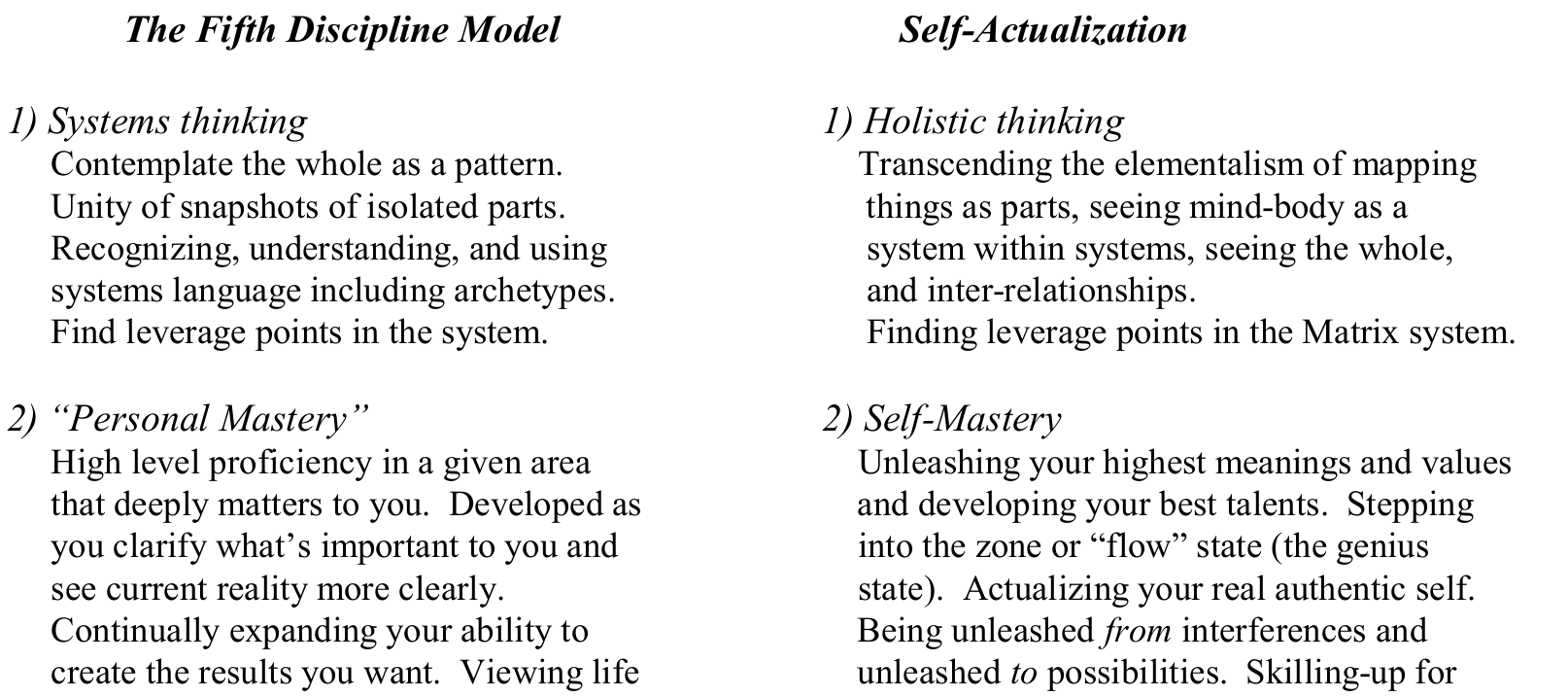
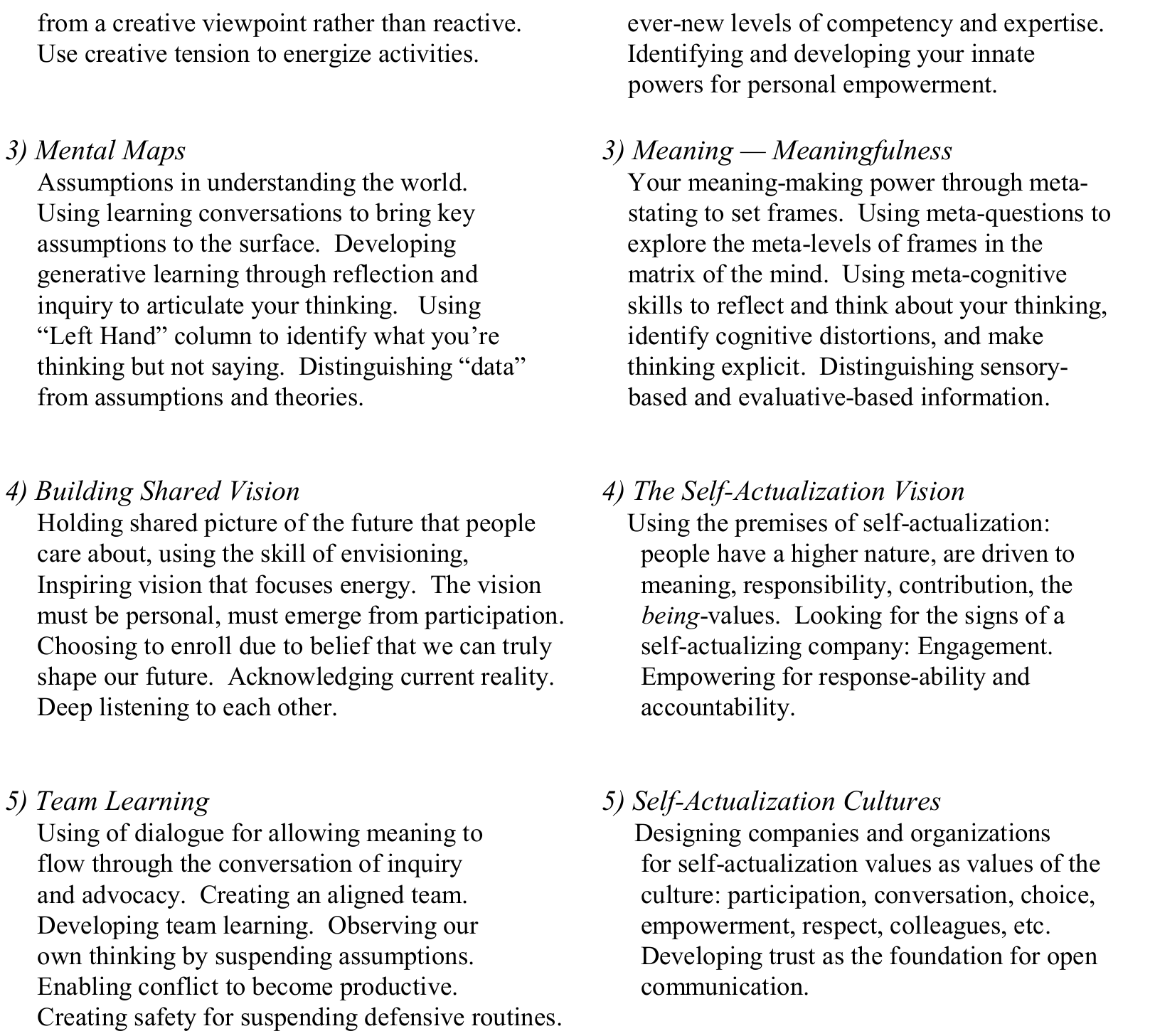
So here we have Peter Senge, back in 1990, writing about Self-Actualizing Leaders and Companies even though he did not use that terminology. As a comparison between what Senge presented and what we have in Self-Actualization Psychology — the hidden psychology of NLP and the explicit psychology of Neuro-Semantics and Meta-Coaching, here is a summary: