
THE META-LANDSCAPE OF YOUR MIND Part I
In Neuro-Semantics we have long been speaking about the land of Meta —Meta Land.

 Share
Share



Reading preferences
Optional. Your reading and listening position stays in this browser, not in your public profile. Avoid enabling this on a shared device.
In Neuro-Semantics we have long been speaking about the land of Meta —Meta Land. This is the space within your mind where you go when you use your self-reflexive consciousness. This is where you go when you “go inside.” It is where you go when you experience the hypnotic state of trance. This is the space that’s very, very special to us humans— the upper decks of your consciousness, the place where you “store” your conceptual framework about reality, and all of your beliefs about yourself, others, time, and the world. It is the space that we call your Matrix. It is all the thoughts “in the back of your mind.”
In fact, while the two co-founders of NLP have completely ignored this region of consciousness, it has primarily been Robert Dilts who attempted to do so. Studying the “logical levels and types” of Bateson, Robert created an elementary model some twenty years ago that he designated, the Neuro-Logical Levels. With it, he offered a list of belief distinctions along with how much each level affected one’s neurology. The biggest problem with the model is that it has not evolved, grown, or developed over the past twenty years even though Robert has.
Within the Neuro-Logical levels, the first three distinctions occur at the primary state level. 1) The ability or capability to act, 2) the behaviors that result and 3) the context of some environment are all primary state distinctions. Above that we get to the meta-level distinctions:
1) beliefs, 2) values, 3) identity, and 4) spirit.
Over the years, numerous writers in NLP have shown that the Neuro-Logical levels is not actually a “logical level” system, and certainly not hierarchical. Wyatt Woodsmall was the first to do so, showing that Environment is not a member of the class of Behaviors. Inside the class of behaviors, we do not put environment. Behaviors are not more psychologically "encompassing and impactful" than Environment.
Environment is a larger phenomenon than Behaviors. Even though behaviors may effect environment, behaviors do not drive or modulate Environment as the term "logical levels" suggests. Yet this model did encourage the thinking of many other NLP trainers about the meta landscape.
The Dilts’ list does provides a useful laundry list of items as a checklist regarding beliefs. After all, in Meta Land it is beliefs all the way up. And Robert Dilts has structured the levels to correspond to the basic indexing questions of where, when, who, what, why, etc.
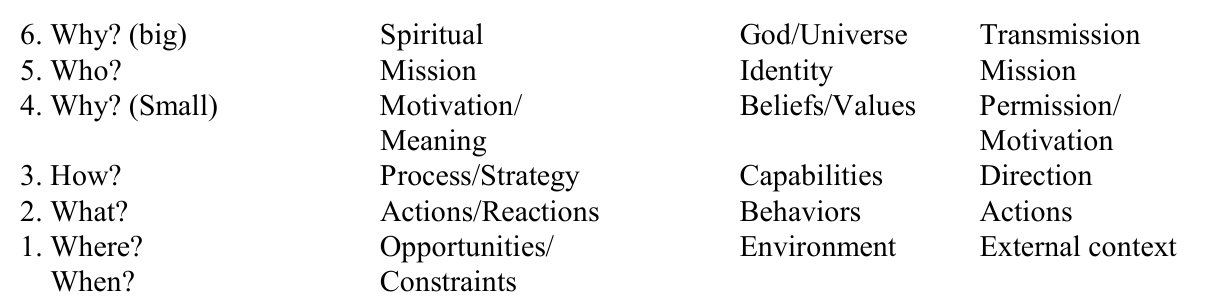
Robert (1990, Beliefs) has also noted the relationship between the landscape of Meta Land and what occurs at the lower levels of our neurology. "These different levels each bring a deeper commitment of neurological 'circuitry' into action." (p. 210). That’s due to the feed forward communication loop (as noted in Meta Reflection #8).
Given this we can now step back and explore the contributions that Robert Dilts has made to our understandings of Meta Land. Not only did he initiate the first NLP mappings of this area, but he relied heavily upon Gregory Bateson’s work on logical levels. Robert highlighted that this is the land of beliefs —beliefs about our abilities, behaviors, and environment; beliefs about our values, beliefs about ourselves, our identity, our sense of self, and beliefs about our purpose and mission.
This means that the landscape of Meta Land is the landscape of beliefs. No wonder this area of mind works so differently from the outside world. Bateson contrasted the two as “the world of physics and the world of communication.” And in the world of communication, what you “believe” and say has tremendous influence unlike the effect of words and beliefs in the world of physics. Here the mechanism of a self-fulfilling prophecy works. Here we metabolize our ideas so that our ideas become self-organizing frames. This refers to how our mind-body system is always seeking to actualize what we think. It may or may not succeed at it, but it seeks to “make real” inside us and then outside us the messages we send our neurology.
No wonder we have to be careful what we believe. If we get a thought-virus installed in our thinking or live by old antiquated beliefs, especially beliefs that are limiting, diminishing, or even toxic and morbid, this can create all kinds of things, from illness, diseases to self-sabotaging behaviors and even destructive and pathological states.
Meta Land — the place where you live most of your life. There’s more to write about it, so till next week, may you assume the full powers of your creativity and make the landscape of meta in your mind-body system a wonderful place to live!