
THE META-STATE OF RESILIENCE Part III: Creating Resilience
To be resilient, you have to have something with which to be resilient.

 Share
Share



Preparing your audio…
You can keep reading while we get it ready.
- Waiting to start
- Creating audio
- Checking recording
Waiting to start
Audio ready
Tap Play to start listening.
AI-generated narrationListen at your own pace
Listen to this article
 Listen to this article
AI-generated narration
Narration covers the article text on this page. Linked documents and illustrations are not read aloud.
0:00--:--
Enable JavaScript to listen, or read the complete article below.
Reading preferences
Optional. Your reading and listening position stays in this browser, not in your public profile. Avoid enabling this on a shared device.
To be resilient, you have to have something with which to be resilient. That’s because resilience requires resources which give you bounce for generating the meta-state of resilience. Given this, the question is: How do you build this state for yourself or for others?
It all begins (as I mentioned in Part I of this series) with avoiding contaminating your spirit with the “learned helplessness” that brings the bad or evil thing “out there” inside yourself. And that means setting boundaries for yourself so that you interpret the set-back as 1) external and not about you, 2) local and not pervasively everywhere, and 3) now and not forever. That’s step one. Do this and you create a proactive core within yourself that enables you to operate from a non- victim role, one that enables you to look for resources and to focus on solutions.
Step two emerges as you recognize that the set-back is not forever, it is just a matter of time and, “This too will pass.” Knowing that, you set a higher frame and then know at your deepest level, “I will get through this.” “It’s just something to deal with.” Do this and you create the space and freedom within yourself for accessing the resources you’ll need to pull this off. Then it is just a matter of how to get through it, how to cope with the losses, and how to replace them appropriately. All of this implies meta-stating yourself with acceptance of life as it is and a problem-solving mentality that goes to work on addressing whatever has been lost or set-back.
Next, ask the “bounce” question: What puts bounce in your soul? What enables you to come back with energy, enthusiasm, excitement, and commitment? As you now develop your own personal menu list of resources that do this for you— you are developing your strategy for coping and mastery the challenges of life. Here is a list for identifying the energizers of resilience within you:
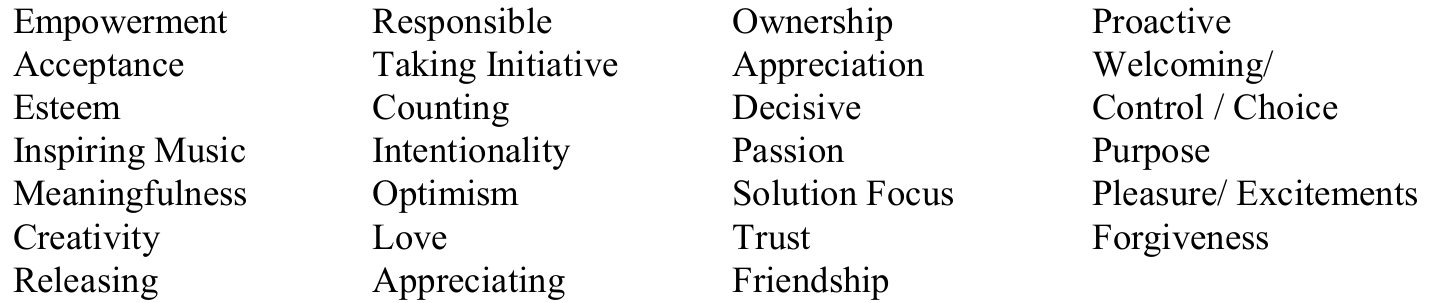
What’s on your list of best resources that puts the most energy and bounce into your soul? Identify them and then take the time to access each, amplify it to the optimal level for you, then set up a trigger (an anchor) so that you can re-access that resourceful state of thought, emotion, or body whenever you so desire.
At the heart of resilience is being in real-time, that is, being in-the-moment, and experiencing life here-and-now. So key to resilience is being present to this moment. Yet you could interfere with this present-ing. You could sabotage it through resentment (re-sentiment, feeling the old sentiment again and again), holding onto the past, and/or living in bitterness or resentment. Do any of these things and you have a fool-proof way to avoid the vitality of resilience. Obviously, not recommended!
In NLP we have a saying about the past: “It’s never too late to have a happy childhood.” That’s because whatever memories you are carrying around from the past and using as your reference system for today is precisely that— something you are doing today to keep your representations of the past alive in your body. Now that you know, stop it! Change those representations. Use the “Change Personal History” pattern and create a new and more useful past to keep within you and to use as your reference.
Are you ready for resilience? Are you ready to take charge of your mind and heart and not let some set-back set the frame for your future? Resilience is not a simple primary state like love or hate, tension or relaxation, anger or fear, etc. It is a meta-state and so layered with numerous belief frames and resourceful states.
Want more? Great.
See the foundational book for Neuro-Semantics, Meta-States: Mastering the Higher Levels of the Mind (2008) or the Training Manual, Resilience. Or contract with a Meta- Coach!