
THE STILL SHOCKING TRUTHS ABOUT SUB-MODALITIES
While presenting APG in Israel, several NLP Trainers constantly asked me about my view of Sub-Modalities.

 Share
Share



Reading preferences
Optional. Your reading and listening position stays in this browser, not in your public profile. Avoid enabling this on a shared device.
While presenting APG in Israel, several NLP Trainers constantly asked me about my view of Sub-Modalities. “How can you say that they are not sub-modalities, but meta-modalities?” With two of them, I went over the arguments over and over before they got it. The thing that finally convinced one of them was the very description of sub-modalities in the NLP books. I asked him to bring me some NLP books that he had which would have a passage or a chapter on sub- modalities, then we could look at how sub-modalities are described. To his surprise, the so- called sub-modalities are described using the meta-language so that the so-called sub-modalities were described as “nominalizations,” “concepts,” “categories,” and “generalizations.” He was stunned. What is a so-called sub-modality? Typical statements that we found were these: If a visual image or picture is close or far then that is the distance sub-modality. When you have a sound, it can be loud or quiet, so the volume of the sound is a sub- modality. A sub-modality may be digital, either you are in the picture or out of it, or it may be analogue like fuzzy or clear to varying degrees. In the first case, associated or disassociated, in the second clarity of the image. “...the degree of pleasure you have in that memory is a direct consequence of the color, size, brightness, and distance of the visual image you hold in your mind’s eye.” (An Insider’s Guide to Sub-Modalities, p. 2) “Learning to manipulate the sub-modalities (like color, focus, size, distance movement, pitch, volume, location) is the first step in developing the flexibility to control your internal states” (Insider’s Guide, p. 18)
Given these statements, what can we conclude? The authors are constantly confusing a detail like “close” with the category that it is a member of, “distance.” Distance is not sub-distinction of anything, distance is a generalization. You can’t see “distance,” it is a concept. You cannot put distance in a wheelbarrow (the nominalization test of NLP), so distance is a nominalization. So with volume. It also is a nominalization, a concept, and a generalization. You can record volume. You can record a sound at a particular decibel, but not volume. And the same thing applies to the concept of association and clarity. None of these so-called sub-modalities are “sub” to anything.
Funny, isn’t it? NLP people talk about sub-modalities using meta-level concepts. You will find this everywhere in NLP literature. Why? Because we are actually not dealing with smaller components of a movie, we are actually operating at an editorial level. This is the level at which you consider the movie that you are representing and then start noticing how you have automatically coded the movie. Noticing gives you an awareness of your representational code and with that awareness now comes choice. How would you like to code (i.e., choose the sub- modality distinction) for your movie?
In an excellent book, Introducing Neuro-Linguistic Programming (1990) by O’Connor and Seymour the list of sub-modalities are listed as follows. Can you put any of these distinctions in a wheelbarrow? If not, then we are really talking about a meta-level distinction. What has been called sub-modalities are nominalizations and if so, then we know that we’re not dealing with sensory-based descriptions, but generalizations and categories.
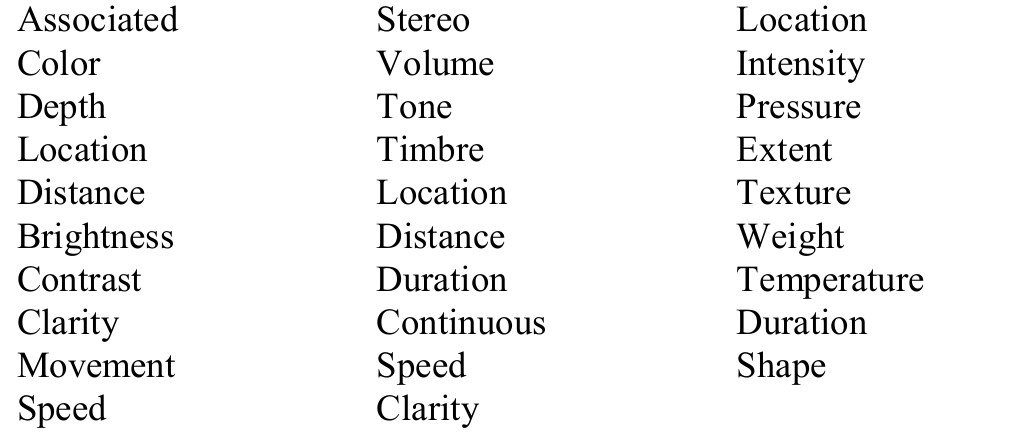
Amazing! The so-called “sub-modalities” are described by words that are nominalizations and generalizations all. This is why we (Bob Bodenhamer and I) wrote in the book, Sub-Modalities Going Meta (1999, 2005) that you have to “go meta,” you step back and notice your code. You have to do that just to become aware of sub-modalities. The code of your representational system comes with some cinematic distinctions— first notice them, then choose the ones that will be enhance your life.
Now whatever cinematic distinction you choose to use in your movie code, that distinction in itself means nothing. It only means whatever meaning you give it. Again, that’s why we noted back in 1997 that the so-called sub-modalities work semantically. They work symbolically by the semantics that you give them. If you treat distance as meaning “less real” and “less compelling” then when you code a picture with distance, you experience it in that way. If you didn’t construct that meaning, the coding would not be felt in that way.
When you take a “sub-modality” distinction and notice that it is a nominalization which indicates a category or classification, then you have to follow up by asking, “What is the standard? What is the measurement code and/or units that you are using?”
The category of duration is said to be short or long. But short and long are also nominalizations! How are you measuring “short” or “long” by minutes, days, years, centuries? Is 30 days “short?” By what benchmarks? May 30 minutes is “long?” The category of speed is slow or fast, also needs a measurement standard and benchmark so we can tell if 100 miles-an-hour is fast or is it slow. It is “fast” if we are talking about driving a car or running. But if our benchmark is the speed of light (186,000 miles a second), the 100 miles-an-hour is incredibly slow. This holds true for every so-called sub-modality. The distinction is actually a meta-modality which is why we call them cinematic features of our movies and intimately related to meaning and, in fact, multiple levels of meaning.