
THE VICTIM — RESPONSIBILITY META-PROGRAM
After last week’s post (#8) about the relationship between complaining and responsibility, I began entertaining the possibility of the idea that a person in the mind-set of complaining have it as a perceptual filter.

 Share
Share



Preparing your audio…
You can keep reading while we get it ready.
- Waiting to start
- Creating audio
- Checking recording
Waiting to start
Audio ready
Tap Play to start listening.
AI-generated narrationListen at your own pace
Listen to this article
 Listen to this article
AI-generated narration
Narration covers the article text on this page. Linked documents and illustrations are not read aloud.
0:00--:--
Enable JavaScript to listen, or read the complete article below.
Reading preferences
Optional. Your reading and listening position stays in this browser, not in your public profile. Avoid enabling this on a shared device.
After last week’s post (#8) about the relationship between complaining and responsibility, I began entertaining the possibility of the idea that a person in the mind-set of complaining have it as a perceptual filter. And if so, then similarly the mind-set of responsibility could also be a perceptual filter. We already have one meta-program about responsibility (Figuring Out People, #53 Degree of Responsibility). That meta-program addresses the degree of responsibility, this one contrasts responsibility with its opposite– victim thinking and perceiving. What would this meta-program would look like, sound like, and feel like in actual responses and behaviors?
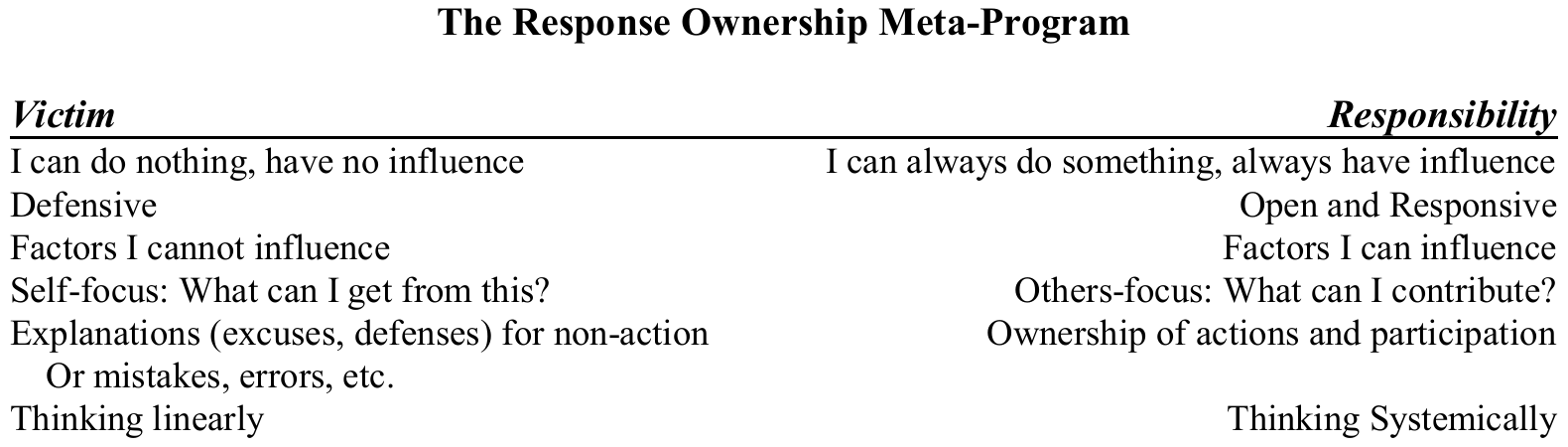
On the Victim side of the scale a person thinks and feels, “There’s nothing I can do about this! I cannot influence any of the factors that make up the experience. I can’t. It’s beyond me, someone else has to do this.” Thinking in terms of dis-empowerment puts the person in a passive victim role— receiving the actions of others, of circumstances, of culture, of history, etc. “They make me... think, feel, and experience what I do.” Given this, the person is always looking for external reasons and explanations for what causes things to occur. The person does not put oneself into the picture as if an actor in his or her own life.
On the Responsibility side of the scale a person thinks and feels precisely the opposite, “I can always choose my response; I can always do something. There are factors that make up the experience that I can influence.” Thinking in terms of empowerment puts the person into the role of Actor and Architect of his or her life. Viktor Frank described this attitude in his book, Man’s Search for Meaning.
“We who lived in the concentration camps can remember the men who walked through the huts comforting others, giving away their last piece of bread. They may have been few in number, but they offer sufficient proof that everything an be taken from a man but one thing: the last of human freedoms—to choose one’s attitude in any given set of circumstances— to choose one’s own way. ... It is this spiritual freedom—which cannot be taken away—that makes life meaningful and purposeful.” (p. 75)
As a meta-program, each perspective provides a different lens through which to look at things. As a perceptual filter, dis-empowerment thinking means that the person pays attention and focuses on what he cannot influence. So he blames. She accuses. He explains. She adopts this as her explanatory style as a response style. Rather than being an under-responsible pattern, it is an anti-responsibility pattern.
As a perceptual filter, empowerment thinking means that the person is paying attention and focusing on the factors that she can influence. He looks around and takes the full context into account. She identifies the things that she can do and distinguishes the things to accept and the things to change. Thinking systemically, he knows he is a part of the system and therefore always, to some extent, responsible. While this is bad news to one with the victim-filter, this is good news for this pattern. That’s because if you are a part of the system, you can do something to influence it. Being part of the problem means you can be part of the solution!
Each pattern experiences and treats explanations in a different way. The victim-filter leads one to think that an explanation releases one from responsibility or the need for action. This has the effect of multiplying explanations. The victim-filter increases the perceived value of explanations, reasons, and justifications. Yet some explanations are not only worthless, but positively sabotaging of one’s ability to influence the direction of one’s life.
Consider what happens when your phone rings. Some people pick it up and answer it when it rings and then explain that they had to answer it because it rings. This probably sounds reasonable, at least on the surface. Yet that is deceptive. When you answer your phone, you do so not because it rings. The ringing is just a trigger. You answer it because you want to answer it. You answer it because you choose to answer it. You always have a choice. No one has to answer it. You can let it ring, can you not? Or, you can turn it off.
Other explanations may be true as far as the facts go, but they do not lead to any useful response. Suppose a glass of orange juice falls from your breakfast table. You say, “Opps, the juice fell and spilled on the floor.” Well, yes, it “fell,” but why? “Why did the juice spill?” “Gravity!” Yes gravity played a roll in the experience. If there was no gravity, the glass may have been knocked down but it would not have spilled. It might have floated away. But the explanation that gravity caused it does not help. It gives us nothing practical that we can do. Knowing that solves nothing. There’s nothing you can do about gravity. Conversely, recognizing that you didn’t pay attention to the glass, that you moved too quickly and jarred the table, or that you threw your coat and it hit the glass—those explanations give you something to do to prevent future problems. And that should be the design of any and every explanation. That’s why people who have a responsibility-filter think about explanations.