THERE’S META-STATES HIDING IN YOUR EVERYDAY LANGUAGE
When you know how meta-states manifest themselves, you will discover that they are everywhere in your life— and in the lives of everyone around you.

 Share
Share



Reading preferences
Optional. Your reading and listening position stays in this browser, not in your public profile. Avoid enabling this on a shared device.
When you know how meta-states manifest themselves, you will discover that they are everywhere in your life— and in the lives of everyone around you. Why is that? Precisely because of the special and unique kind of human consciousness (self-reflexive consciousness) is dynamically active every moment of our lives. And that means that you never just think and leave it there. Ah, if only life was so simple! No, you think and then you think about your thinking. And then about that thinking- of-thinking. And that’s not the end of it. There’s yet more after that. You feel about your thinking, you think about your feelings, and you do so level upon level upon level.
Okay, so good for theory. That’s the theoretical framework for understanding how the layering of self-reflexive consciousness works. But how does it show up in our lives? How does it show up in your life? Ah, this is actually where the magic occurs.
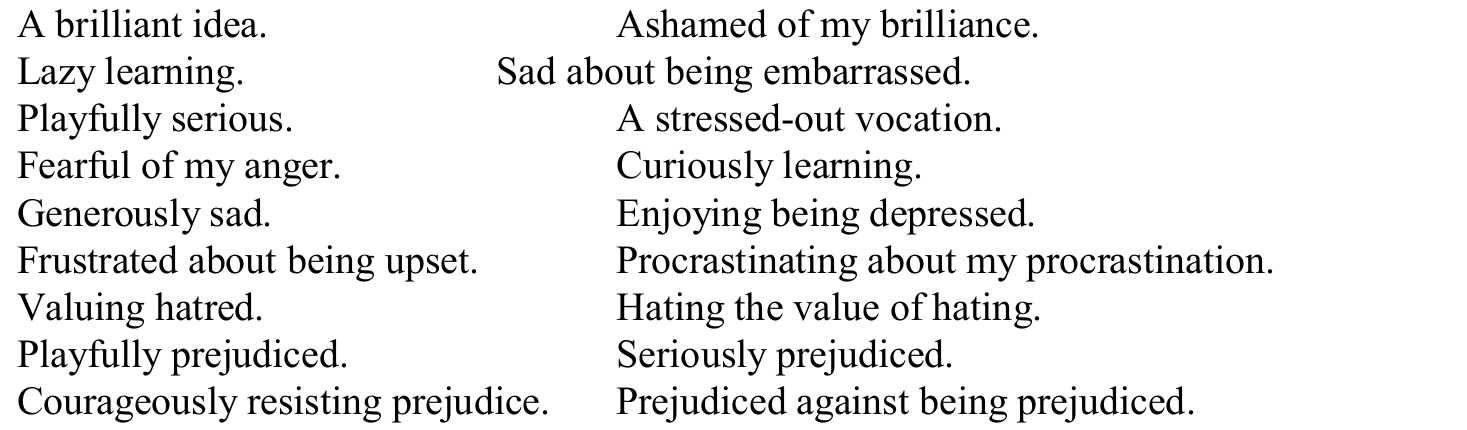
When you bring one state to another state in your thinking-and-feeling, you texture the first state with the second. Bring joy or fun or delight to your learning and you create a layered experience— joyful learning. What’s the quality of that learning? Joy. You could bring impatience for impatient learning. You could bring seriousness for serious learning. Whatever state you bring to the state of learning (the first state), that second state textures it, qualifies it, and sets the frame for it.
And if you noticed — this shows up in language: joyful learning. In grammar, this is an adjective, it could just as well be an adverb, joyfully curious. Here then is one place where meta-states hide. Today I supervised and benchmarked a coaching session. The client wanted a change in his concentration. It was too intense. He said he wanted to be less stressed because he is good at focusing, but then when he gets focused, it’s too much. His head starts to hurt, he gets headaches. So eventually talking it out, he said “I just want a relaxed concentration.” Ah, there it is. A meta- state and one hidden in language.
Along this line, in an article in Rapport: The Magazine for NLP Professionals (London), Joe Cheal wrote an article that he titled, “The Impact of Language” (2012/2013). There he wrote and described primary and secondary qualities.
“Primary qualities are said to be the qualities that something has that are ‘independent’ of a perceiver. This might include shape, solidity, movement, and location. Psychologically, these primary qualities are what we experience when we imagine nouns and verbs.” “Secondary qualities are dependent on a perceiver and are more about our own personal experience of the thing/relationship. This might include color, brightness, focus, and loudness. Secondary qualities tend to be more descriptive, adding detail to the framework of primary qualities. Secondary qualities are akin to adjectives and adverbs and are likely to be more comparative and subjective than primary qualities.” (p. 24) “Adverbs describe the quality of the verb and hence will likely affect the internal representations.” He illustrates with ‘quickly’ ‘comfortably, disastrously, curiously.
I wrote to Joe and noted that he had just described how meta-states show up in language in these secondary qualities. And that as qualities that we bring to our experiences in the world, what we had always assumed were sub-modalities are actually meta-modalities. After all, “color, brightness, focus, and loudness” are not things, they are all nominalizations of the categories that we invent in our minds as concepts. Blue as a color arises from how our eyes interpret the light that strikes our eyes. But “color” is a concept, it is not red, or brown, or yellow, or any color; it is a category of these colors.
“Secondary qualities are akin to adjectives and adverbs and are likely to be more comparative and subjective than primary qualities.” (p. 24)
Yes, and that’s because we invent these qualities and then frame the primary qualities or events with them. Translated: We meta-state experience. And we do it every single day. Yet most of the time, we never notice. But you can. What meta-states have you heard today?
References: [email protected] NLP Master Trainer. Rapport: The Magazine for NLP Professionals. article “The Impact of Language” Joe Cheal, Winter (2012/2013)
For more about the language of Meta-states, see the Book, Meta-States: Managing the Higher Levels of the Mind (2005) in both paperback and hardback. Also, Secrets of Personal Mastery (1997).