
THINKING IN UNCERTAIN TIMES
Thinking itself is challenging enough.

 Share
Share



Reading preferences
Optional. Your reading and listening position stays in this browser, not in your public profile. Avoid enabling this on a shared device.
Thinking itself is challenging enough. And it is not easy. That’s because most of the time we are not actually thinking, we are only mentally reacting. We are talking “off the top of our head” quoting things we already know, politically correct bullet points, and from our biases. In Executive Thinking (2018) you can find six stages of non-thinking which occur before real thinking occurs. Given that, then add uncertainty. Thinking in uncertain times and with uncertain information— wow, that is an incredible challenge!
Consider the thinking that’s been going on regarding the Covid19 virus. Even though President Trump closed travel to China in January, the information from the CDC and the World Health Organization at that time was that the virus could not be passed from human to human. Later in late February, Nancy Pelosi criticized Trump for shutting air travel from Europe and telling people to “come to Chinatown” there’s nothing to fear. Later the CDC predicted two million Americans would die if the President didn’t shut the country down to slow the spread and that was to prevent the hospitals and health care system from being overwhelmed.
Since then we keep getting all sort of conflicting information about masks, treatments, social distancing, vaccines, etc. There have been lots of inaccuracies and disinformation and perhaps lies. The Governor of California has been over-zealous in forbidding people to go to church to pray while ridiculously tolerant for allowing protests and riots. Dr. Anthony Fauci, who the media looks to for expert answers, has changed his recommendations 180 degrees over those months. Lots of uncertainty!
So given all that ... how are you and I to engage in clear, rational thinking in contexts of such confusion and uncertainty? Ah, that is the question! Multiply that insecurity, that not-knowing- what’s-going-to-happen times the economic insecurity, the loss of jobs, the decline of the economy, the not-knowing-when-we-will-get-back-to-normal— and what do you have? What we have is the best conditions possible for irrational fearful thinking. And to a great extent, that’s what we’re getting.
Up against all of that then imagine that a couple of outrageous racial incidents occur— as we did at the end of May. Then suddenly, the people who have been “locked up” at home, fearful, insecure, confused, and irrational turn into destructive riots that burn, loot, and destroy. Then that irrationality gets the “bright idea” that all police everywhere are the problem and so the “defund the police” irrationality. Talk about the lack of clear thinking! Talk about the lack of critical thinking!
And as if all that wasn’t bad enough, add in the fact that it is political season when millions cannot think straight or clear anyway, but only through the lens of their political agenda.
Further, some elected officials seem unable to put sanity before party affiliation. The call for Police Reform was lead by an African American Senator, Tim Scott, yet it was rejected outright even though 80% of the reforms is precisely what the democrats say they want. Why? Apparently to have a political issue for the fall. Party comes before doing what’s right.
All of this gives us a formula and what a formula it is!
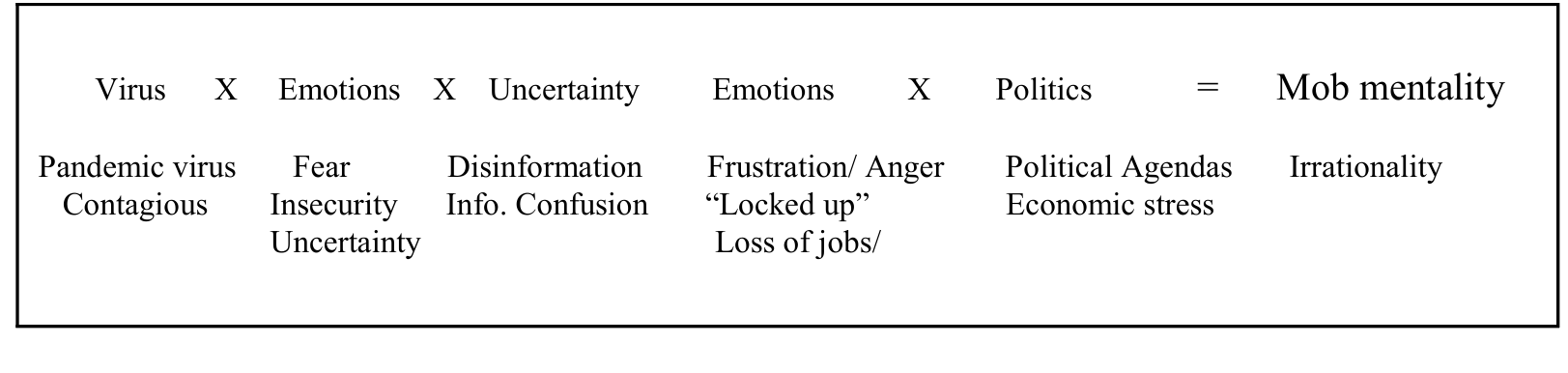
No wonder it is next to impossible for there to be reasonable conversations by reasonable people. I’m talking about people who have the skills to listen to each other, “seek first to understand and then be understood,” and bring compassion into the dialogue. It is much, much easier to think things through when all is calm, peaceful, and secure. It becomes increasingly difficult to think clearly when things are stressful, chaotic, and insecure. Yet that is precisely when we most need the understanding and skills for collaborative conversations.
What can we do? What can you and I do? Since all change always begins at home— each of us has to first “be the change that we want to promote.” That means learning to access a state of inner peace and security within ourselves. Like everything else human, it is inside-out. Then we need to learn the principles and skills of collaborative communication. The good news is that this is precisely the domain of Neuro-Semantic NLP. This is what we most essentially do.
With the NLP Communication Model, you learn how to handle language and non-verbal conversations effectively so you can be clear and precise. That’s “critical thinking.” You learn how to be reasonable by learning how to listen from a state of rapport. You learn self-communication by which you get yourself in a good state so that you can listen, care, be clear, be creative, and solve problems. You learn to both embrace and manage uncertainty so you can handle it effectively.
For more, www.neurosemantics.com Click Writings > Neurons Compiled Meta Reflections
For Executive Thinking – click www.neurosemantics.com/products/executive-thinking/