
THINKING SYSTEMICALLY FOR ACTUALIZING YOUR HIGHEST AND BEST
There’s no more extensive theme in The Fifth Discipline by Peter Senge than thinking systemically.

 Share
Share



Reading preferences
Optional. Your reading and listening position stays in this browser, not in your public profile. Avoid enabling this on a shared device.
There’s no more extensive theme in The Fifth Discipline by Peter Senge than thinking systemically. For Senge, this is the secret for enabling ourselves and our companies to overcome the learning disabilities of the cognitive distortions. Senge devotes Chapter 2 to “the learning disabilities” in which he lists some key cognitive distortions to systems thinking. To clean up those distortions and disabilities, he presents in Chapters 3 and 4 about how to use systems models for thinking and working systemically.
For Senge, to think systemically is to think structurally. It is to ask, “What is the structure?” And while that’s challenging enough with static structures—blueprints for houses, planes, pipelines, etc., it is a hundred-fold more challenging when we seek to understand and model dynamic structures. This refers to those structures that move, that involve movement, life, growth, and change. Senge defines systemic thinking as seeing the whole, seeing the inter-relationships and connections, looking to the consequences, thinking in circles or spirals, and mapping out how multiple sets of variables influence each other over time.
Senge also stresses that oftentimes it is the system itself that creates troubles and problems in organizations, and equally a system can also make it easy to create solutions. In a complex living system— “structure” is how we form and structure our thinking, feeling, deciding, relating, which is based on how we structure/ form our premises, understandings, beliefs— how we construct the way we create meaning.
Regarding human systems like organizations and companies, there are many subtle influences. These hidden and subtle influences often arise from our beliefs and premises about ourselves and human nature. Then they are normed into rules and policies— standard operational procedures that become a “system” of control. In Neuro-Semantics we call these premises and beliefs— frames— frames that create limitations, instability, and sabotage. And the subtlety also arises from the fact that we are part of the system— we’re inside and often cannot see the system itself.
And of course, in Neuro-Semantics the most basic systems model that we use for coaching, training, and modeling is The Matrix Model. As a systems model, the Matrix enables us to see the whole and the interconnectedness of our process and content information. It enables us to track our frames of mind and how they set up the governing factors for our emotions and responses. In Meta-Coach training, one of the “conversations” we teach is how to “follow the client’s energy” through his or her system. There are several skills involved in that. Central among them is learning to see and hear “frames” and bring them to a client’s awareness and to then invite the person’s self-reflexive mind to respond to it yet one more time.
When you can follow yours or another’s frames, thinking in circles or spirals, you can begin mapping out how the multiple sets of variables in the back of someone’s mind and how they influence each other. This will enable you to see how belief frames influence decision frames which influence understanding frames, which influence permission, expectations, identity, and so on. And this kind of systemic thinking and working plays a central role for anyone who wants to actualize his or her highest and best. It is essential for detecting our frames, getting leverage for change with those frames, and developing more empowering frames for unleashing potentials. All of this is very familiar for those who know the Meta-States and the Matrix Models.
What surprised me afresh was that Peter Senge actually created a meta-state like diagram, a diagram of meta-levels in The Fifth Discipline (p. 52).
Levels of Focus
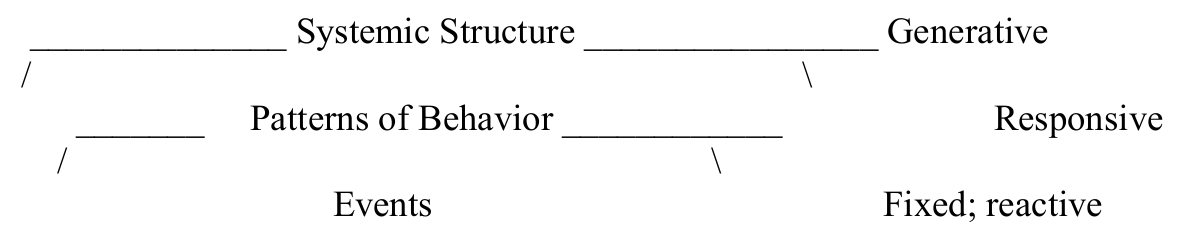
If you start at the bottom of the diagram with “events” then we have three levels of focus and analysis.
1) Event thinking. This is thinking that is all about events— emotions, actions, etc. Here we make snapshots of things and create entities in our mind. Event thinking thingifies reality; that is, it creates things in our mental mapping that are actually processes, activities, and dynamic patterns of responses. This creates a false-to-fact static world that is not accurate, that is formulated by Either/Or thinking, and that creates a form of elementalism which breaks reality, problems, solutions, etc. into parts as if they are not a part of a system.
2) Behavioral thinking. At the level of “patterns of behavior” we move up to detect patterns. Here we ask, “What are the patterns?” Here we recognize patterns of instability and amplification, of boom and bust, and so on.
3) Structural thinking. To move up to the level above patterns of behavior thinking, we look for and distinguish the premises and presuppositions as the spoke or unspoken explanations. It is at this level we can now generate new possibilities and speak to the operating policies. And here we can learn to see the whole of a system and the inter- connections that make it live.
And all of that can enable you to work with human mind-body-emotion systems for actualizing potentials that emerge from the system as a whole.