TO TRULY “THINK” — TO ACCELERATE YOUR LEARNING
On the surface it seems so simple, yet when you explore within it—it is profound.
Reading preferences
Optional. Your reading and listening position stays in this browser, not in your public profile. Avoid enabling this on a shared device.
On the surface it seems so simple, yet when you explore within it—it is profound. What? That “to think is to learn.” Obviously, to learn anything, you have to think. And that thinking involves lots of things. Namely, you have to use your mind to entertain ideas about something so that you can understand that something, comprehend how it works, consider its consequences, calculate its costs and benefits, transform the idea into practical actions that you can learn as skills, apply to self, and then practice with feedback until it comes under your control.
All of this says that thinking is far more than just one thing— there are actually dozens and dozens of aspects and forms of thinking and that means there are multiple dozens of thinking skills. Before I did the research into this, and the training, I never even thought in terms of thinking skills or enumerated the many different kinds of thinking skills. (You need skills to think?) But now I have. And as with any and all skills, there are beginning skills, fundamental skills, core skills, more demanding skills, and skills at the expert level— advanced skills. So it is with thinking skills.
To think about thinking skills, in the training Cognitive Make-Over, I constructed a continuum and then stretched out the cognitive skills from simple to complex along that continuum. I also distinguished the various stages of non-thinking (reacting, being on automatic, passive thinking, borrowed thinking, agenda thinking, and “knowing” or closed-minded non-thinking).
The point? All thinking is not the same. How about that? Thinking comes in many forms and expressions. And that leads to many, many thinking styles or patterns. Now in NLP we have a model, the Meta-Programs Model (see Figuring Out People and Words that Change Minds by Charvet) that describe the basic 20 along with another 40 for unique contexts. With meta-programs we distinguish how as person is thinking— optimistically or pessimistically, globally or specifically, by matching or mismatching, for options or procedures, etc.
Now, to get back to learning. If in learning we think, then all of these thinking skills, styles, and patterns give us multiple aspects of learning. And for every one of them that you are missing or under-developed in, you essentially have a learning disability. That is, your capacity to learn using any given thinking style, skill, or pattern is undeveloped or weak in its development. Now imagine that!
But the good news is that every one of these thinking skills, styles, and patterns gives you want to expand your learning, enrich it, make it more robust, and accelerate your learning. Imagine that!
Consequently, one of the things that many are getting from Cognitive Make-Over is an expanded boost to their learning capacities. Without focusing on “learning” per se, they are becoming more competent in their learning abilities due to their expanded thinking competencies.
Implicitly, rather than explicitly, they are meta-learning. They are learning about their learning which is one of the key aspects of meta-cognition and the executive functions of the pre-frontal cortex. And when you expand your thinking abilities to be able to learn about your learning, you are in a position to choose new and better learning strategies for yourself, eliminate factors that undermine effective learning, and improve your entire learning system. And all of this is a very generative way to enhance yourself as a person.
Now I say that this is implicit in the training, yet you could make it explicit if that is one of your goals. And if you do that, you would be engaged in a Learning Cognitive Make-Over. Or, as noted in the previous Neurons’ post— you could focus on several other kinds of cognitive make-overs.
Here’s the thing, just as enriched learning is not automatic and just as you can accidently learn some really wrong things, stupid things, and even dysfunctional things— so also is thinking. Good healthy informed clear thinking is also not automatic. You have to learn how to think clearly and precisely so that our thinking is of high quality and truly enhances your life. None of us were taught this in school. They did not tell us that thinking has to be learned and practiced to be of high quality. Yet it does. And given that, that’s why in Negro-Semantics we are not only focusing on the content that you need for “running your own brain,” but also the very activity of thinking.
On being a Hammer-Head
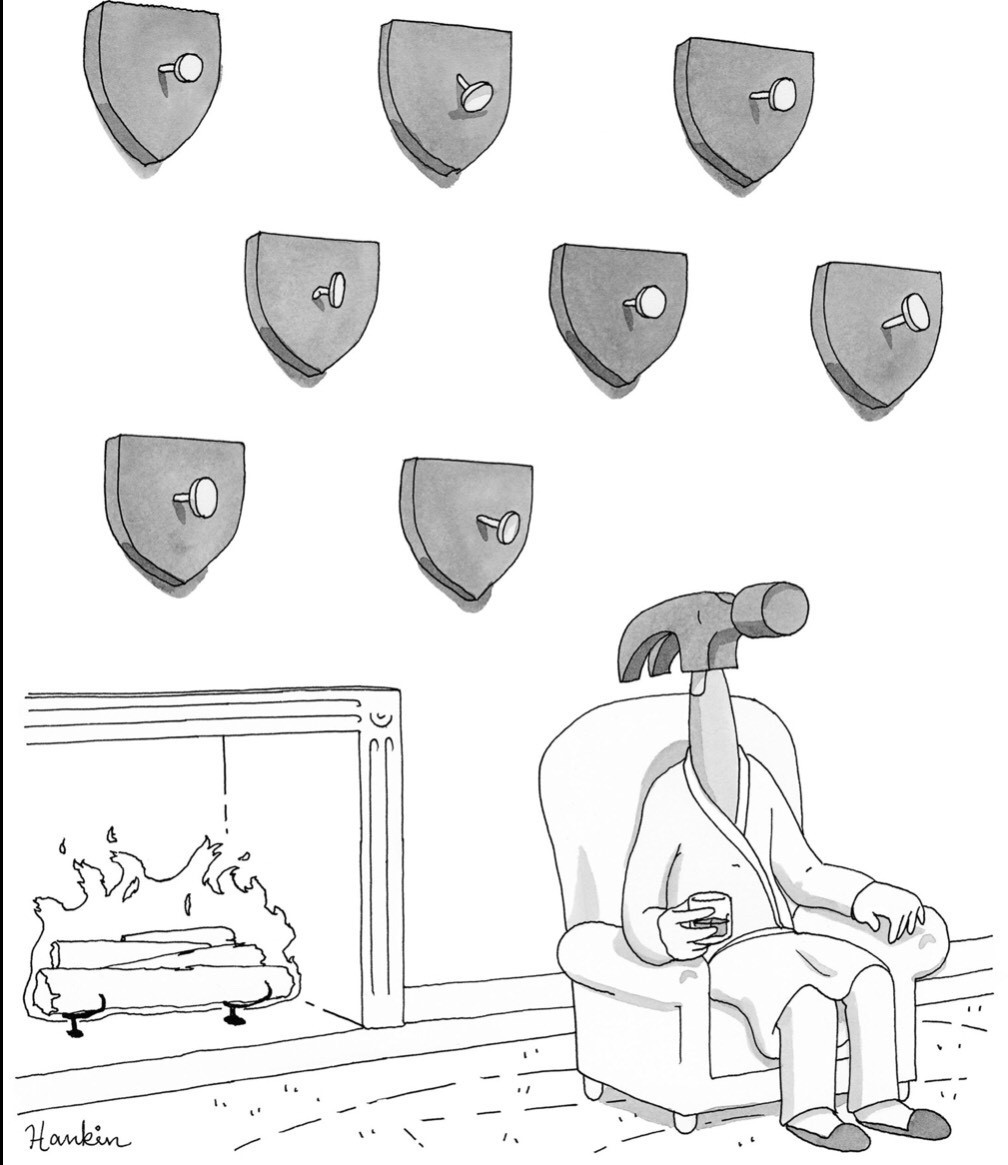
If all you have is a hammer— everything that you see (and want to fix) looks like a nail. That’s what Abraham Maslow said in his book on the Psychology of Research. This leads to the insight that what you are to a great degree determines what you can perceive. What you have experienced (and therefore received) highly predicts what you can discern as you move through life.
In terms of your thinking patterns and skills— what you have been trained to discern, distinguish, and perceive— determines what you can detect. No wonder your meta-programs play a highly significant role in your intellectual development (learning) and in your skill development (competencies). Each meta-program, as a perceptual filter (or lens) determines what you can see and given that, what you can do in response.