TWO MODES OF CONSCIOUSNESS
“The two modes of consciousness, observer and participant, are very much present in every part of science.”

 Share
Share



Preparing your audio…
You can keep reading while we get it ready.
- Waiting to start
- Creating audio
- Checking recording
Waiting to start
Audio ready
Tap Play to start listening.
AI-generated narrationListen at your own pace
Listen to this article
 Listen to this article
AI-generated narration
Narration covers the article text on this page. Linked documents and illustrations are not read aloud.
0:00--:--
Enable JavaScript to listen, or read the complete article below.
Reading preferences
Optional. Your reading and listening position stays in this browser, not in your public profile. Avoid enabling this on a shared device.
“The two modes of consciousness, observer and participant, are very much present in every part of science.” William Byers Science and the Crisis of Uncertainty, (2011, p. 95)
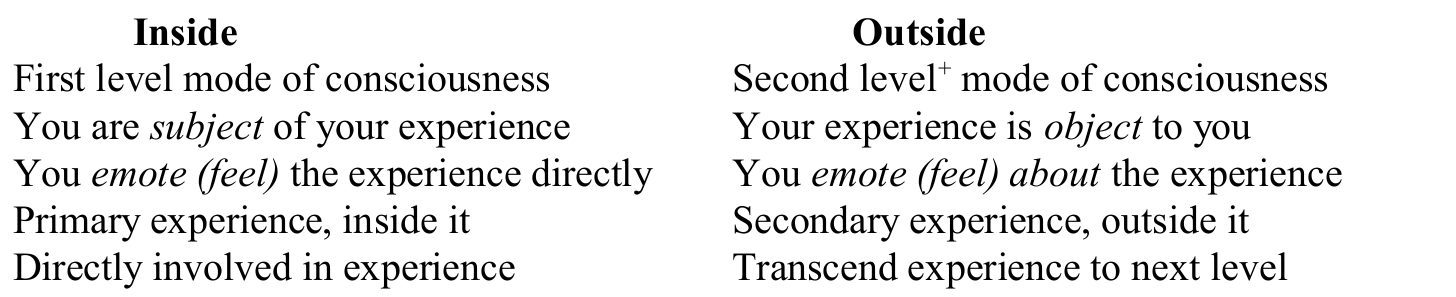
In NLP we recognize two modes of consciousness, that is, two ways that you can view something. The traditional NLP words for this, which I dislike intensely, are “associated” and “disassociated.” So during my research of cognitive thinking styles within the field of Cognitive Psychology led us (myself and Bob Bodenhamer) to generate an encyclopedia of 60 Meta- Programs. You can now find that list in Figuring Out People (1997/ 2005) and in that book I rephrased these two modes of consciousness as inside the movie and outside (Meta-Program #20).
In one mode of consciousness, your perspective is that of being the subject of your experience, you are inside the representations that you have accessed and/or created, and so you are fully associated into the experience of your thoughts. In the other mode of consciousness, your perspective is that of viewing your experience as an object to your awareness. Now you have stepped out of the experience, out of being the subject of the experience, and now the experience is an object to you that you can observe, reflect on, and experience other thoughts and emotions about.
The Step Back
Now when you step out of an experience, it does not mean that you are dissociated! It does not mean that you are non-emotional. It does not mean that you are no longer able to feel something about the experience that you are observing. What you specifically feel depends. It depends on the state that you step back into! That’s because you are always in some state. Now typically, when you and I step back to “observation” the emotional affect of that state is less and the quality of the state is more one of neutrality. But you could just as well step back to curious, fascinated, intrigued, passionate, excited, etc. For that matter, you could step back into fear, anger, guilt, shame, regret, or a whole host of negative feelings.
Dichotomous or Dialectical?
Most people think about the choice between these two modes of consciousness as an either-or choice. Either you are inside your representations and experience or you are outside. One or the other. You are perceiving from the inside perspective or from the outside perspective. In fact, I think that I can safely say that most of us frame these perspectives in this dichotomous way. But it does not have to be an either-or choice. In fact, to move to a higher level of consciousness, and do so holistically, do this in a dialectical way. Take the inside perspective, and holding on to that view, step out and take the observer view, and holding that, you can step back in and see it with that awareness in mind.
The inside experience view is the perspective that we all commonly use us as we live everyday life. We are participants, subjects and so we adopt the participant perspective. People who do not do this typically have either tabooed their emotions and so seek to avoid their emotions or they have adopted the scientific perspective to such a degree, that they have habituated the observer perspective and now simply lack flexibility.
The outside view is the one that classic science has adopted, practiced, and developed to a high level which has enabled humankind to create sciences apart from our biases and beliefs. It has enabled us to truly observe using a general commitment to what is true without any specific commitment to a particular creed. Obviously both of these are equally valuable and valid. Not only do each offer a very different view of reality, life, and experiences, each also is inadequate if used by itself. For a holistic perspective, we need both. Yet this is not easy. William Byers in Science and the Crisis of Uncertainty writes:
“It is intrinsically difficult to simultaneously adopt the position of observer and participant.” (2011, p. 95)
From Subject to Object to Subject to Object
Developmental psychologist Robert Kegan (1982) The Evolving Self, uses these two modes of consciousness to describe human development. He uses it to describe the levels of growth that we all go through from infancy to maturity.
The Incorporation Stage or Self: When it all begins, you are all subject and there is no object. At birth, a baby is his or her experience, is the subject to life and life’s experiences, and that’s all there is. There is no “self,” there is only subjective experience. There is no differentiation not even of one’s body. From birth to one year of age, prior to the develop of the brain’s ability for “constancy of representation,” it is all sensory-motor experience. The baby is fully incorporated in the experience, is subject of experiences.
The Impulsive Stage or Self: Differentiation begins in earnest around the first year, the infant is in the Impulsive Stage of being a subject in an object world. Here occurs the birth of self, of “I” as an object. Here for the infant, perception is reality, map is territory. The infant is a subject of his or her impulses, there’s no “I” that can “have” the impulses. Impulses have the infant. In this stage, the infant projects out onto the world his or her perceptions and impulses.
The Imperial Stage or Self: With the age of two comes the Imperial Self. Now the world becomes an object to the person, now there is a permanence to the world beyond perceptions. No longer is “out of sight, out of mind,” when an object is presented now, the infant will keep searching for an object even when hidden or out of sight. Yet here also, the infant is embedded in the world and a subject of it.
The Interpersonal Stage or Self: As a child grows, the child becomes aware of his or her perceptions as perceptions. Incredibly they now become an object to the child. The child realizes that others also have perceptions and they may be different from his. This initiates the interpersonal stage. The child is no longer a subject of perceptions, but transcends the perceptions so they are objects to observe.
The Institutional Stage or Self: From the interpersonal the next dimension is that of institutions— families, schools, government, etc. the child now realizes that there’s a larger world beyond the house. So no longer the subject of the interpersonal, the interpersonal now becomes an object.
The Inter-Individual Stage or Self: With this next stage, now the institutions themselves become an object to observe.
Each new level, we experience ourselves more fully. With each level acquired, a new self emerges, there is a new expansion beyond the former subjective view of self and world. But the former stage is not repudiated, it is re-appropriated. It is seen in a new light and so becomes different as you move to the next level of independence. When you transcend a subject-level, you create a new object level. You are then re-embedded into a new perspective. As your perspective grows, changes, you see more, and there is more. Your world becomes larger and richer.
There’s a lot more to all of this. And as you can tell, these two modes of consciousness work together to not only describe the progress of growth, but also a more holistic perspective. When you are in the subject mode, your experience operates as a primary level experience and with every stepping back to transcend and observe it, your experience operates as a meta-state process.