WHAT IS THE THIRD GENERATION NLP?
Robert Dilts along with Judith DeLozier and Debra Dilts have just completed a new book that presents “third generation NLP.”

 Share
Share



Preparing your audio…
You can keep reading while we get it ready.
- Waiting to start
- Creating audio
- Checking recording
Waiting to start
Audio ready
Tap Play to start listening.
AI-generated narrationListen at your own pace
Listen to this article
 Listen to this article
AI-generated narration
Narration covers the article text on this page. Linked documents and illustrations are not read aloud.
0:00--:--
Enable JavaScript to listen, or read the complete article below.
Reading preferences
Optional. Your reading and listening position stays in this browser, not in your public profile. Avoid enabling this on a shared device.
Robert Dilts along with Judith DeLozier and Debra Dilts have just completed a new book that presents “third generation NLP.” And “NLP: Volume II” is a good book. It is a book filled with Robert’s contributions of models and patterns to NLP— Neuro-Logical Levels, SCORE, SOAR, Somatic Syntax, Time-Lines, etc. It is a very good collection and synthesis of what Robert has created over the years.
And simultaneously it is this tremendous contribution from Robert that is the book’s the biggest weakness. That’s because the book presents nothing else that has happened in NLP for the past 20 years except what Robert has contributed and by doing that it leaves the impression that nothing else is part of “the third generation of NLP.” So the title of the book announcing “The Next Generation” of NLP and especially “the third generation” is really a misleading one.
Has nothing else occurred in the field of NLP? For instance, there is nothing in the book about the developments that I’ve contributed regarding Meta-States, Neuro-Semantics, Meta-Coaching, etc., or that of James Lawley and Penny Thompson and their development of Clean Language, or Lucas Derks and his Social Panorama model, or writings and contributions from Ian McDermott, or Richard Bolstad and the RESOLVE model, or Rodger Bailey and Shelle Rose Chevet and their work on the LAB profile and the use of Meta-Programs, and many more people who have contributed and developed NLP since 1990. So while the title suggests an inclusiveness about the field, the content of the book does not include anything other than the author’s own works. I find this facet of the work is really disappointing because the book could have brought more of the field together and could have embraced what others are doing.
So with that critique out of the way, now for the good parts of the book, Robert does present a set of distinctions that he uses to distinction the first, second, and third generation of NLP. “Key distinctions and tools of the first generation of NLP include:
• The Meta-Model language patterns
• Representational Systems and the 4-Tuple
• Sub-modalities
• Eye Accessing Cues
• Anchoring
• Six-Step Reframing
• Changing Personal History
• Visual Squash
• V-K Dissociation Technique [Movie Rewind Pattern]
• New Behavior Generator
• Metaphor and Milton Model hypnotic patterns” (page xxvii)
“Second generation NLP techniques integrated the use of new distinctions such as Time-Lines, Neuro-Logical Levels and Perceptual Positions. Some of the other key distinctions and techniques that emerged from the second generation of NLP include:
• Sleight of Mouth patterns [Mind-Lines Patterns]
• Spatial Sorting and Psychogeography
• Meta Mirror
• Imagineering Strategy and Strategies for Genius
• ReImprinting
• Integration of Conflicting Beliefs
• Neuro-Logical Level Alignment” (page xxviii)
And what about the “third generation NLP?” Robert presents the following as his thinking and evaluation about that. He describes it as meeting the following criteria:
First there are three different intelligences or minds: “a cognitive mind that emerges from the brain, a somatic mind centered in the body, and a ‘field’ mind that comes from our connection and relationships with larger systems around us.” (xxix)
“Some of the practices and processes of third generation NLP include: centering, the inner game and finding your inner zone of excellence, opening to the field, generative change, holding difficult feelings, integrating archetypal energies, the hero’s journey and archetypes of change, transforming belief barriers by building belief bridges, techniques for promoting collective intelligence and generative collaboration.”
“Third generation NLP also adds other frames and values to those applied by earlier generations of NLP and places more focus on issues such as: generativity and empowerment, connection and relationship, aesthetics and harmony, and purpose and transformation.” (xxx)
Now if that is the “third generation” of NLP, then the funny, or crazy, or weird thing is that this is precisely where so many of us in the field of NLP has been moving. So the book could have been a great collection of similar ideas converging with a commonality. But it isn’t. No one else form the field is quoted except Robert’s personal friends, Steven Gilligan, Robert McDonald, etc. Instead Robert quotes from several people outside the field and brings in information on Neurology from several people: Michael Gershon, Andrew Armour, Jeffrey Ardell, Donald Epstein, etc. and quotes from some pop writers like Malcolm Gladwell. But he does not quote and describe with others in the field of NLP having been doing and are doing that meets the criteria that he sets forward.
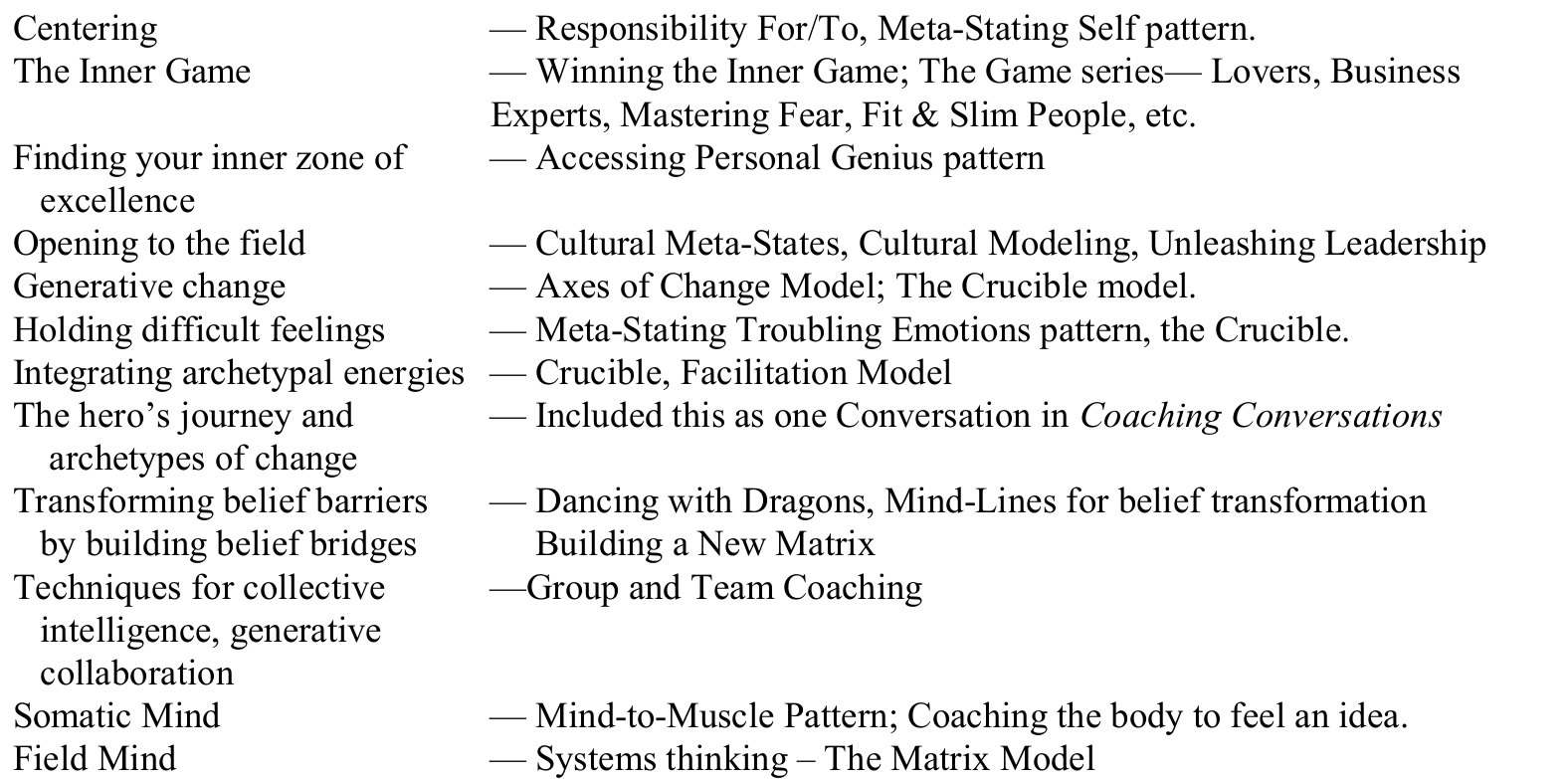
As I read the book regarding these criteria, I thought about how Neuro-Semantics does or does not measure up to the criteria of “third generation NLP.” So I wrote out (below) Robert’s list of criteria and then identified where we in Neuro-Semantics have been addressing these concerns:
Dilts’ Criteria Neuro-Semantic Models and Patterns
Now an interesting pattern occurs toward the end of the book. Robert quotes Virginia Satir, “How do you feel about feeling that way?” (p. 347). He then created a Meta-States Pattern, even with a meta-states diagram, but without any reference to the Meta-States Model (pp. 350-351).
Here is the Unacknowledged Meta-States Diagram [Read from the bottom up].

I’ll end this review with one of the jewels in the book. Robert presents a great question about what it takes for something to be “NLP?” What makes something NLP? And he answers it in this way:
“Emphasizes process and structure, as opposed to content. Grounds processes and distinctions in the anatomy and functions of the human nervous system. Ensures that distinctions and processes are able to be easily identified and influenced natural and spontaneous patterns of verbal and non-verbal communication. Organizes the results of the study into practical exercises, techniques, tools and practices that can be used to influence or make a difference in people’s experience or behavior.” (xxiii)