DISTINGUISHING MEANING AND MEANINGFULNESS
“The meaning of life is meaning: whatever it is, wherever it comes from, a unified purpose is what gives meaning to life.

 Share
Share



Reading preferences
Optional. Your reading and listening position stays in this browser, not in your public profile. Avoid enabling this on a shared device.
“The meaning of life is meaning: whatever it is, wherever it comes from, a unified purpose is what gives meaning to life. “It is not enough to find a purpose that unifies one’s goals; one must also carry through and meet its challenges. The purpose must result in strivings; intent has to be translated into action.” (Flow, 217)
The confusion between these two words, meaning and meaningfulness, arises from language. They sound the same. Yet in one we are constructing meaning to make sense of things and in the other we are enriching something with meaning to make meaningful. These are two different experiences. The first is about invention of meaning, the second is about the richness of experience. We use the word meaning for the first and meaningfulness for the second. With each kind of meaning that you make, a different skill set is required.
Last week I introduced the terminology of meaning1 and meaning2 in distinguishing these two kinds meaning and these two kinds of subjective experiences. While this is not made specific in this language in the book, Neuro-Semantics (2012), it is implied throughout the book. Now it is time to make this distinction explicit and show the benefits that you can derive from the distinction.
First, the Construction of Meaning — Meaning as Making Sense Structurally we human beings are designed so that we have to “make sense”of things. Our sensory senses do not give us sufficient information. We can see and hear and smell and taste and feel without knowing much about what we are seeing or hearing, etc. That’s because the knowledge and understanding of what something is and how it works is not given in our nature. Consequently, we have to “make sense” to have a basic knowledgeable understanding of something.
The purpose of this meaning1 (making sense) is in order to survive— to cope with the demands, needs, and challenges of life. We construct meaning1 in order to rationally understand the world and to be able to deal with it. You need to know what your internal biological drives mean and how to gratify them in order to preserve your body and to establish health and well-being.
That’s because without “instincts” like animals have information-context instincts—we humans do not know what the urges and the drives mean. We feel and urge and we ask, “What do I need?” Maslow offered his Hierarchy of Needs to answer that question and sorted out the human needs in five categories: survival, safety and security (stabilization), the social needs of love and affection, bonding, the self needs for feeling important, and the self-actualization needs. So our first learnings involves making sense of these drives, learning how to cope with them, and creating an overall understanding of how they influence our personality and motivation.
More abstractly “making sense” refers to constructing a set of meanings about things so that you understand what a thing is and how it works. When you understanding that, you have some basic knowledge. Understanding begins with learning what something is and how it works. Yet this is just the beginning. There is so much more. In Neuro-Semantics, we have expanded this by detailing many of the constructions that we have to build in order to “make sense” of something.
1) Identification of what a thing is. What is it? What do you call it?
2) Understanding categorization. How do you classify it?
3) Understanding how a thing works or functions. How does it work? What X causes Y?
4) Understanding consequences. What does it lead to? What effects or results?
5) Understanding norms. What rules regulate it? What heuristics?
6) Understanding the system. What are the variables and their relationships? What additional systems is this system inside? How does the system cohere (fit together)?’
7) Understanding human purpose and motivation. Given this, what’s your intention?
8) Understanding the significance or importance of the thing. What is the significance of Z? How important is it? What is the value?
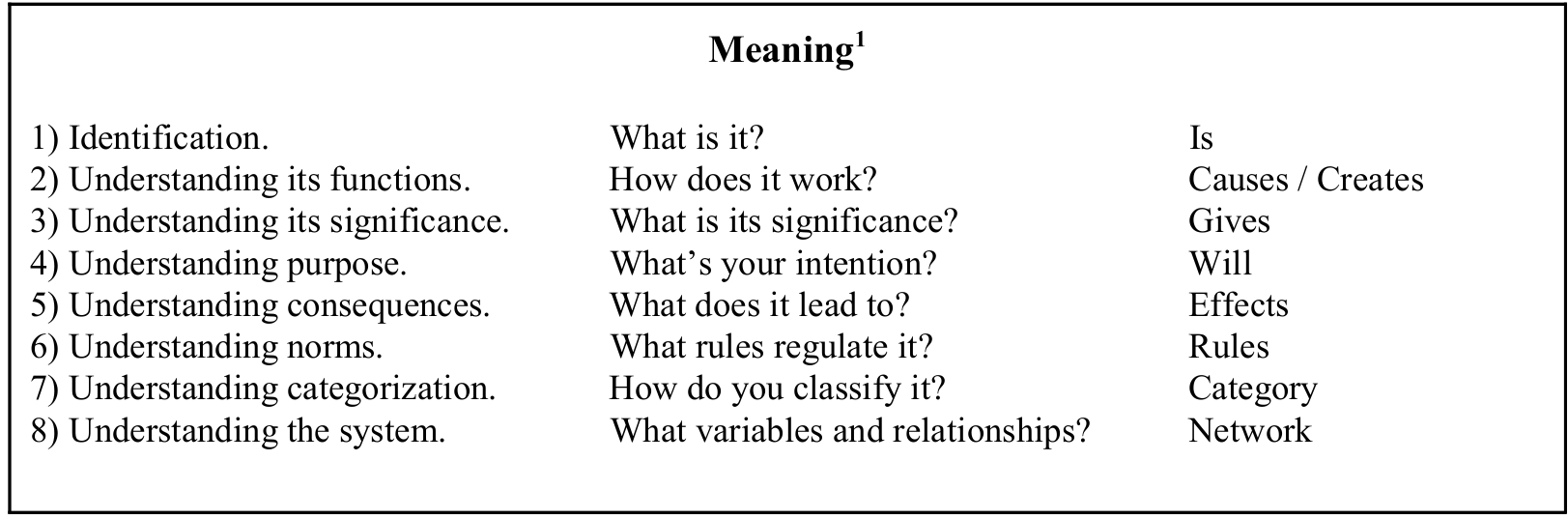
Meaning1 as “making sense” of things is the human activity of developing a full understanding of something. This, in turn, develops knowledge — a systematic mapping so that you can relate one thing to another. Understanding is the basic learning that generates the knowledge then that makes up a field or a domain. When you learn a field you create a map, a model, a paradigm that enables us to fit all of the diverse information into a structured way of understanding. We thereby create an ordered structure out of the chaos.
1) Identification. What is it? We first gather information about the variables that make up the facts of the case. This involves a selection of facts that can be put together into some form. Here we establish time-space coordinates, where, when, with whom. Here also we begin to classify the information as we give it a name and call it something. This is linguistic meaning. This enables us to begin to create some beginning boundaries, “It is X ... it is not-Y.” “It does not mean...”
2) Understanding categorization: How do you classify it?
This is classification meaning and refers to what categories are used to understand X.
3) Understanding its functions: How does it work?
Next we begin to look at the processes and functions of the thing. How does it work. What does it do? This is causational meaning— what causes what? How does X operate or how can you operate X to achieve some goal?
4) Understanding consequences: What does it lead to?
This is consequential meaning and requires the ability to think consequently about what will happen over time when a thing continues to operate.
5) Understanding norms: What rules regulate it?
This is structured meaning about what is permitted (allowed) and what is prohibited (forbidden, tabooed). What must I do? What do I have to do with X?
6) Understanding the system: What variables and relationships?
This is system meaning. It refers to the entire network of variables and components
7) Understanding its significance: What is its significance?
By identifying what a thing is and how it works, we then attribute value or significance to it. This is significance meaning, the meaning of value.
8) Understanding purpose: What’s your intention?
This is intentional meaning. “What I mean to do is...”
Making it Personal How are you at making sense of things? This is important since life can be confusing. Things can be vague and ambiguous and we can wonder what this really is, how does it make sense, how should I understand it? Next is meaningfulness, the second use of “meaning.” Look for it next week.