RISING UP TO MEANINGFULNESS
“The meaning of life is meaning: whatever it is, wherever it comes from, a unified purpose is what gives meaning to life.

 Share
Share



Preparing your audio…
You can keep reading while we get it ready.
- Waiting to start
- Creating audio
- Checking recording
Waiting to start
Audio ready
Tap Play to start listening.
AI-generated narrationListen at your own pace
Listen to this article
 Listen to this article
AI-generated narration
Narration covers the article text on this page. Linked documents and illustrations are not read aloud.
0:00--:--
Enable JavaScript to listen, or read the complete article below.
Reading preferences
Optional. Your reading and listening position stays in this browser, not in your public profile. Avoid enabling this on a shared device.
“The meaning of life is meaning: whatever it is, wherever it comes from, a unified purpose is what gives meaning to life. “It is not enough to find a purpose that unifies one’s goals; one must also carry through and meet its challenges. The purpose must result in strivings; intent has to be translated into action.” (Flow, 217)
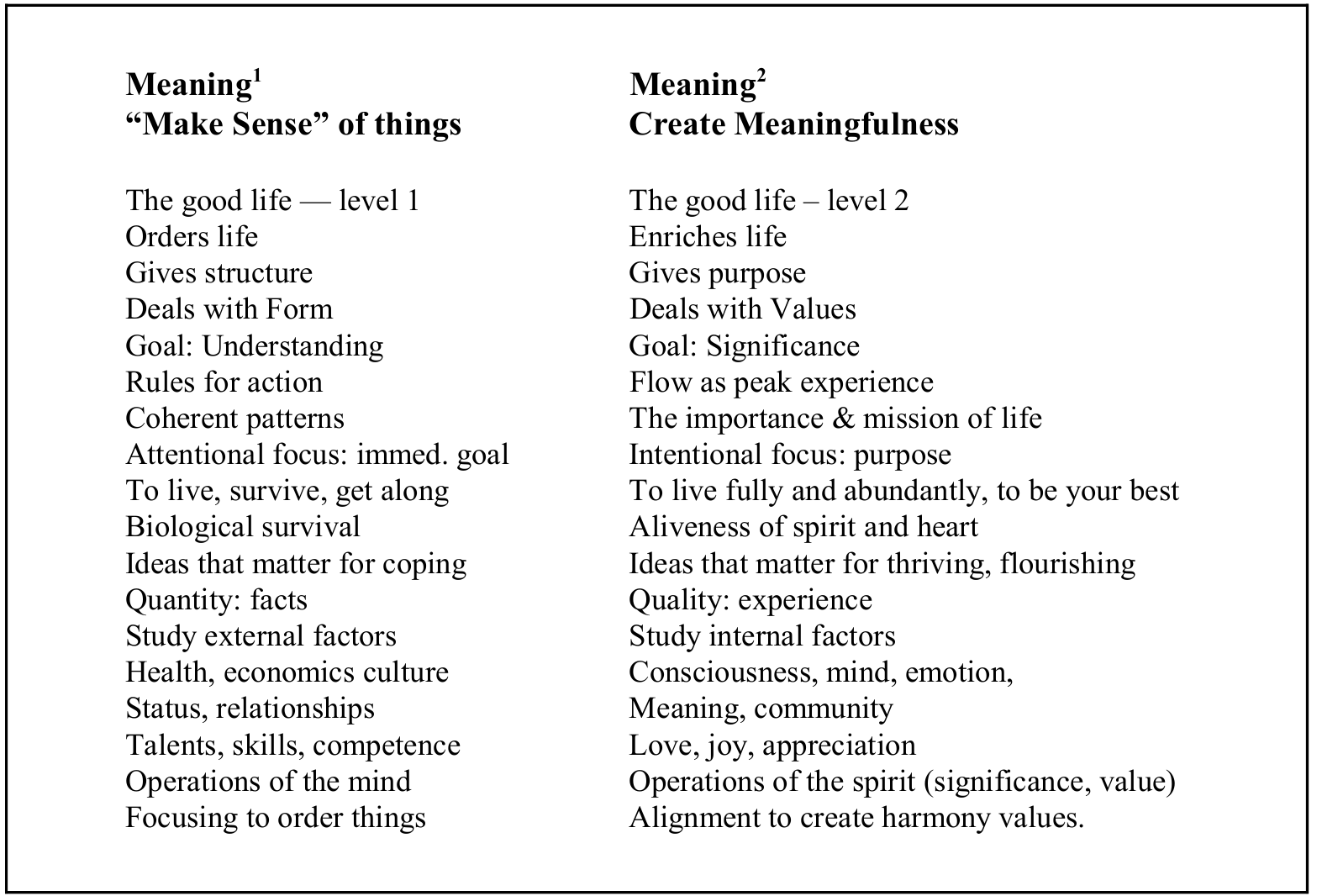
We start with meaning as in “making sense” of things, but it does not end there. In fact you could be highly intelligent and able to “make sense” of a lot of things, and yet simultaneously be unable to experience life and the wondrous daily mysteries of it as meaningful. That’s an entirely different kind of subjective and one that requires a different skill set. Here also is a distinction in Neuro-Semantics that differs from NLP. NLP focused almost exclusively on meaning 1 —the making of meaning in the sense of making sense of things. In Neuro-Semantics we include a strong emphasis on meaning1 and then we move to meaning2 —the making of meaning in the sense of create sacred meanings about things.
Meaning2 as Meaningfulness. Once there is a structure of meaning, it can be meaningful or meaningless or anywhere in between. This aspect of meaning speaks about the quality of the meaning and refers to the significance given to the meaning. Meaning2 refers to the quality of the experience. When something is loaded with meaning— given lots of value and significance— we enter into it wholeheartedly so we are totally engaged.
“An experience is meaningful when it is related positively to a person’s goals. Life has meaning when we have a purpose that justifies our strivings, and when experience is ordered.” (Flow, p. 244)
Meaning2 refers to the quality of the experience. When something is loaded with meaning — given lots of value and significance, we enter into it wholeheartedly so we are totally engaged. Once we “make sense” of something, our concern shifts to asking, Is it meaningful? Is that all there is? The purpose of endowing life with significance goes beyond survival now it deals with the quality of life. Now we focus on thriving as human beings, to living with purpose.
Living with purpose means to really live, to take charge of the quality of your life. Here what we fear is not hunger or thirst, not homelessness or losing a job. Here we fear and seek to avoid despair, futility, passivity, being a victim, being miserable.
When we find life meaningful (i.e., meaning2), we develop an intention or purpose to do one or more of the following: Improve the quality of life and experience, to humanize life. Enjoy immediate experience, appreciate, take pleasure in life, cheerful. Sacralize, value, and create harmony of mind. Choose ownership, responsibility, “I choose” my action as my response. Be resilient, to respond with courage, and perseverance. Challenge, choose significant goals, not trivial ones that stagnate our development. Purpose, set a reason to be, connect things to overall vision. Turn into a flow experience, look for challenges, translate threats into enjoyable challenges to use one’s skills.
If this language sounds “spiritual,” that’s because it is. To speaks to the human spirit more than to the mind. Meaning1 speaks to the mind, to what is rational as it builds up a solid understanding about what things are and how they work. But that does not speak to the heart. It does not inspire people to live at their best, to extend themselves, to open their eyes and develop a “continued freshness of appreciation.” That phrase comes from Maslow which he used for the subjects of his self-actualization studies. He said that at the height of living a self-actualizing life is having a “continued freshness of appreciation.”
Meaning1 — here once you understand what things are and how they work, you set goals and use your intentionality to set your direction. Here you “make sense” of things by connecting events in a causal way to create coherent patterns in life. Here you create order and you order experience around some theme, this brings a sense of structure and coherence in your mind and actions.
Meaning2 — here you do not just establish goals, but you look further and set final purposes, the overall significance of your life. What are the long-term consequences of your goal? Without this you probably will not persist. You will give up when things get tough. Here you gain a sense of your life’s mission. Here you identify what you are about, what makes your life count, and the legacy that you’ll leave.