
SELF AND OTHER AND SELF-ACTUALIZATION
You know about the hierarchy of needs.

 Share
Share



Preparing your audio…
You can keep reading while we get it ready.
- Waiting to start
- Creating audio
- Checking recording
Waiting to start
Audio ready
Tap Play to start listening.
AI-generated narrationListen at your own pace
Listen to this article
 Listen to this article
AI-generated narration
Narration covers the article text on this page. Linked documents and illustrations are not read aloud.
0:00--:--
Enable JavaScript to listen, or read the complete article below.
Reading preferences
Optional. Your reading and listening position stays in this browser, not in your public profile. Avoid enabling this on a shared device.
You know about the hierarchy of needs. You’ve seen the pyramid that is typically used to represent the levels of human needs and you may have become acquainted with the two different kinds of motivations within this hierarchy of human drives: the D- and the B-needs. The D-needs are those driven by the mechanism of deficiency. The B-needs are driven by the mechanism of abundance, that is, to be without an instrumental purpose.
This was how Abraham Maslow mapped out the area of human “motivation and personality” in his classic book by that title. The first four levels of needs are hierarchical in that the lower needs are more predominant and powerful (prepotent) than the higher needs and that as a person gratifies the lower needs, this gives rise to the emergence of the higher needs.
Because deficiency drives the lower needs, they arise from lack and scarcity. Then when gratified, they go away. They cease to drive. Their motivation ceases and so we no longer experience their urges to act. Maslow called the first four levels the basic needs and noted several things about them.
First, the higher intelligent animals have these needs. The social animals need love and affection, bonding, connection, and belonging and with that they need to know that they are important and valuable in their community. These are not uniquely human needs, they are animal needs! And, as Maslow said, “Be a good animal. Have good healthy appetites for these needs.”
Second, the lower or basic human needs which are biological and which we share with the animals describes “the jungle.” In these levels of needs, we are seeking primarily to get. We need. Whether it is the survival needs, safety needs, social needs, or self needs— these are basic to physical and psychological well-being.
When we move to the higher needs, these are being needs— we need these, not for any particular purpose. They are not instrumental like the lower needs. We need them simply to be and to express our humanity. And it is these needs that bring out our humanity so that we begin to become what we are designed to be. It brings out our highest meanings and values and it leads us to our best performances. Here we become real— authentic human beings. This realm is about giving, not getting. It is your gift and expression to humanity.
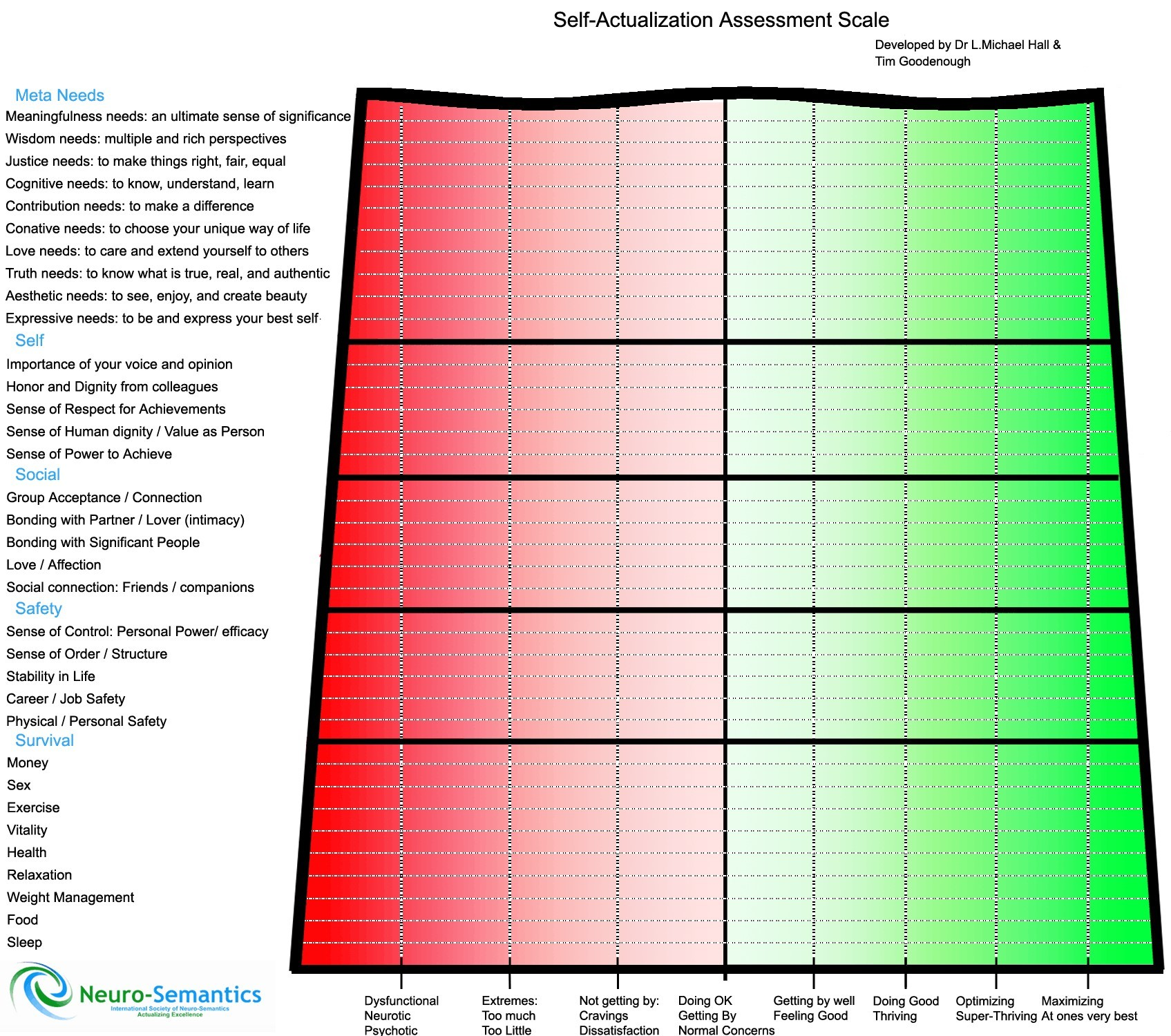
the diagram included here, The Self-Actualization Assessment Scale gives you an overview of the specific human needs at the five levels. (See the diagram.)
An interesting perspective starts with the basic, lower, and deficiency needs focusing on getting and the higher, being, and abundance needs focused on giving. About living a self-actualizing life, this says that as you move upward into the truly human needs— you live a life of contribution, giving, and making a difference. Your life is no longer solely about yourself. It is about others.
When you start meeting your needs, your focus is on you— surviving, stabilizing, belonging, validating your value and then you move to focusing on others— the expression of your gifts and potentials. And yet, it is not quite that simple. There’s another complexity. Actually the shift from self to other oscillates as you move up the hierarchy of needs. That is, there is a dialectic tension, first of differentiation of your self and the of integration with others.
It begins with a focus on you— on your self surviving. Here others take care of you. They feed, clothe, nurse, care, love, protect, etc. In this period, we differentiate ourselves and now we enter into the social area where we need to belong and to be loved and cared for. Now the focus shifts to others— how to get along, how to understand others, how to relate. Once we figure out how to gratify this human need, the focus oscillates again from other to self. Now we ask, “Am I important? Do I count?” This is the human need for value and worth. Upon gratification of this need, the focus oscillates again, from self to others and to the self-actualization needs.
Self—> Other —> Self —> Other. And because these needs are never “once and forever” gratified, but keep re-emerging as we develop over the life span, we are forever shifting back and forth. Self is your base; other is the target of your love. It is not all about you. Yet it involves you. So similar to the safety announcements on flights— first you, “Put on your oxygen mask first, then help those around you with theirs.” Self-actualization is through you, never about you.