
SELF AND THE ROLES OF SELF
One of the most challenging questions to answer is a question that seems on the surface so simple: Who are you?

 Share
Share



Reading preferences
Optional. Your reading and listening position stays in this browser, not in your public profile. Avoid enabling this on a shared device.
One of the most challenging questions to answer is a question that seems on the surface so simple: Who are you? How could this be a challenging question? Answer: It is challenging because you are not just one thing. You are not a “thing” at all, you are a set of energies, activities, or processes. And you are a mystery. It is challenging because you live and breath and operate in a great number of dimensions. And in each dimension of experience— who you are differs.
Who are you? To answer it here is a set of dimensions that will govern your answer:
• In your essential essence: in your beingness, in your basic humanness, in your worth and value and dignity as a human being.
• In your value socially: in your social skills, in getting along with others.
• In your value economically regarding your business skills: in your ability to create value and earn a salary, who are you? What value do you experience in yourself as a contributor who will be rewarded?
• In your musical abilities: in your ability to create, enjoy, appreciate music.
• In your creativity and inventiveness: in your ability to think of new ways of doing things and putting them together.
• In your physical body: in your health and fitness, in your energy and vitality. In the things you do as exercise or the sports that you play.
• In your experience and skills of shopping: in making good selections, those that are good economic buys and that bring high quality to the purchase.
• In your relationships, especially with your closest loved one as a lover, and your relationships with children, friends, colleagues, etc.
In these areas and many, many more—you have an identity and you experience yourself differently. Who are you in each of these areas? You are not the same in each of these. Even though you may be the same person, in each of these areas you play different roles. And this, I think, is one thing that often confuses us about our identity, about who we are.
• Who am I when I’m with this person or that one, when I’m in this context or that?
• How many roles do I play in life?
• What influence do these roles have on my overall sense of self?
Imagine a circle, and then a circle around that one and so on. I have not drawn it here in this email post, so you’ll have to imagine it. The following columns provide the categories for these four layered circles.

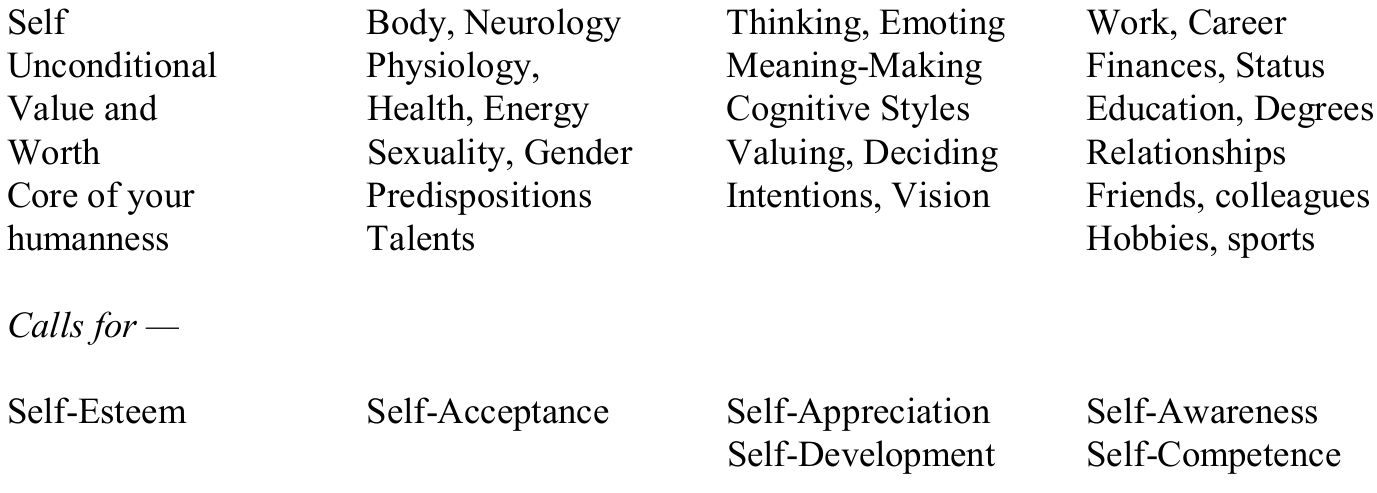
Central Circle
The central circle represents you as a person, as a human being. It is the essential you—the you who transcends your situation, your history, your body, your mind, and all of the peripheral aspects of you. It is you above and beyond all of the accidents of life. This is the mysterious you. It is you as an unconditionally valuable and lovable human being. It is yourself that you can honor and esteem unconditionally because it is based and conditioned on nothing other than the mysterious fact that you are a valuable human being as is every human being. This core aspect of you calls for self-esteem, and if you esteem your core humanity unconditionally, then you experience your core self as being innately worthwhile and valuable.
Second circle of Qualities — Your Embodied Self
Now imagine a second circle. In this one we will put all of the features, factors, and qualities that arise from your embodiment, that is, from having and experiencing yourself in terms of your body. So this facet of you include factors that are very close to you and factors that seem a given— your physiology, neurology, brain, mind, consciousness, emotions, gender, sex, race, etc. Yet while given, this aspect of your self is also conditioned by your growth and development, how you use and develop these facts of your embodied self. Some of it is within your control, although much of it is not. It is what was given you at birth— your genetic heritage, the talents within your body and mind, the predispositions within, etc. Other aspects arise over the years of your development, sometimes through accidents and illness, sometimes through disciplined practice. This is you as you know yourself in your body. And this aspect of you calls for self- acceptance.
Third Circle — Your Cognitive Self
If you next imagine another concentric circle, we can designate it your cognitive self. This speaks about you as you develop through your thinking, evaluating, believing, deciding, understanding, etc. Here you actually have a lot of control over what you think and the meanings you give about your core self (first circle) and your embodied self (second circle). Here you play such a critical role in your definition and creation of you. Here the quality of your thinking (cognizing) determines the quality of your experience of yourself.
So, if you dislike and disvalue your core self or your embodied self or of any of the roles you have in life (fourth circle), then you can undermine your development and turn your energies against yourself. If you take on toxic and limiting beliefs about you, you can not only fail to actualize your highest potentials, you can distort those potentials so that they sabotage your best efforts. Your cognitive self is your semantic self— who you are in terms of the meanings that your create with your thinking-and-emoting powers.
At birth your cognitive self was all potentiality and no actuality. Piaget and other developmentalists have mapped out how our cognitive powers develop and we grow over the lifespan, how we move through various cognitive stages of development. And as you navigate those stages by learning and developing your powers of thinking-feeling, you learn to take charge of your ability to create positive meanings that unleash more and more of your potentials. This facet of your require self-acceptance, self-appreciation, and a commitment to self-development.
Fourth Circle — You in Your Roles
The final circle of you is you as you are in the many roles that you play in life. These roles describe the relationships and positions that you operate in— a worker, friend, mate, spouse, parent, owner of various things, experiencer of numerous activities, etc. Here’s an experiment for you: make a list of all of your roles for a couple weeks.
I was surprised when I did this. I quickly made a list of the first twenty or so, then over a week or two, another twenty roles emerged. I am a son, a brother, a father, a friend, a colleague; I have been a husband, a therapist, a minister, a front-line counter server, a supervisor, a backpacker, a homeowner, a tax payer, a driver, shopper, a workshop participant, a student, a graduate student, a doctorate candidate, an expert witness (in district court), a plaintiff (in county court), a premier executive and a 1-K (with United Airlines), a committee member, president of an HOA (homeowners association), and the list goes on and on.
The roles you play in life may be highly influencing factors in your life governing how you think about yourself or they may be minor influencing factors. Here you use the activities of life (your work, sports, finances, education, family, friends and so on) to define yourself. The roles you play in life may last just a few weeks or an entire lifetime. This facet of you calls for self- confidence as much as anything, that is, the confidence that you develop in that role that you can effectively and skillfully cope with the requirements of that role. If you are competent in a given role, then you feel confident in yourself that you can play that role well.
So who are you? Well, you are lots of things. You have multiple facets to you— your essence, your physical presence, your semantic meaning-making self, and the scores even hundreds of roles that you play in life. And all of these facets of you aligned and unified? Are you fully congruent in yourself?
How do you define yourself (that’s your self-definition) and how do you identify yourself (your self-identifications)? Taking these four circles of influences, which one do you identify yourself with?