
THE META-STATE OF RESILIENCE Part I
In life things often don’t go as you want them to go.
Reading preferences
Optional. Your reading and listening position stays in this browser, not in your public profile. Avoid enabling this on a shared device.
In life things often don’t go as you want them to go. For various reasons, your plans don’t pan out, your dreams don’t become reality, your investments don’t increase in value, your relationships aren’t as loving and supporting as you want, and your career plans experience set backs. And what about some of the bigger problems that set us back: divorce, bankruptcy, health crisis, robbed, attacked, etc. Now what?
• What’s your attitude when you experience one or more set-backs in life?
• What state does that trigger in you?
• What coping and mastering skills are you able to access when you’ve been knocked down?
These questions explore your level of resilience—your strategy for bouncing back when you suffer a set-back and get knocked down. Set-backs happen. And sets-backs are pretty democratic— they happen to all people of all ages, races, religions, economic status, etc. And in the last two weeks with the US Stock Market losing between two and three trillion dollar (yes, trillion, not billion) that loss has also shown up with a similar loss between 3 and 6 per cent of value in other Stock Markets. So with that, lots of people have suffered economic, personal, and relational set-backs.
I first took on the resilience questions after completing my master practitioner and trainer’s training in NLP. At the time I was engaged in two activities that brought to face to face with people suffering set-backs and needing to cope with them. The first activity was my psychotherapy practice and the second was my NLP trainings. That constantly brought me into the presence of people who were in the throes of set-backs and I was amazed at how some of them had such a spirit of resilience. Nothing was going to keep them down! No matter how traumatic the experience, they were going to get up again and they were going to come back. And they did. And they were in therapy to develop the self-awareness and resourcefulness to make that come back.
But not everyone was like that. Sometimes I saw people in therapy who were down and they were behaving as if they were out. With their set-back, they were down and were staying down for the count. They seemed to have had the life sucked out of them and to be without any “bounce” inside for coming back. And it wasn’t the degree or severity of the set-back. That wasn’t the determining factor.
“What makes the difference between someone who gets knocked down and then gets up with an attitude of determination, persistence, and optimism from the person who just lies there like a zombie? What makes the difference between the person who thinks, feels, talks, and acts like a victim of life’s fate and the person who thinks, feels, talks, and acts like the architect of his or her life?
That’s what I wanted to know. So I began interviewing people who had “been to hell and were back.” I wanted to know how they had come back. What was their secret? What were the resources that enabled them to bounce back? That led to a modeling project that lasted three years. At that time (1990) there was very little literature on resilience, yet what there was, I read.
Eventually, using the NLP Strategy model, I worked out a strategy for resilience. At least I thought that I had the step-by-step process for creating a state of resilience. What I didn’t know was that resilience was not a regular kind of state. It is not the kind of state that you just access a feeling or a thought, step into it, amplify it and presto! ... the Resilience State! That’s because some states are so complex and so systemic that they do not operate as a primary state that NLP is so excellent at enabling you to access, amplify, anchor, and apply states. Some states involve levels of thoughts-and-feelings. So states operate from the self-reflexive consciousness that sets higher level frames and meanings which in turn govern the state.
That’s what I discovered about resilience. To create this state, you not only have to have a basic core sense that whatever happens, it is just something to deal with, but you have to have empowering believes about yourself as a person (your value and worth as a person), your ability to learn and develop skills to cope with things (your self-confidence), your relationships with others who you can depend and trust in the process, your determination and persistence that over time you will recover and bounce back and be as strong as ever, your meanings and intentions that keep you inspired, hopeful, and optimistic, and your sense of self-efficacy that you can take proactive initiative to turn things around.
That’s a lot! That requires layer upon layer of resourceful states about your resourceful states. And it is systemic, each resourceful state or frame influencing the others so that something “more than the sum of the parts” emerge. And that emergent state of resilience is a state that takes the “bad” thing of the set-back that happens and keeps it out from oneself so that it is not personal. It keeps it out from one’s whole life so that it is not pervasive. And it keeps it out from one’s sense of time so that it is not permanent.
I found this in Martin Seligman’s works, Learned Helplessness (1975) and Learned Optimism (1990). How you interpret a set-back is the key. If you take the “bad” thing and interpret it with the following three Ps, you experience learned helplessness. If you interpret the bad thing using the three Ts— you experience learned optimism.
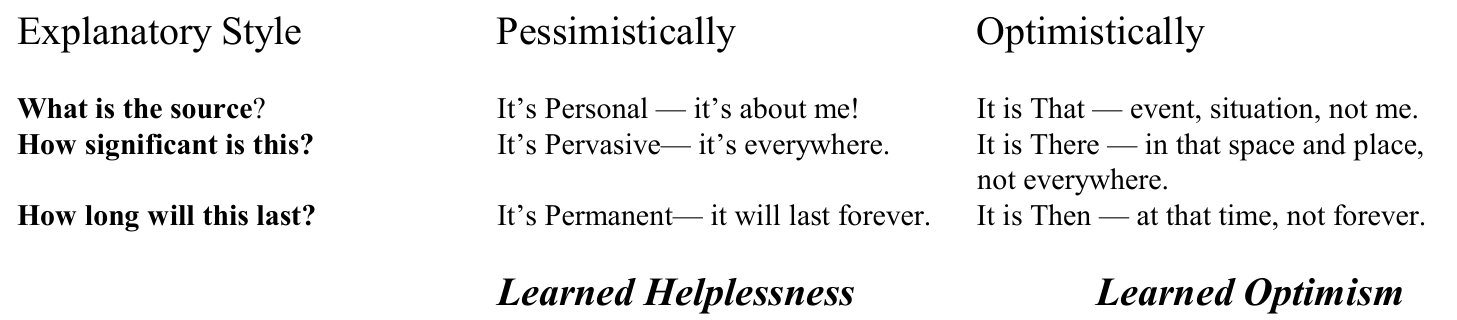
The way to create non-resilience is to P-all over yourself, that is, interpret any set-back as personal, pervasive, and permanent. Do that and you can piss all over yourself and dampen your spirit. The cure that leads to resilience is to T-off on the set-back, that is, interpret it as That, There, Then. These are the three magic words that keeps the evil outside of you and your matrix of frames— that, there, then. (Or if it is happening at this moment: this, here, now.)
Which will you do? It is entirely your choice. No one can force you to interpret a set-back (or anything else) in a particular way. Yet how you interpret it and the meanings that you give determine the experiences you have and the quality of your life.