
TWO MODES OF CONSCIOUSNESS
L. Michael Hall, Ph.D.

 Share
Share



Reading preferences
Optional. Your reading and listening position stays in this browser, not in your public profile. Avoid enabling this on a shared device.
L. Michael Hall, Ph.D.
“The two modes of consciousness, observer and participant, are very much present in every part of science.” (p. 95)
William Byers (2011) Science and the Crisis of Uncertainty.
In NLP we recognize two modes of consciousness—two ways that you can view something. The traditional NLP words for this (which I dislike intensely and do not use myself) are “associated” and “disassociated.”1 So during my research of cognitive thinking styles within the field of Cognitive Psychology led us (myself and Bob Bodenhamer) to generate an encyclopedia of 60 Meta-Programs. You can find that list in Figuring Out People (1997/ 2005) where I rephrased these two modes of consciousness as inside the movie and outside (Meta-Program #20). Here I will introduce two additional terms. These terms not only extends this distinction, they also enable us to work with this critical distinction in a much more expansive way.
In practice, every situation comes with a point of view. Whether an observer or a participant, you always have a point of view. In one mode of consciousness, your perspective is that of being the subject of your experience. You are inside the representations that you have accessed and/or created, and so emotionally you are fully associated into the experience of your thoughts. In the other mode of consciousness, your perspective is that of viewing your experience as an object to your awareness. Now you have stepped out of the experience, out of being the subject of the experience, and now the experience is an object to you that you can observe, reflect on, and emotionally you can experience other thoughts and emotions about that object.
This subject-object dynamic offers a more accurate vocabulary and also describes a dialectic for how we mentally organize ourselves and the world. In his book In Over Our Heads, Robert Kegan defines object and subject in the subject-object relationship as follows:
Object: Those elements of your knowing or organizing that you can reflect on, handle, look at, be responsible for, relate to each other, take control of, internalize, assimilate, or otherwise operate on.
Subject: The elements of your knowing or organizing that you are identified with, tied to, fused with, or embedded in. You have objects, you are subject. You cannot be responsible for, in control of, or reflect upon that which is subject. Subject is immediate; object is mediate. Subject is ultimate or absolute; object is relative. (p. 32)
What is especially valuable and insightful is that the dialectic movement from subject to object describes how we develop mentally, emotionally, socially, etc. We always begin as subject, then develop the ability to step back from that experience and reflexively realize that what we were subject to is now an object of our perspective. Each successive level of development subsumes or encompasses the prior level. In this way, that which was subject becomes object to the next level. All of this makes the dialectic relationship between subject and object as transformative, qualitative, and incorporative as you and I grow and develop.
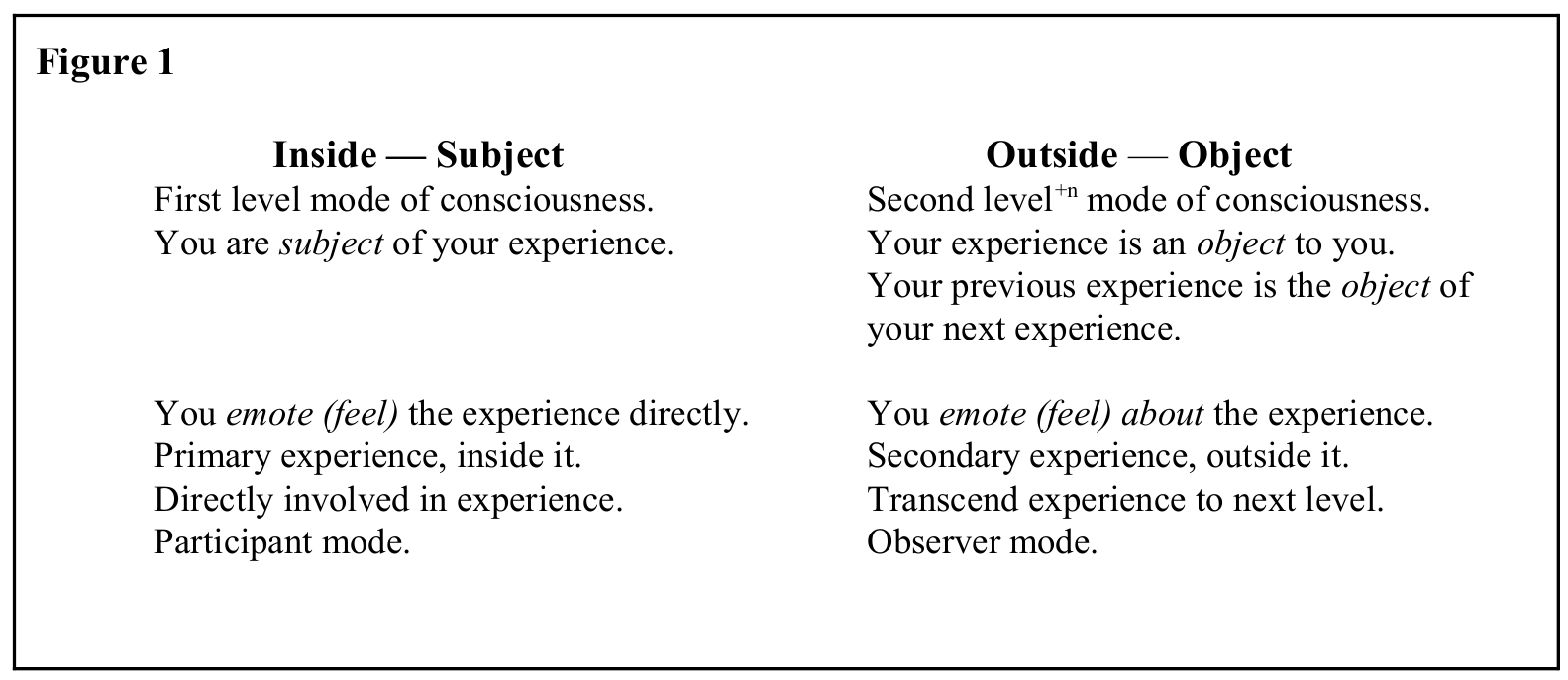
The Step Back
The big NLP misunderstanding centers in labeling the meta-move as “dissociation.” This is profoundly wrong on numerous accounts. When you step out of an experience, it does not mean that you have become dissociated! It does not mean that you are non-emotional. It does not mean that you are no longer able to feel something about the experience that you are observing. The move from being associated in an experience to the next stage is one of being able now to reflect upon, observe, and treat the associated experience as an object for a broader perspective.
Question: What do you feel when you step out of an experience? Answer: What you specifically feel depends. It depends on the state that you step back into! There’s a reason for this: You are always in some state. True enough, when you typically step back to “observation,” the emotional affect of that state is lessened and the quality of the state is more neutral. But not necessarily. You could just as well step back into a state of curiosity, fascination, intrigue, passion, excitement, etc. For that matter, you could step back into fear, anger, guilt, shame, regret and a host of negative emotional feeling states. The key is the state you step into when you step back and out of your previous state to now experience the first state through the lens and filters of the second.
Dichotomous or Dialectical?
Most people think about the choice between these two modes of consciousness as an either-or choice. Either you are inside your representations and experience or you are outside. One or the other. You are perceiving from the inside perspective or from the outside perspective. I think that I can safely say that most of us frame these perspectives in this dichotomous way. But it does not have to be an either-or choice.
In fact, to move to a higher level of consciousness, and do so holistically, you can do this in a dialectical way.
Take the inside perspective, and now holding on to that view, step out and take the observer view, and holding that, you can step back in and see it with that awareness in mind.
The inside experience view is the perspective that we commonly use in everyday life. We are participants—subjects—and so we adopt the participant perspective. People who do not do this typically have either tabooed their emotions or experiences as they seek to avoid their emotions or they have adopted the scientific perspective to such a degree, that they have habituated the observer perspective and now simply lack flexibility.
The outside view is the one that classic science has adopted, practiced, and developed to a high level which has enabled us to create sciences apart from our biases and beliefs. It has enabled us to truly observe using a general commitment to what is true without any specific commitment to a particular creed. Obviously both of these are equally valuable and valid. Not only do each offer a very different view of reality, life, and experiences, each also is inadequate if used by itself. For a holistic perspective, we need both. Yet this is not easy. William Byers in Science and the Crisis of Uncertainty writes:
“It is intrinsically difficult to simultaneously adopt the position of observer and participant.” (2011, p. 95)
Levels of Development: From Subject to Object to Subject to Object
Developmental psychologist Robert Kegan (1982) Evolving Self, uses these two modes of consciousness to describe the process of human development as we actualize more and more of our human potentials. He uses it to describe the levels of growth that we all go through from infancy to maturity.
As a result he has identified levels of development using the ongoing shift from subject to object. That is, we grow, develop, and actualize our next level of development by continually transcending from subject to observer. From fully participating and experiencing a level of being subject to a process, we rise up and include that within a new larger perspective of observing.
This is meta-stating. First you accept and welcome and participate fully in an experience— you are subject of the experience. Then when you are ready, you step up to become aware of your participation, you make the experience an object to you. You transcend and include the participation experience inside a broader perspective so that you can simultaneously recognize and observe that experience.
Kegan uses these subject-object relations to define the process of development that we all go through. In this dialectic, we experience a succession of qualitative differentiations of self as we transcend our present world to the next higher world of consciousness. As we are embedded in one world, we are subject and participant. Then we rise up from the embedment so that we can truly and cleanly observe that world. Now we can hold two views simultaneously. It is like being born into a new world. You experience what you were subject to as a qualitatively more extensive object. Each is a successive triumph of “relationship to” rather than “embeddedness in.”
Subject—> Object Development
The Incorporation Self Stage: At birth when it all begins, we are all subject, there is no object. At birth, a baby is his or her experience, is subject to life and life’s experiences. And that’s all there is. There is no “self” that is distinct from one’s subjective experience. There is no differentiation, not even of one’s body. From birth to one year old, prior to the develop of the brain’s ability for “constancy of representation,” it is all sensory-motor experience. The baby is fully incorporated in experience— the baby is the subject of experiences.
The Impulsive Self Stage: Differentiation begins in earnest around the first year, the infant is in the impulsive stage of being a subject in an object world. It is here that the birth of self, of “I” as an object occurs. For the infant, perception is reality, map is the territory. The infant is a subject of his or her impulses, there’s no “I” who can “have” the impulses. Impulses have the infant. In this stage, the infant projects out onto the world his or her perceptions and impulses. This is the foundation of mind-reading.
The Imperial Self Stage: Around the age of two comes the Imperial Self. Now the world becomes an object to the child’s perceptions and reasoning. Now the child perceives a permanence to the world, a permanence that transcends perceptions. No longer is something that is “out of sight, out of mind.” When an object is presented, the infant will keep searching for an object even when hidden or out of sight. Yet at this stage, the infant is still embedded in the world and a subject of it.
The Interpersonal Self Stage: As a child grows, the child slowly becomes aware that his or her perceptions are just that—perceptions. This evokes the next level transcendence as these perceptions now become an object to the child. The child realizes that others also have perceptions and they may be different from his. This initiates the interpersonal stage. The child is no longer a subject of perceptions, but as he or she transcends the perceptions they become objects to observe.
The Institutional Self Stage: From the interpersonal the next dimension is that of “institutions”— families, schools, government, etc. The child now realizes that there’s a larger world beyond the house. So, no longer the subject of the Interpersonal, the interpersonal now becomes an object.
The Inter-Individual Self Stage: With this next stage, the institutions become an object to observe. This allows for us to become aware of and critical of the institutions we have been subject to. Now there’s the very real possibility of transcending our culture and becoming a citizen of the world.
With the emergence of each new level, we experience ourselves more and more fully. With each level acquired, a new self emerges, there is a new expansion beyond the former subjective view of self and world. Yet the former stage is not repudiated, it is re-appropriated. It is seen in a new light and so becomes different as you move to the next level of independence. Every time you transcend a given subject-level, you create a new object level. This re-embeds you into a new perspective. As your perspective grows, changes, you see more, and there is more. Your world becomes larger and richer.
How do you “know” yourself at each stage of your self development? At each level you transform your epistemology. You liberate yourself from that in which you are embedded. You make what was subject into object so that you can “have” it rather that “be had” by it. Kegan comments, “This is the most powerful way I know to conceptualize the growth of the mind.”
What happens to your values as you transcend one subject-level and include it into the next level? Answer: Your values expand. You begin to see what it valuable and important from a higher perspective. And you are able to observe your values rather than merely be subject to them. This means you are now able to subordinate and regulate your values and ideals. You can now relate to your values and ideals as objects rather than the subject of your knowing which poses the danger of being a fanatic. You can now make your beliefs and ideology explicit. Each level reflects a distinct order of consciousness as you enter into different relationships between what is subject and what is object in your way of knowing.
Participant Subject and Observer Object
Your two modes of consciousness then are the participating mode and your observing mode. Kegan says that he finds it interesting that the positions of observer (object) and participant (subject) are not symmetrical. So while you can observe your state as a participant, but you cannot participate in your observation.
1) You can be a participant.
2) You can observe (be aware of) yourself as participant.
3) You can observe your observation of yourself as participant.
4) And so on.
The participant level is unique in that here you are active and involved— you are participating. Yet it is not iterative. You cannot meta-state it. You cannot be active about being active, participating about participating. Yet when you transcend from embedded within an experience as subject to observing the subject as an object, you can iterate that. And you can do so level after level after level. So while the experience of participation stands alone, observation can be iterated. For me this explains much of the NLP confusion between these two states or experiences.
“This makes the former unitary and foundational, whereas the latter is intrinsically bifurcated and therefore capable of a kind of infinite refinement.” (In Over Our Heads, p. 99)
In other words, participating as subject to an experience is foundational. In Neuro-Semantics we say that you ground your state as you fully associate into the experience and are subject to it. Then upon that foundation, you can keep qualifying it layer upon layer as you meta-state it, that is, as you step aside from it to observe it as an object of your perception.
The Observer Mode of Consciousness
The observer mode occurs when you step back from life and your experiences and you adopt a more “objective” point of view. The term “objective” has two meanings. One, objective means “not subject to personal feelings or opinions” and the other is that objective is “not depend on the mind for existence.” In the first sense, you have an objective perspective if you are not using your present feelings and opinions to understand. In the second sense, you are being objective if your observations and reports are independent of needing a human mind to acknowledge or interpret it, but that it can be recorded by a machine or indicator of some sort.
The philosophy of science operates from the point of view of an observer. What science (traditional science) typically does not do, and mostly seeks to avoid, according to William Byers, is to include the self-consciousness of the observer in a description of science. Why? Because that creates layers of complexity. That’s why we create double-blind studies and do everything we can so that a participant in an experiment doesn’t know what the experiment is about or what the experimenter is seeking to discover. If he knows, his knowing messes it up.
The Participant Mode of Consciousness
By way of contrast, you live your everyday life as a subject. In everyday life you are on the inside of your experiences. You are the subject of your experiences and so your perspective is one wherein you are subject to something as up participate in something. Then, from your subjectivity you reach out to embrace the objective world.
Quantitative science goes in the opposite direction. It brings the outside world into your subjective comprehension. Now classical science focuses on operating from an observation state and so seeks to be “objective.” It seeks to avoid any hint of the participatory mode of consciousness. Yet to truly and fully succeed in science, our science must be written from both the inside and the outside of an subject. It must include both quantitative and qualitative research processes. “It is intrinsically difficult to simultaneously adopt the position of observer and participant.” (p. 95). And, in the end, creativity is a function of both modes of consciousness.
Wrapping Up
Subject-object theory does much more. Kegan says subject-object is a “constructive-developmental” approach to human experience (p. 199). As a theory, it brings together two powerful lines of intellectual discourse that have influenced the field of psychology and nearly every corner of intellectual life. These two lines of thought are constructivism, the idea that people or systems constitute or construct reality and developmentalism, the idea that people or organic systems evolve through qualitatively different eras of increasing complexity according to regular principles of stability and change.
The relations between subject-object explicates the clumsy expression in NLP between associated and dissociated. The description maps out human development and especially identity development as well as epistemological development. It offers yet another view of grounding as a subject and transcending to include the subject in a new and higher object identifies how the levels of perceptual positions work in NLP.
Note References
1. I’ve written about the unfortunate use of the term dissociation numerous times.
MovieMind (2002, page 129): [In psychiatric terms, this is often called “dissociation.” We dis-associate from our normal and typical thoughts and feelings ... due to the unpleasantness or pain of such. If we do this around our sense of identity, we create a dissociative identity disordering.]
When we step out from a painful memory, we frequently turn on a movie that psychiatrists call “Dissociation.” They think it’s a bad movie. They even list it as a “personality disorder” in their bible that records all of the ways to get messed up (the DSM-IV). They assume that when you step out, you have to forever stay out of all emotions. Foolish doctors.
Dissociating, or stepping out, from an ugly memory enables you to not signal and therefore not process all of the body sensations with the corresponding emotions of the memory. You can see and hear the information while maintaining a calm, mindful, resourceful perspective. And that, in a nutshell, is the structure of the way to resolve or cure a phobia. To do this we operate from the radical idea of accessing our best resources when we deal with the information that involves thinking about horrible things without confusing those thoughts with the reality of being there. We can just think about them. And we can do such thinking from a state of resourcefulness— with courage, confidence, esteem, calmness, etc.
Meta-States (2007, p. 240): In Neuro-Semantics we describe this as stepping back or stepping aside from an experience, and do not use the term “dissociate” or “dissociative.” The idea of dissociation was another design flaw in traditional NLP. Neither Richard Bandler nor John Grinder were therapists or psychologists and so they were not aware of the error of describing this as “dissociation.”
Actually, the term “dissociate” is just a metaphorical and conceptual way of speaking. We do not do this literally—we do not literally step out of our bodies. There is no actual dis-embodiment! In using the term “dissociation” we refer to the felt sense of no longer being inside a painful memory. Yet we are still inside of our bodies when we experience this feeling of “dissociation.” I mention this due to some of the over-literalization that some theorists, psychologists, and NLP practitioners have fallen victim to assuming that the “dissociation” label is the territory or at least describes a real thing. It’s just a way of talking about a shift in feeling.
Here’s another NLP myth. Moving to a meta-level this does not equate to being “dissociated.” Actually, many higher meta-states, far from being bereft of feeling, involve even more feelings—joyful learning, excitement about falling in love, anticipation of feeling confident, etc. We often experience more emotion when we move to meta-levels. Consider the negative meta-states of self-contempting, self-despising, unforgiveness, and personalizing and the intensity of emotion these involve.
Associating and dissociating are relative terms. They speak about stepping into an experience and stepping out of another. In fact, every time we associate into one state, we thereby “dissociate” from another. And every “dissociation” implies an “association.”
2. Object/ objective: the root of “object” ject refers to a motion, to throwing, hence “thrown from, thrown away from.” An object is some motion which has made separate or distinct from something else.
Book References:
Byers, William. (2011). The Blind Spot: Science and the Crisis of Uncertainty. Princeton, NJ: Princeton University Press.
Kegan, Robert. (1994). In Over Our Heads: The Mental Demands of Modern Life. London/ Cambridge MA: Harvard University Press.
Kegan, Robert. (1982). The Evolving Self: Problem and Process in Human Development. Cambridge, MA: Harvard University Press.
Author: L. Michael Hall, Ph.D. is a psychologist, trained and educated in the Cognitive Behavioral models but now focusing on modeling and expanding the Self-Actualization Psychology models. An NLP Trainer and contributor, developer of Neuro-Semantics, prolific author of 41 NLP books.