UNLEASHING YOUR HEALTH POTENTIALS
Having identified the strange and mysterious mechanism in medicine knows as “the placebo effect,” and having described it as a “belief,” a mental state of an “expectation,” a frame of mind composed of our meta-states, it is now time to explore “the placebo effect” and our self-reflexive consciousness.

 Share
Share


Reading preferences
Optional. Your reading and listening position stays in this browser, not in your public profile. Avoid enabling this on a shared device.
Having identified the strange and mysterious mechanism in medicine knows as “the placebo effect,” and having described it as a “belief,” a mental state of an “expectation,” a frame of mind composed of our meta-states, it is now time to explore “the placebo effect” and our self-reflexive consciousness. It is time to ask some curiously fascinating questions about how our reflexivity plays a role with our health and well-being.
• So, what happens if you know that a placebo is a placebo? Will it still work?
• Will knowing that something is a placebo undermine and interfere with its effectiveness?
• And can we take control of our self-reflexive awareness so that we can intentionally activate “the placebo effect” to facilitate our own health and well-being?
The answer to these questions is that— it is relative. That is, it depends. Sometimes it does; sometimes it does not. It depends on the person and on the layers within any given person’s mind. It depends on how you respond (or react) to your awareness of your thoughts and to the beliefs that your belief are embedded within. And that’s another reason for learning the Meta- States Model and how to effectively manage the higher levels of your mind. [You know I had to throw in that commercial!]
What we have discovered is fantastic. Namely, the mere fact that you know that an idea or belief is a placebo does not necessarily prevent it from working to create “the placebo effect.” Now most placebos work because you think the placebo is real and has actual medicinal value, and so essentially you confuse the inert substance or procedure with a real one. You think that the placebo works because your beliefs and state of mind communicates a message, or order, to your nervous systems and body which thereby somehow activates a healing process. You believe it and somehow the belief itself makes it happen.
Yet there is now evidence that a placebo will often work in spite of our knowledge that it is just a placebo. The evidence? 1965 two researchers from Johns Hopkins University gave placebos to 15 patients, “We feel that a so-called sugar pill may help you.” 14 agreed to take it and 13 improved during the week of taking them. [Park, L.C. and Covi (1965). Nonblind placebo trial. Archives of General Psychiatry 12:336-345.]. This is so incredible, you just have to reflect on that for a moment: They knew it was a placebo. They were told that it was harmless, inert, and useless as a pill. And they took it anyway, and in spite of that, it still worked with the majority of them.
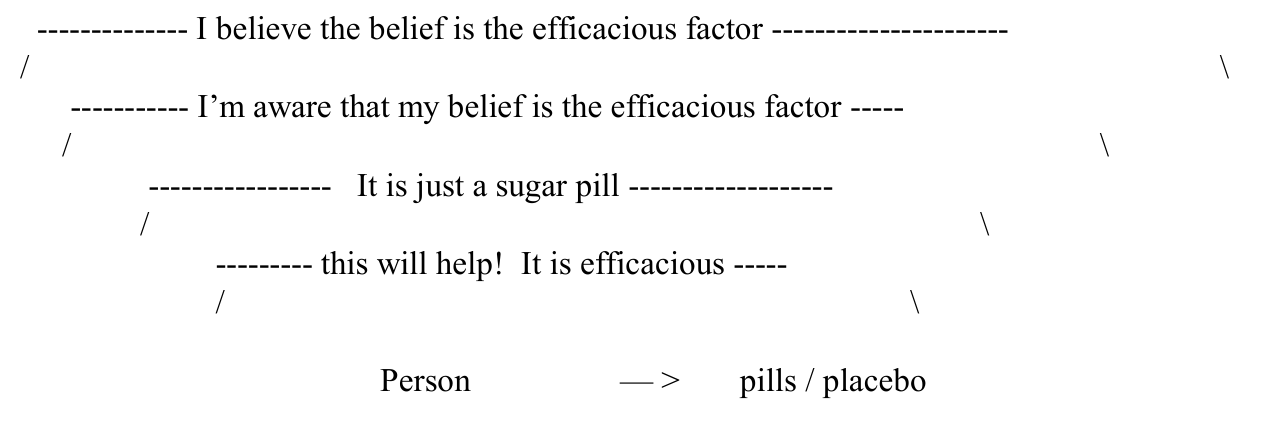
In other words, merely knowing that something is a placebo does not necessarily have to invalidate it. That means that at the first meta-level you can know and acknowledge that some pill or procedure is empty in itself. That means that you do not believe in it! At least you do not believe in it at the first meta-level. But what if you believe in it at the next level up?
What if, instead of a first meta-level belief in a particular placebo intervention, you believe in your belief itself as the efficacious factor? What then? Could that next level belief over-ride your awareness that it’s just a placebo? Suppose that when you know that there is a power in your belief process itself. Suppose you believe in the power of your mind to set a strong expectations. Suppose that you believe in your ability to send messages to your body for your healing, energy, vitality, and well-being. Could that become a higher level placebo, a meta- placebo? If merely knowing at the first level that something is a placebo does not necessarily undermine or counteract the experience, what if you rise above that and set a meta-placebo belief?
It was this understanding that led me to experiment with a new pattern in Montreal in May. I chose the title of “Unleashing Your Placebo Power,” and then designed the process around a positive expectation. Comparing and contrasting it then against a weak expectation, a mere wish or hope then enabled us to find “the difference that makes the difference.” And finding that suggested how to code (or re-code) a belief so that we present it to ourselves as a strong expectation. And from there, setting the next level up meta-state, namely a belief in the expectation.
Our understanding is that placebos work by expectational beliefs—beliefs about what you expect. A strong expectation sets up an orientation, perception, and intention. What do you expect about health, aging, sickness, etc.? How strong do you expect this?
Distinction: we will explore the differences between two states: when you are in a strong expectancy state and when you are not.